Afghanistan attacks targets in Pakistan

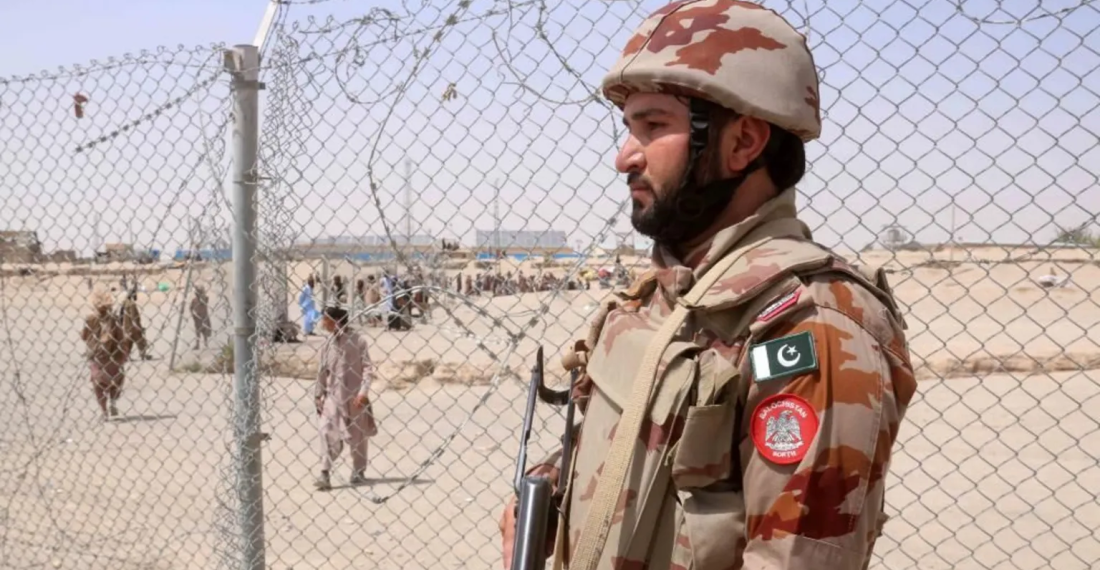
Afghanistan's Taliban regime said they have carried out strikes on targets along the border with Pakistan, injuring several people in Pakistan's southwestern Balochistan province.

Pakistan's military said it had shot down four rudimentary drones and warned any further provocation "would receive a befitting response". 

The strikes come after Pakistan launched its own airstrikes on Afghanistan on Sunday, killing 28 civilians, according to the UN.

Tensions have reignited in the region after months of relative calm. The two countries had agreed to a ceasefire in October following weeks of deadly clashes.

Pakistan has long accused Afghanistan of harbouring terrorists who carry out attacks on its soil, a claim the Taliban government rejects.

Kabul in turn has accused Islamabad of carrying out unprovoked attacks which kill civilians. Pakistan says it only targets militants.

Afghanistan said Pakistan's attack on Sunday hit civilian homes and put the civilian death toll at 36, with more than 160 injured.

It described the attack as a "cowardly act" and an "atrocity".

source:commonspace.eu with BBC (London) and agencies
Related articles

Popular

Editor's choice
Interview
Thursday Interview: Murad Muradov

Thursday Interview: Murad Muradov

Today, commonspace.eu starts a new regular weekly series. THURSDAY INTERVIEW, conducted by Lauri Nikulainen, will host  persons who are thinkers, opinion shapers, and implementors in their countries and spheres. We start the series with an interview with Murad Muradov, a leading person in Azerbaijan's think tank community. He is also the first co-chair of the Action Committee for a new Armenian-Azerbaijani Dialogue. Last September he made history by being the first Azerbaijani civil society activist to visit Armenia after the 44 day war, and the start of the peace process. Speaking about this visit Murad Muradov said: "My experience was largely positive. My negative expectations luckily didn’t play out. The discussions were respectful, the panel format bringing together experts from Armenia, Azerbaijan, and Turkey was particularly valuable during the NATO Rose-Roth Seminar in Yerevan, and media coverage, while varied in tone, remained largely constructive. Some media outlets though attempted to represent me as more of a government mouthpiece than an independent expert, which was totally misleading.  Overall, I see these initiatives as important steps in rebuilding trust and normalising professional engagement. The fact that soon a larger Azerbaijani civil society visits to Armenia followed, reinforces the sense that this process is moving in the right direction." (click the image to read the interview in full)