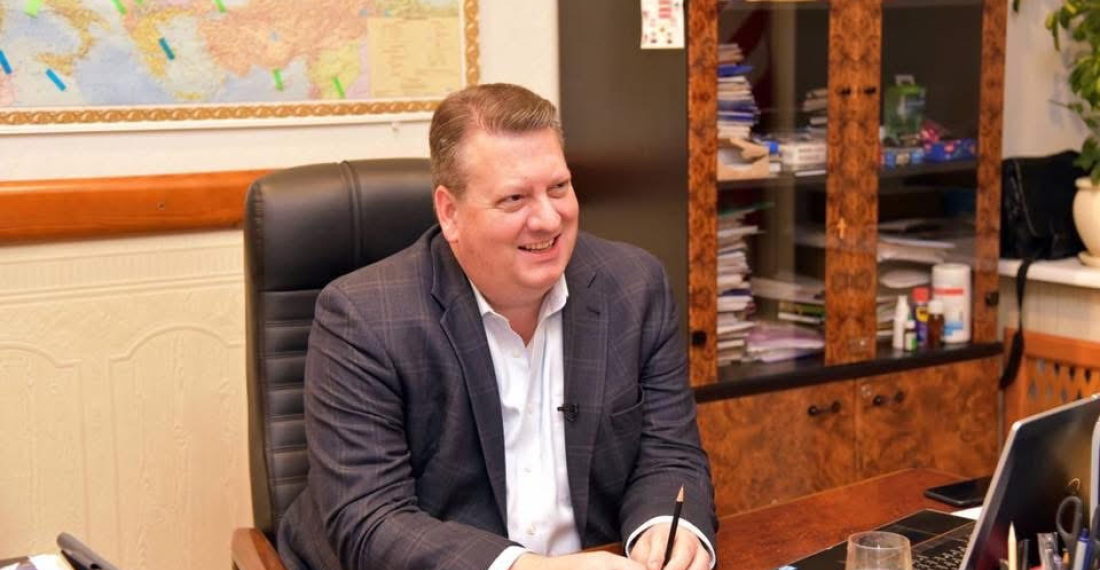
After more than 25 years working in Ukraine, Brian Mefford has witnessed the country through revolution, reform, and war. He began working in Ukraine in 1999 with the International Republican Institute, supporting democratic development and political reform, and later served as an adviser during the presidency of Viktor Yushchenko. He is the founder of Wooden Horse Strategies LLC, a boutique government and public affairs firm, and has also been heavily involved in humanitarian assistance efforts throughout Russia’s aggression in Ukraine, delivering over $6 million in humanitarian and medical aid to date.
In this interview, he outlines how the war has accelerated long-standing reform challenges. He argues that corruption and national security are deeply intertwined, and that Ukraine’s changing public attitudes and strengthening institutions offer cautious optimism, provided international partners maintain both support and pressure in the years ahead.
“Now, in the middle of war, is the time for the kind of structural changes Ukraine needs to make to prepare for eventual EU accession.
We don’t know exactly when accession will happen. Perhaps it will be part of negotiations or a future peace settlement, but Ukraine needs to be ready. It shouldn’t wait until after the war to pass this legislation. Now is the time to do it, and it will likely be easier to do it now than later.”
Read the full conversation here:
Welcome, Mr. Mefford. To begin, could you briefly explain to our audience the work you do today, and what originally brought you to Ukraine more than two decades ago? How did your early work shape your long-term engagement with Ukrainian politics, and could you briefly describe your journey?
I started work in Ukraine in May of 1999 with the International Republican Institute. I planned to stay for about six months, and I ended up staying since that time 27 years later. I worked 10 years with the International Republican Institute (IRI), which was a democracy and governance project working with political parties and governmental reform.
After that, I went to work for President Viktor Yushchenko in Ukraine, who was the country’s president during the time of the Orange Revolution, so I received good experience from that. After he left office, I set up a consultancy called Wooden Horse Strategies. It’s a boutique government relations and public relations firm working in Ukraine since 2016.
During that time period, I also worked three years as an advisor to the Minister of Health of Ukraine, during a time when we were implementing a national healthcare transformation, transforming the broken Soviet system into a system that actually works based on international best practices.
So I have experience in a lot of different areas in Ukraine. I still do a little bit of political work sometimes, but mostly it is government relations, lobbying, and public relations.
I’m very proud of the fact that even during wartime, we were able to continue our operations. In the first days of the war, it wasn’t clear what was going to happen, but as we know, Ukrainians rose up to fight and defend their country. This has made all the difference, and they continue to do so today, even though this war has already lasted longer than American involvement in World War II.
That has allowed us to continue our business. We’ve kept all of our major clients and added some new clients from time to time as well. So we continue our work, and that’s what keeps me in Ukraine.
Weak institutions in Ukraine and in many former Soviet states have historically created openings for Russian influence. In a commonspace.eu interview, the former deputy mayor of Bucha, Mykhailyna Skoryk-Shkarivska, argued that European integration requires strengthening institutions across the country, especially at the local level. From your perspective, should rule of law reform in Ukraine be seen mainly as a legal overhaul, or as a broader national security project?
Mykhailyna Skoryk-Shkarivska did some amazing work in Bucha. Ukraine needs more public officials like her. I know she’ll continue to do great things in the future.
She’s right. The answer to the question is both. It’s both a legal reform as well as a national security issue.
Why is that? For decades, Ukraine has had two enemies: one, Russia, and number two, corruption. One could even make the argument that corruption was primarily fuelled by Russian subversion and involvement in Ukraine. You would always hear Russian media highlighting corruption in Ukraine, but never mentioning what’s going on in Russia. The person complaining the loudest is often the culprit themselves.
It has been an important issue. In the past, the problem wasn’t that Ukrainians didn’t know how to reform or fix things, the issue was political will, and that has been lacking.
During the Poroshenko administration and after the Euromaidan demonstrations and civil unrest in Ukraine, spanning 21 November 2013 – 22 February 2014, a lot of reforms were implemented. A new healthcare system was introduced, the police were professionalized, and some legal reforms were attempted. Anti-corruption institutions were also established.
So a lot of good things happened, but political will remained a challenge.
The next big area that Ukraine really needs reform in is rule of law, so that people are treated equally regardless of position. In the past, justice could be bought in the courts through corrupt prosecutors and judges.
A couple of things are different now, though, and this gives me optimism about the future of Ukraine. People’s tolerance for corruption is no longer there. Before, people might have been willing to pay small bribes off the books to a bureaucrat or police officer. But because of the war, Ukrainians now believe in themselves in a way they perhaps always did - but were afraid to express. Their tolerance for corruption is not going to continue.
If someone asks for a bribe, people are more likely to say no and take action to have that person removed from office. The country has fundamentally changed, and there will not be tolerance for that.
The anti-corruption institutions that were put in place almost 10 years ago have also started working more effectively. Recent high-level cases show that these institutions are now functioning in a meaningful way, something that would be unlikely in Russia, where such scandals are typically covered up.
For example, the recent “Mindich case,” launched by the National Anti-Corruption Bureau and the Specialized Anti-Corruption Prosecutor’s Office, involves large-scale bribery in Ukraine’s energy sector during the war. The fact that such a case is being actively investigated and prosecuted is a strong signal that these institutions are beginning to tackle serious, systemic corruption rather than minor violations.
The National Anti-Corruption Bureau has been able to start prosecuting cases successfully. That’s a good sign, it means the institution is working.
Up until about a year ago, these institutions were largely ineffective, again because of a lack of political will. They focused on technical violations of the law rather than tackling oligarchs and major offenders. But now the trend seems to be shifting toward addressing real corruption issues rather than minor symptoms. That’s encouraging.
If Ukraine hardens its political and legal institutions, where people are equal under the legal system, it will significantly reduce corruption and strengthen the country. Corruption has long undermined Ukraine’s national security.
I believe Ukraine is moving in the right direction now. One unexpected result of the war is that tolerance for corruption has dropped significantly. Going forward, Ukraine is ready to make tough choices, pass legislation, and implement real rule of law.
Too many people have sacrificed for Ukraine not to take that next step toward a European standard of living and eventual European Union accession.
What are the next tough decisions in anti-corruption and rule of law matters that Ukraine will be facing in the next five to ten years, or after the war with Russia ends, in your opinion?
One is synchronizing Ukrainian law with European law, so that when Ukraine eventually becomes a member of the European Union, people’s rights are fully protected.
Another is successfully prosecuting major corruption cases. We’re already seeing movement with the National Anti-Corruption Bureau and the prosecution of recent cases. Successfully prosecuting these large cases will give people confidence in the institutions.
Up until about a year ago, trust in these institutions was very low, similar to trust in parliament, maybe around 10–15%. That’s because they weren’t effective in doing what the public expected.
Now, however, they are moving in the right direction. Once you see a major prosecution, whether it’s the Mindich case or something else, that will build public confidence in the system.
It’s one thing to pass a law, but another to have public confidence that the system actually works.
There will also be a strong desire for justice after the war. People will want accountability. There will be a reckoning, and people will want a system that functions properly.
Otherwise, they may feel that many people died in vain, and that Ukraine has not achieved the European standard of living that people are striving for.
In this wider reform and accession process, where do you see EU support, or support from other partners, being most crucial in developing and strengthening Ukraine’s institutions going forward?
The European Union is doing a great job. Its support is critical for Ukraine’s defence.
I do believe the EU could continue to put pressure on Ukraine in a positive way to pass reforms and synchronize Ukrainian law with European Union law.
Some people in Ukraine are going to say, “It’s wartime, can’t we do this afterwards?” You could, but let me give you an example. During the American Civil War, President Abraham Lincoln made the decision to free the slaves. At the time, people said, “Let’s wait until after the war, it’s not the right moment.” But his argument was that there’s never a better time than during periods of upheaval. If you wait until the economy is stable and growing, people will resist major changes and permit only small adjustments.
Now, in the middle of war, is the time for the kind of structural changes Ukraine needs to make to prepare for eventual EU accession.
We don’t know exactly when accession will happen. Perhaps it will be part of negotiations or a future peace settlement, but Ukraine needs to be ready. It shouldn’t wait until after the war to pass this legislation. Now is the time to do it, and it will likely be easier to do it now than later.
So I think continued EU support, combined with constructive pressure is important, essentially saying: we will continue to support Ukraine militarily and financially, but we also need to see progress on reforms.
In the past, institutions like the World Bank and the International Monetary Fund provided financial assistance to Ukraine with conditions attached. You have to pass this law, make these changes, and so on. Adding that kind of structure to assistance can be helpful.
Yes, it’s wartime, and support should continue, but that doesn’t mean reforms should be put aside.
I also think this approach would help counter arguments from leaders like Fico in Slovakia or Orbán in Hungary, who oppose Ukraine’s EU membership. If Ukraine makes these reforms now, it removes many of their arguments.
From your humanitarian work and your experience living there, what have been, in your opinion, the biggest logistical and political challenges to supporting Ukrainians during the war, in a more general sense?
In the first year of the war, especially in the first few months, there was a huge global response. People went online and donated to charities and humanitarian groups, and it was great. There was a massive outpouring of support. I think in the first year, Ukraine received something like $50 billion in charitable and humanitarian assistance, which was critical, particularly early on.
But now the war has gone on longer than the United States was involved in World War II. For Americans who are far away, it’s a challenge to keep them engaged and interested, and I interface with them. People ask, “Is that war still going on?” Unfortunately, it is. We’re still experiencing daily rocket and drone attacks and electricity outages.
Keeping the story at the forefront of people’s minds is the biggest challenge. There is naturally war fatigue in the West. There is also war fatigue in Ukraine, but Ukrainians don’t have a choice, they have to keep going.
From a humanitarian perspective, it has become much more difficult to raise money. We recently had one of the worst winters, with Russia targeting energy infrastructure. Sometimes there were 20 hours without electricity each day.
In my own case, there was a period of about 50 hours without electricity, gas, or water, and that was in Kyiv, the capital. I was fortunate enough to stay in a hotel with a generator and bomb shelter, but most people don’t have that option.
Ukrainians are still suffering. The kinds of stories people heard in the first year are still happening, and in some cases are even worse now. But many people are unaware, because the war has gone on so long. Nobody expected Ukraine to resist for this long, or as successfully as it has.
So keeping attention on the war is the biggest challenge.
When the war started, we converted an existing US nonprofit that I direct into a humanitarian organization delivering medical and humanitarian assistance to Ukrainians in need. To date, we’ve raised and delivered more than $6 million worth of aid.
These days, financial donations are lower, although we still receive some medical donations, which are very helpful. But overall, keeping people in the West focused on what’s happening in Ukraine is the biggest challenge.
To close off the interview, is there anything about Ukraine’s current situation, politically, socially, or more broadly, that you think international audiences still misunderstand or that deserves more attention?
One important thing that has come out of this war is a growing realization in the West that Ukrainians and Russians are completely different.
When I was younger and the Soviet Union still existed, people often said Ukrainians, Russians, and Georgians were all the same. That’s obviously not true. There are significant ethnic, religious, and linguistic differences. Commonspace.eu, with its work on the South Caucasus, is of course familiar with these cultural, ethnic, linguistic, and religious distinctions.
People often assume Ukrainians and Russians are the same, and Vladimir Putin reinforces this narrative. He portrays Ukrainians as essentially “little Russians (Malorossy),” but that’s not accurate.
There are clear differences. The Ukrainian language is distinct and has similarities with Polish. There is an independent Ukrainian church recognized by the Patriarch in Constantinople, separate from the Russian church. Historically, Ukraine has always been more closely connected to Europe.
In fact, Kyiv existed centuries before Moscow. These historical and cultural dimensions matter.
There’s also a misconception in the West about language. Some people ask why Ukraine doesn’t allow Russian speakers more space, but this is misleading. Ukrainians are largely bilingual, they speak both Ukrainian and Russian.
A recent survey showed that only about 14% of Ukrainian households use Russian as their primary language. To put that in perspective, about 12% of households in the United States speak Spanish as their primary language. Yet no one suggests making Spanish the national language of the US.
This issue often comes up in ceasefire discussions, where Russia pushes for the elevation of the Russian language in Ukraine. But these arguments ignore the actual linguistic and cultural reality.
I think policymakers, especially in the West, should take these facts into account and recognize that Ukrainians and Russians are distinct peoples, ethnically, linguistically, and culturally.