


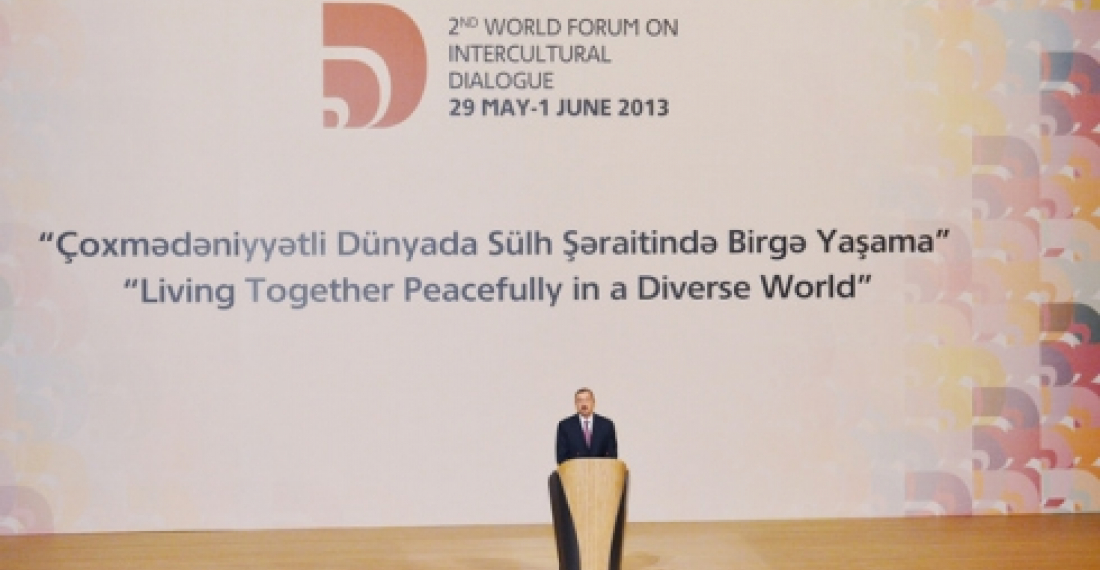
"Жить вместе в условиях мира в мультикультурном мире". Алиев говорит, что на протяжении веков Азербайджан является родиной для многих национальностей.

II Всемирный форум по межкультурному диалогу на тему "Жить вместе в условиях мира в мультикультурном мире" стартовал в Центре Гейдара Алиева, что в Баку. Президент Азербайджана Ильхам Алиев принял участие в церемонии открытия и выступил с речью.

В своем выступлении президент Алиев отметил, что на протяжении веков Азербайджан является родиной для многих национальностей, которые верят в разные религии: "Этот фактор играет большую роль в успешном развитии Азербайджана. Мы желаем предотвращения негативных фактов, но, к сожалению, не можем этого добиться. Во многих странах мира наблюдаются противостояния на религиозной и национальной почве."

Отметив, что Азербайджан является примером толерантности на протяжении веков, президент Ильхам Алиев заявил, что  в годы независимости эти положительные тенденции не только сохранялись, но и развивались: "Межнациональный диалог усиливает эти тенденции. У всех стран есть политические и экономические интересы. Для укрепления связей  между странами нужно также налаживать межнациональные отношения. В этом мире есть место для каждого народа и национальности. Главное, чтобы были мир и сотрудничество. Связанные с региональными отношениями наши шаги направлены на сотрудничество".

Отметив, что Азербайджан является частью мусульманского мира, президент подчеркнул, что европейское влияние на Азербайджан ощущалось с 19-го века.

Президент Алиев заявил, что Азербайджан играет важную роль в Организации исламского сотрудничества, в прошлом же году в Баку был проведен самый популярный песенный конкурс Европы, а в 2015 году в Баку состоятся I Европейские олимпийские игры. Он добавил:

"В последнее время можно услышать различные противоречивые мысли и пессимистические заявления в связи с мультикультурализмом. Некоторые политические заявления, медиа-структуры служат не диалогу между цивилизациями, а работают против него. В Азербайджане мультикультурализм существовал на протяжении веков. Азербайджан является одним из адресов мультикультурализма. Эта тенденция может усилиться в любой точке мира, главное, чтобы была политическая воля".

На форуме также выступили глава Альянса цивилизаций ООН и Верховный представитель генерального секретаря ООН Насир Абдулазиз аль-Насер, генеральный директор ЮНЕСКО г-жа Ирина Бокова и генеральный директор ИСЕСКО Абдульазиз Осман эт-Тувейджри.

В конце официальной церемонии открытия, участники форума сфотографировались с президентом Ильхамом Алиевым.

Затем, в фойе Центра Гейдара Алиева состоялся флэш-моб.

Источник: commonspace.eu по материалам AПA

Фото: Президент Алиев на открытии II Всемирного форума по межкультурному диалогу в Баку, 30 мая 2013 года. (Фотография предоставлена пресс-службой президента Азербайджана)


Related articles

Editor's choice
News
Uzbekistan calls for bigger voice for Central Asia in the UN

Uzbekistan calls for bigger voice for Central Asia in the UN

Uzbekistan called for a more effective and representative United Nations on September 23, as presidential administration chief Saida Mirziyoyeva used her address to the UN General Assembly to seek support for the country’s candidacy for a nonpermanent Security Council seat in 2035–2036. Speaking at the Assembly’s 81st session in New York, Mirziyoyeva argued that international cooperation remains necessary despite growing geopolitical divisions. She endorsed UN Secretary-General António Guterres’ UN80 reform initiative and called for an expanded Security Council, arguing that international rules should be applied consistently rather than according to the interests of powerful states. Uzbekistan’s planned chairmanship of the Non-Aligned Movement in 2027 was presented as another platform for promoting dialogue. Her emphasis on multilateralism also fits a broader Central Asian effort to increase the region’s role in international institutions. Kyrgyzstan, for example, will hold its first Security Council seat in 2027–2028. Mirziyoyeva also highlighted regional cooperation, pointing to improved relations among Central Asian states over longstanding border and water disputes. On Afghanistan, she urged countries not to view it solely as a security threat, stressing the importance of creating conditions for peaceful development. She linked Uzbekistan’s international agenda to domestic reforms, citing economic growth, falling poverty and expanded education. Climate and water security also featured prominently, with the Aral Sea serving as an example of the consequences of poor environmental management. (click image to read more)

Popular

Editor's choice
Interview
Thursday Interview: Murad Muradov

Thursday Interview: Murad Muradov

Today, commonspace.eu starts a new regular weekly series. THURSDAY INTERVIEW, conducted by Lauri Nikulainen, will host  persons who are thinkers, opinion shapers, and implementors in their countries and spheres. We start the series with an interview with Murad Muradov, a leading person in Azerbaijan's think tank community. He is also the first co-chair of the Action Committee for a new Armenian-Azerbaijani Dialogue. Last September he made history by being the first Azerbaijani civil society activist to visit Armenia after the 44 day war, and the start of the peace process. Speaking about this visit Murad Muradov said: "My experience was largely positive. My negative expectations luckily didn’t play out. The discussions were respectful, the panel format bringing together experts from Armenia, Azerbaijan, and Turkey was particularly valuable during the NATO Rose-Roth Seminar in Yerevan, and media coverage, while varied in tone, remained largely constructive. Some media outlets though attempted to represent me as more of a government mouthpiece than an independent expert, which was totally misleading.  Overall, I see these initiatives as important steps in rebuilding trust and normalising professional engagement. The fact that soon a larger Azerbaijani civil society visits to Armenia followed, reinforces the sense that this process is moving in the right direction." (click the image to read the interview in full)

