Azerbaijan can be a loyal and effective partner in the fight against Islamic radicalization due to its resilience and experience in solving the main problems related to the role of religion in society, Ramazan Samedov argues in this article for commonspace.eu.
For a Muslim-dominated country whose neighbors include Russia, Iran and Turkey, an effective foreign policy is essential for basic survival, and is also an important tool for capitalizing on regional opportunities. Situated at the intersection of major trade and energy routes between East and West, North (Russia) and South (Iran) and supporting a secular state with a Muslim heritage, Azerbaijan is a natural bridge between Europe and Asia, the Muslim and Christian worlds, and a gateway to energy and international transport corridors for your region. As the world tries to combat the global growth of radicalization, Azerbaijan, as a secular state with a Muslim majority, can become a valuable partner for Europe in its search for solutions to the problem of radical Islam.
Despite the fact that more than 90% of the population of Azerbaijan are Muslims, people prefer not to call them as such. Azerbaijan is a member of the Organization of Islamic Cooperation (OIC) and also a member of the Council of Europe. The people of Azerbaijan were shamans, Christians, Sunnis and Shiites at different periods of their history, which was a good tool to defend against external threats. When Russia gets too close, they say they are Muslim; when Turkey does this, they say they are Shiites; when Iran approaches them, they are Turks. Another fact that is interesting to mention is that, according to a recent Gallup poll, Azerbaijan is one of the most secular countries in the Muslim world, with about 53% of respondents indicating the importance of religion in their lives as little or no. The same survey shows
One of the spiritual fathers of Azerbaijan, Mirza Fatali Akhundov, the son of a mullah who became a playwright-philosopher-atheist, was one of the first famous people who began to promote secular ideas in Azerbaijan in the 19th century. To understand the scale of his role in our region, he is compared with Montesquieu, Rousseau and Voltaire in the West, and even called the "Moliere of the East." Akhundov strove to reform the country and develop a secular culture. A few decades after his birth, Azerbaijan had its own theaters, opera halls, newspapers and even a magazine called Molla Nasraddin - possibly the world's first Charlie Hebdo, which published anecdotes and satirical caricatures of Islam and mullahs. These were historical events for the Muslim and Turkic world. This happened over a hundred years ago, but no one was attacked because of this.
Светская жизнь в Азербайджане продолжалась по этой траектории. Это даже отражено в азербайджанском языке - «dunyəvi», азербайджанское слово «светский», буквально переводится как «мирское». В 1918 году во время первой азербайджанской республики состоялась дискуссия о государственном гербе страны - флаге. Мусульманская фракция парламента Азербайджана хотела, чтобы зеленый цвет был в верхней части флага, чтобы представлять сильное исламское наследие страны, однако парламентское большинство приняло решение против этого и, уважая то, что ислам является частью Азербайджана, решил, что зеленый цвет должен быть внизу флага. Над ним синий цвет представляет тюркское наследие страны, а красный - символ прогресса азербайджанской культуры. Это продолжает служить хорошим отражением того, кем являются азербайджанцы - светские аспекты их национальной идентичности предшествуют религии.
Азербайджан был одной из двух стран с мусульманским большинством, которые направили войска в Ирак для поддержки возглавляемой США коалиции во время Второй войны в Персидском заливе, а также внесли свой вклад в международные усилия против талибов в Афганистане. Он также участвовал в программе НАТО «Партнерство ради мира» и с 2005 года заключил Индивидуальное соглашение о партнерстве с этой организацией.
Азербайджан имеет все возможности для того, чтобы играть роль связующего звена между ЕС и его восточным соседством; не только в военном, экономическом и энергетическом контекстах, но и в добавлении ценного понимания ислама к европейским усилиям по борьбе с насильственным экстремизмом и его предотвращению.
Несмотря на собственный опыт экстремистских группировок, в частности, очагов салафитских радикалов на севере страны, меры по предотвращению и противодействие радикализации в целом были эффективными наряду с продвижением светских правительственных институтов; демонстрируя, что Азербайджан обладает твердой иммунной системой, когда дело доходит до религиозной радикализации. Все эти факторы усиливают аргумент, что Азербайджан - и светские государства, подобные ему, - может быть лояльным и эффективным партнером в борьбе с исламской радикализацией благодаря своей устойчивости и опыту решения основных проблем, связанных с ролью религии в обществе.
Источник: Рамазан Самедов
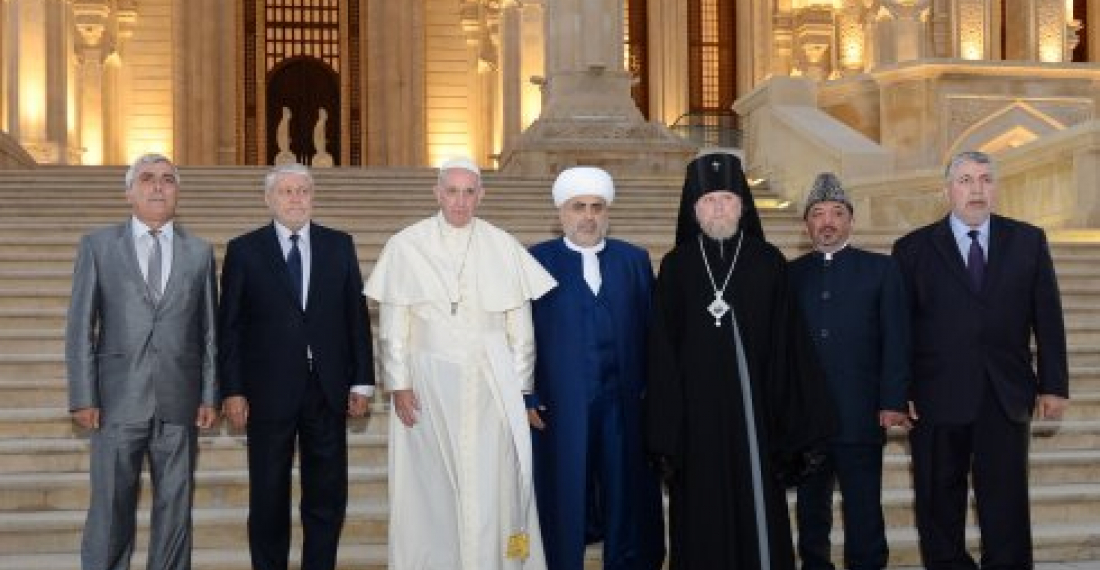
На фото: Папа Франциск во время своего визита в Баку в октябре 2016 года вместе с местными лидерами мусульманской, христианской, еврейской и других конфессий
The views expressed in comments and articles do not necessarily reflect the position of commonspace.eu or its partners.