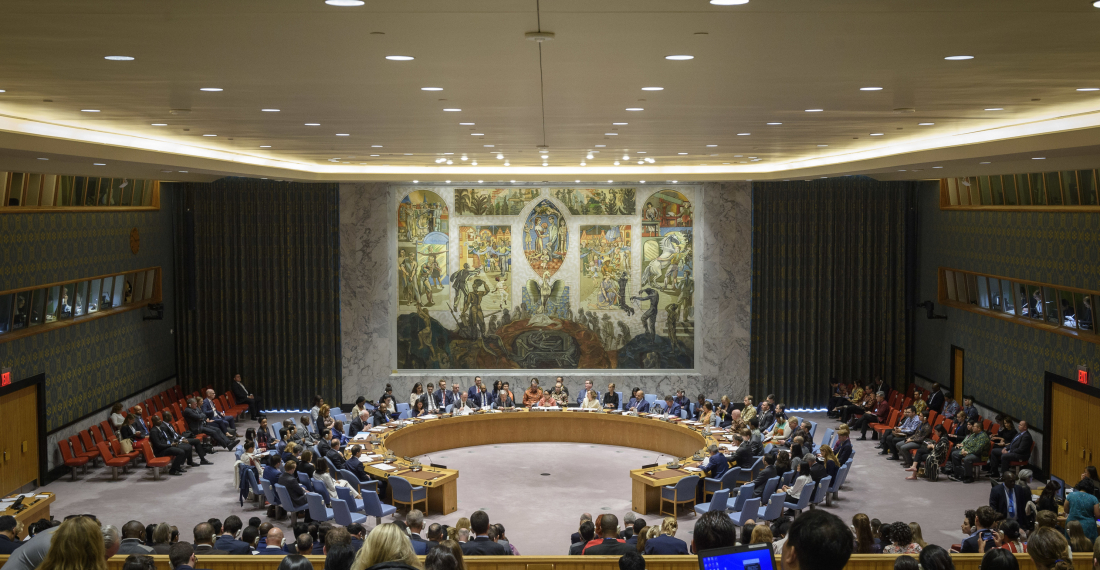
On Monday (26 October), the United Nations Security Council will hold an open briefing to mark the 30th anniversary of the establishment of the children and armed conflict mandate by the General Assembly.
Greek Minister of Foreign Affairs Giorgos Gerapetritis is expected to chair the meeting, which is a signature event of Greece’s October Council presidency. The anticipated briefers are Special Representative of the Secretary-General for Children and Armed Conflict Vanessa Frazier; UNICEF Executive Director Catherine Russell; the Special Envoy for Children Affected by Armed Conflict of the African Union (AU), Jainaba Jagne; and the Director of Watchlist on Children and Armed Conflict, Bethany Ellis.
Greece served as the chair of the Working Group on Children and Armed Conflict in 2025, but has yet to be reappointed this year due to the ongoing delays in the allocation of subsidiary body chairs. It has nonetheless continued to prioritise the agenda, including by promoting a resolution addressing the impact of digital technologies on the perpetration of violations and abuses against children, which was adopted unanimously on 19 October as resolution 2832 and was co-sponsored by 93 member states. (For more information, see our 18 October What’s in Blue story.) In addition to organising tomorrow’s signature event, Greece invited civil society briefers focusing on the protection of children to two Council meetings—on Yemen and Syria, on 9 and 12 October, respectively—and chaired a meeting of the Working Group on Children and Armed Conflict on 13 October.
Greece has circulated a concept note ahead of tomorrow’s meeting, which says that the briefing aims to assess the progress achieved in the 30 years since the children and armed conflict agenda was established as well as the challenges it faces.
Many speakers at tomorrow’s meeting are expected to highlight the unique nature of the children and armed conflict agenda—one of the Security Council’s most developed thematic issues—which provides the Council with concrete measures to compel behavioural change from conflict parties. Through the adoption of 15 resolutions and 13 presidential statements to date, the Council established such tools as the Monitoring and Reporting Mechanism (MRM), which collects and verifies information on grave violations committed against children, and the Working Group on Children and Armed Conflict. (The six grave violations, as determined by the Security Council, are child recruitment and use; killing and maiming; rape and other forms of sexual violence; attacks on schools and hospitals; abductions; and the denial of humanitarian access.)
Speakers are likely to focus on the tangible results produced by the mandate in the past 30 years, including the release of more than 220,000 children from armed forces and groups. Additionally, conflict parties have signed 38 action plans to end and prevent grave violations since the establishment of the children and armed conflict mandate, 12 of which were fully implemented and led to the de-listing of the relevant parties from the annexes in the Secretary-General’s annual report on children and armed conflict.
Despite the important progress achieved by the mandate, there has been a worrying increase in grave violations committed against children in the past several years. The Secretary-General’s latest annual report on children and armed conflict, dated 16 June and covering 2025, recorded 38,558 grave violations that affected 24,174 children—representing the highest number of children affected by violations since the establishment of the mandate. The concept note for tomorrow’s meeting attributes these developments to the evolving nature of conflict—including shifts in fighting from battlefields to urban settings, the use of explosive weapons in populated areas, and the risks posed by emerging technologies—combined with disregard by conflict parties for obligations under international law and lack of accountability for perpetrators of grave violations.
In discussing the challenges faced by the mandate, the briefers and some Council members are likely to note cuts to humanitarian funding and the budgets of UN peace operations, as well as recent and impending drawdowns of some of these operations, which have had negative effects on child protection and monitoring and reporting capacities in the field. Ellis is expected to note that funding cuts to non-governmental organisations (NGOs) have also reduced critical services for children, including support for education and reintegration programmes for children formerly associated with armed forces and groups and mental health and psychosocial support. She is likely to stress that local child protection actors and community-based programming have been significantly affected by such cuts.
Several speakers are likely to emphasise the need to facilitate predictable funding to relevant UN agencies and NGOs to sustain child protection and monitoring and reporting capacities in the field. Some may also note the need for the Council to maintain such capacities in its resolutions renewing the mandates of relevant UN peace operations. A recent example of a positive practice in this regard is a 23 October meeting held by the Group of Friends on Children and Armed Conflict in New York ahead of the mandate renewal of the UN Organization Stabilization Mission in the Democratic Republic of the Congo (MONUSCO) in December, which featured presentations from child protection actors in the field.
Some speakers are also likely to express concern about the hindrance to the functioning of the Working Group on Children and Armed Conflict, stemming from both the delayed allocation of subsidiary body chairs and difficult dynamics among Council members. (For background and more information, see the brief on children and armed conflict in our October 2026 Monthly Forecast.)
The briefers and some Council members are likely to call on member states to demonstrate political will to fully implement the established norms and mechanisms to end and prevent grave violations against children. Frazier and Russell may urge member states to use every tool at their disposal to compel conflict parties to uphold their obligations under international law. Ellis might note that such tools could include using diplomatic leverage to compel parties to sign and implement action plans to end and prevent grave violations, ending weapons transfers, and re-evaluating economic relationships. These speakers may also stress the need to translate normative commitments—such as the 2022 Political Declaration on Strengthening the Protection of Civilians from the Humanitarian Consequences Arising from the Use of Explosive Weapons in Populated Areas (EWIPA) and the Safe Schools Declaration—into national policies and military procedures.
Some speakers may underscore the need to reinforce partnerships among member states, UN entities, regional organisations, civil society, and affected communities to promote the implementation of the children and armed conflict agenda. Jagne is expected to address the AU’s efforts in this regard. For instance, on 2 September, the AU Peace and Security Council (AUPSC) held a meeting focused on “the protection of child soldiers in Africa”, during which it adopted a communiqué that called, among other things, on member states to “integrate child-protection risks relating to recruitment and use into national, regional and continental early warning and early response systems”.
Jagne may call for deeper AU-UN cooperation—including joint advocacy, technical exchanges, and coordinated country engagements—to translate international and continental commitments into concrete outcomes for children affected by armed conflict. Similar issues were apparently also discussed during the 11th informal joint seminar of members of the Security Council and the AUPSC, which was held in New York on 22 October. (Greece apparently facilitated the inclusion of an agenda item on children and armed conflict at the joint seminar.)
Council members’ statements are likely to focus both on developments in specific situations, such as Gaza and Ukraine, as well as broader thematic issues. Many members are likely to express concern about the effects on children of emerging technologies, including the expanded use of uncrewed aerial systems (UAS); the growing integration of artificial.
source: commonspace.eu with Security Council Report (New York)