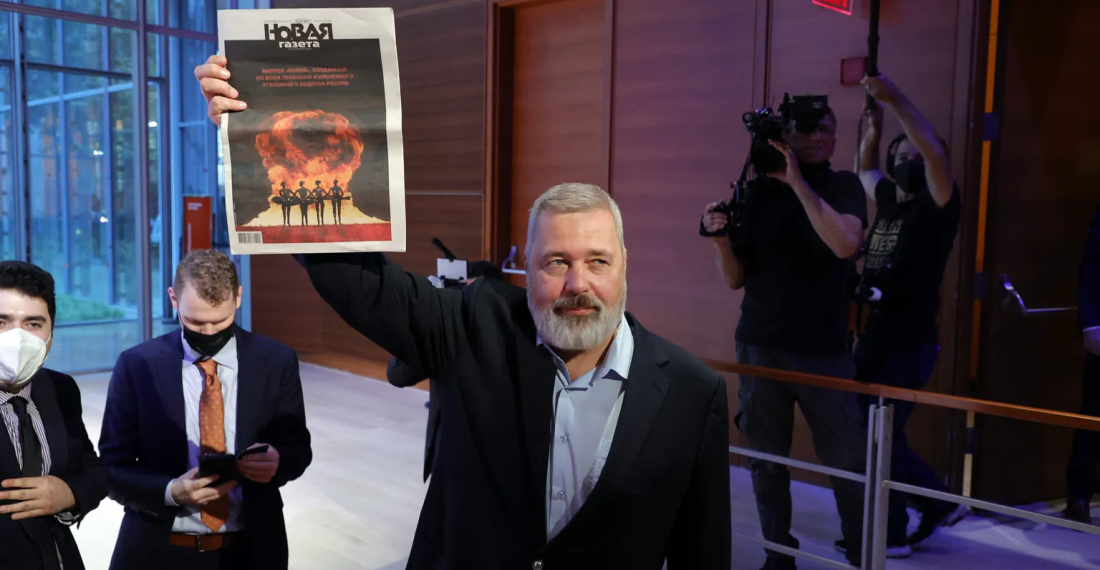
It is not often that people in Russia speak openly against Vladimir Putin. But the Nobel Peace Prize winner, and former editor of Novaya Gazeta, Dmitry Muratov, has broken this silence, in an interview with Steve Rosenberg, the BBC Russia correspondent, which was aired on the BBC news channel.
Rosenberg says that at the Moscow offices of newspaper Novaya Gazeta, the corridors are silent.
There is an overwhelming sense of emptiness
"There is no newspaper anymore," former chief editor Dmitry Muratov says.
Mr Muratov co-founded Novaya Gazeta more than 30 years ago. It became the flagship for hard-hitting independent journalism in Russia, shining a light on human rights abuses and high-level corruption.
In 2021 Mr Muratov was joint winner of the Nobel Peace Prize for his efforts "to safeguard freedom of expression." The Nobel Committee noted that "six of [Novaya Gazeta's] journalists have been killed, including Anna Politkovskaya who wrote revealing articles on the war in Chechnya."
It was recognition for courageous reporting.
But it didn't protect the paper.
"Putin issued a decree and the newspaper's printing presses were nationalised," Mr Muratov explains. "Its registration was revoked."
Novaya Gazeta does retain a presence online. But only just: the authorities have blocked access to its website. It can only be accessed from abroad, or with the help of VPNs – virtual private networks used to circumvent restrictions.
The newspaper's difficulties reflect the broader crackdown on free speech in Russia which has accelerated since the Kremlin's full-scale invasion of Ukraine in 2022.
"Most opinion leaders have been declared 'foreign agents', 'extremists' or 'terrorists'. Several hundred," says Dmitry Muratov.
"Figures vary, but at a conservative estimate, since the start of Russia's 'special military operation' [in Ukraine] at least 1,500 people are now in prison having spoken out against current state policy. That's three times more than during the savage days of the KGB in the USSR."
In his 1975 Nobel Peace Prize lecture dissident Andrei Sakharov listed the names of more than 120 political prisoners he was aware of in the Soviet Union. A decade later what the Kremlin had assumed in 2022 would be a short, successful "military operation" has become the bloodiest conflict in Europe since the Second World War.
Yet a confident President Putin continues to predict victory for Russia. But Muratov insists:
"There will never be 'victory', because what has been going on for nearly five years – no matter how it ends – can no longer be considered a victory. It cannot be a victory when two Slavic nations have ripped a million people to shreds. Or more than a million. It seems to me that the situation with Ukraine now is this: you can destroy it, but you cannot conquer it. What do I mean by destroy? Continued escalation all the way to the use of a nuclear weapon."
Does he really believe the Kremlin leader would use nuclear weapons in this war?
"All those political experts who say 'Putin thinks this' or 'Putin is scared of that'…they're all charlatans," claims Dmitry Muratov. "It's in the same league as astrology. Nobody knows what's going on in Vladimir Putin's head. And I don't know.
"I see things only as a journalist. I study big data. And since the beginning of the year the need to use nuclear weapons has been mentioned more than 500 times. When wackos say this, I pay no attention. But I've heard it discussed on state TV. And at the St Petersburg International Economic Forum, a state-run event, one of the speakers talked up the use of nuclear weapons as something favourable, something good."
When he announced the mass invasion of Ukraine in February 2022, President Putin spoke of "ensuring the security of Russia."
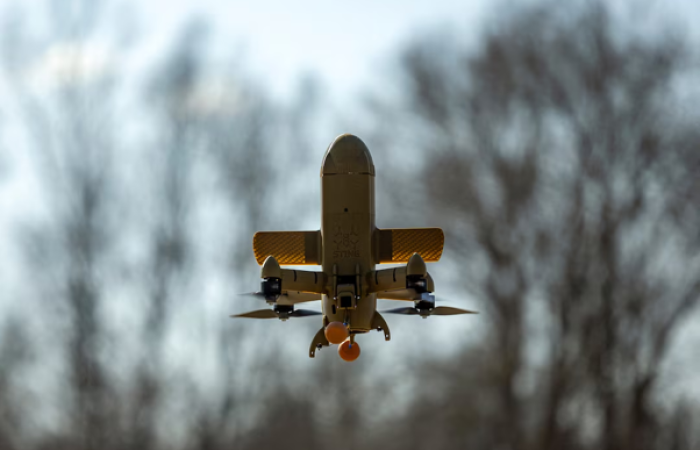
"Tell me, has security increased?" Dmitry Muratov asks. "With Ukrainian drones now attacking warehouses of [Russia's largest online retailer] Wildberries; with the petrol crisis, the disruption to mobile internet, the political prisoners? Has security increased, or not?"
Despite opinion polls registering a fall in Vladimir Putin's domestic approval ratings, Russia's president – Mr Muratov believes - retains a tight grip on power.
"Sorry, I don't believe all this talk about a split among members of the elite, about secret conspiracies. The country is run by Vladimir Putin. They're frightened of him.
"And this fear is reinforced in every way by his main support base: the Federal Security Service (FSB)."
As critical as he is of his own government, he has few illusions about the West.
"[Putin] knows very well the true value of European leaders. On the one hand they talk to him about human rights. He laughs out loud because, with the other hand, they sign agreements – or used to sign agreements – with Russia on trading oil, gas, diamonds…all that stuff. When they talk to Putin about European values, he truly laughs out loud. He knows the true value of people who preached to him those values."
In Russia Mr Muratov has been designated a 'foreign agent', a label often used to punish critics of the Kremlin. 'Foreign agents' have limited rights: they're banned from teaching, from taking part in elections; if they sell their flat, they can't access the assets. The label is also designed to stigmatise, to create the sense in society of an enemy within.
Yet the journalist appears reluctant to focus on the pressures he's under, preferring instead to highlight the plight of compatriots in prison.
"What worries me most right now is that no one in the world is interested in the political prisoners who were first to speak out against the land grab in our neighbouring country," Dmitry Muratov explains.
source: commonspace.eu, with BBC (London)