Ceasefire? What ceasefire?

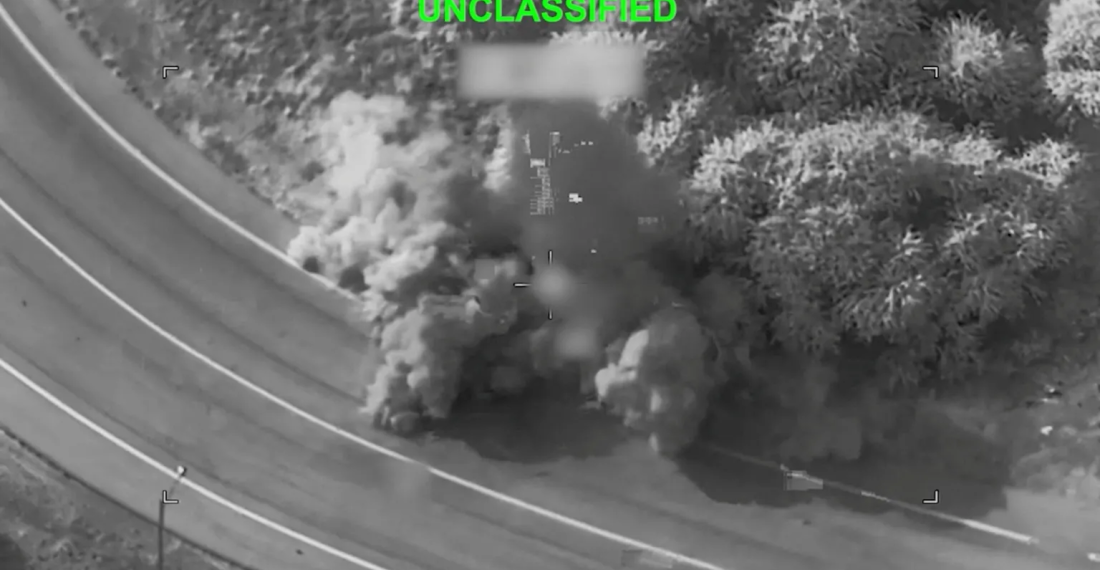
On Thursday night, the US launched a sixth series of aerial attacks on Iran. Iran responded with attacks on US targets in neighbouring Arab countries.

The US launched a wave of strikes against Iran for the sixth night in a row, its military said, as the two sides battled over control of the Strait of Hormuz.

US Central Command (Centcom) said the attacks were intended to "further degrade Iranian military capabilities", before saying it had boarded a vessel as part of its blockade of Iranian ports.

State media reported that the US had hit civilian infrastructure, including bridges, a train station and an airport. The BBC has verified an attack on one bridge to the west of Bandar Abbas in Hormozgan province.

Iran's Revolutionary Guards (IRGC) say they have retaliated by striking US maritime surveillance radar sites in Oman as well as targets in Kuwait and Bahrain. They also claim to have attacked a US special operations command centre in Syria.

The IRGC said the surprise attack at al-Tanf in Syria, near the border with Jordan, was in retaliation for the killing of Iranian soldiers two days ago. Neither Syria nor the US have commented on the claim.

Later on Friday, Jordan's military said it shot down three Iranian missiles with no casualties or damage reported.

Kurdish forces in Iraq also said eight drones were shot down over the Iraqi city of Erbil, with no casualties reported.

source: commonspace.eu with BBC (London) and agencies
Related articles

Popular

Editor's choice
Interview
Thursday Interview: Murad Muradov

Thursday Interview: Murad Muradov

Today, commonspace.eu starts a new regular weekly series. THURSDAY INTERVIEW, conducted by Lauri Nikulainen, will host  persons who are thinkers, opinion shapers, and implementors in their countries and spheres. We start the series with an interview with Murad Muradov, a leading person in Azerbaijan's think tank community. He is also the first co-chair of the Action Committee for a new Armenian-Azerbaijani Dialogue. Last September he made history by being the first Azerbaijani civil society activist to visit Armenia after the 44 day war, and the start of the peace process. Speaking about this visit Murad Muradov said: "My experience was largely positive. My negative expectations luckily didn’t play out. The discussions were respectful, the panel format bringing together experts from Armenia, Azerbaijan, and Turkey was particularly valuable during the NATO Rose-Roth Seminar in Yerevan, and media coverage, while varied in tone, remained largely constructive. Some media outlets though attempted to represent me as more of a government mouthpiece than an independent expert, which was totally misleading.  Overall, I see these initiatives as important steps in rebuilding trust and normalising professional engagement. The fact that soon a larger Azerbaijani civil society visits to Armenia followed, reinforces the sense that this process is moving in the right direction." (click the image to read the interview in full)