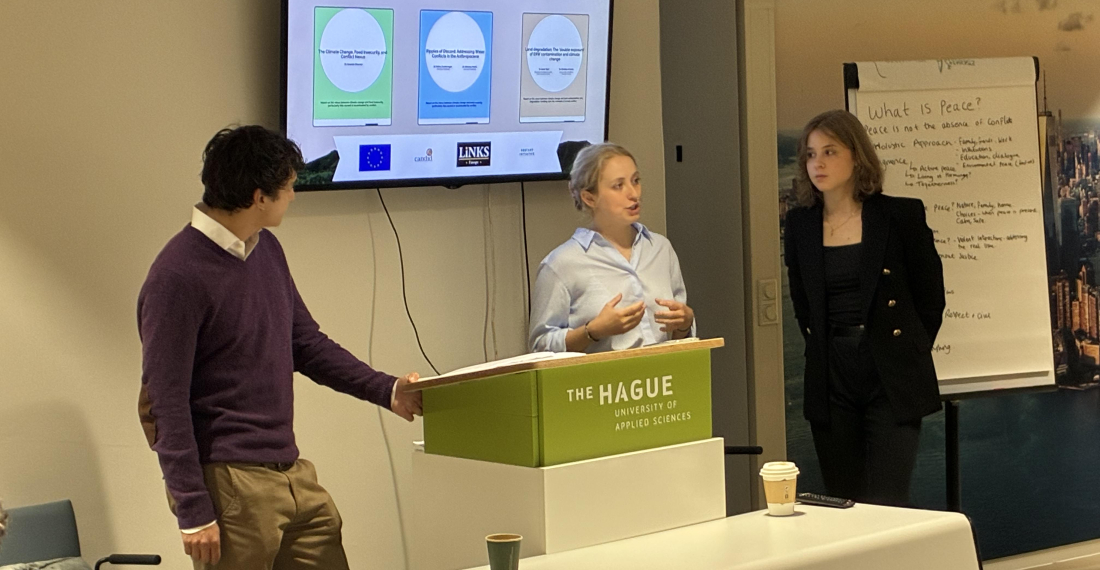
On 18 June 2026, LINKS Europe Research Assistants delivered a capstone presentation at the Youth Peace Summit in The Hague, focusing on the role of youth in bringing place-based knowledge into discussions on climate change, peace and security.
The presentation explored how indigenous, local and community-based knowledge has often been overlooked in policy and academic spaces, despite its importance in understanding how climate change affects vulnerable communities. Santiago Ferbel-Azcarate (Senior Research Assistant), Anna Szedlacsek (Junior Research Assistant), and Serena Claggett (Junior Research Assistant) argued that young people are well placed to help bridge this gap.
The presentation included two case studies. The first focused on Georgia’s Samtskhe-Javakheti region, where farmers have revived traditional agricultural practices to address soil degradation and support more sustainable land management. The second looked at Athar, a youth-led climate innovation incubator in Upper Egypt, which supports locally rooted climate solutions through mentorship, training and access to resources.
The presentation included a framework for strengthening youth participation in areas of climate, peace and security issues. This included recognising youth as stakeholders, improving access to land and finance, taking indigenous and local knowledge seriously in education and governance, and providing resources directly to youth leaders and local communities.
The presentation concluded by linking these themes to the work of the Bonn Contact Group, a LINKS Europe initiative established ahead of COP29 in Baku in 2024. Members of the group emphasised the need for holistic and place-based approaches to land degradation, food insecurity, water scarcity and related climate-security challenges. Read the reports here.