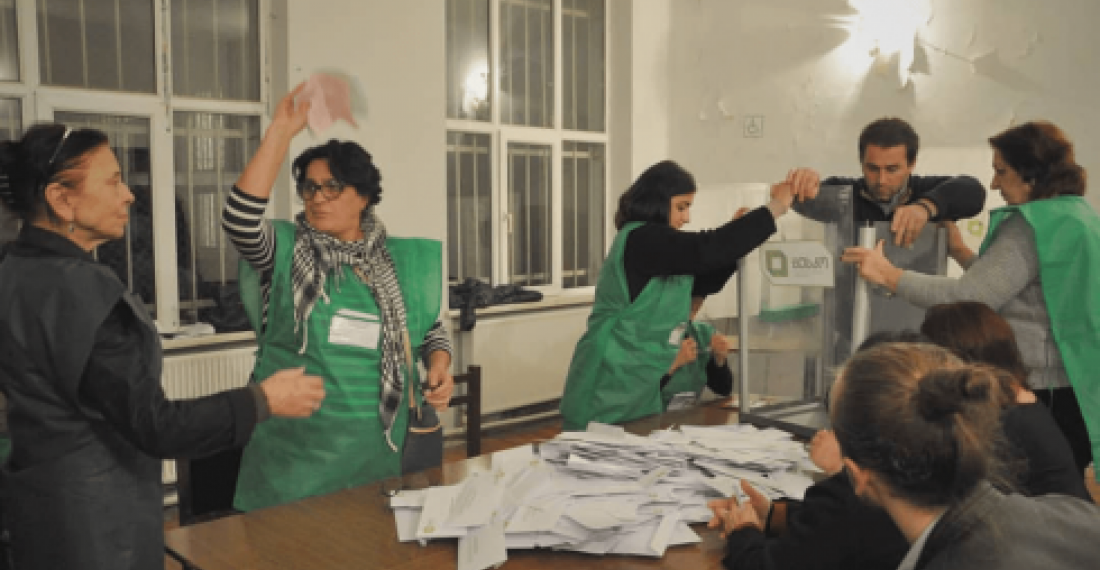
В Грузии проходит второй тур президентских выборов (обновляется в течение дня)

Обновлено

По предварительным данным, по итогам прошедших выборов Зурабишвили побеждает на президентских выборах, состоявшихся в Грузии.

По данным экзит-полл, проведенного Edison Research, Саломе Зурабишвили, кандидат, поддержанный правящей Грузинской мечтой, одержала победу во втором туре президентских выборов, получив 55% всех голосов. По данным еще одного экзит-полла, проведенного телекомпанией «Имеди» Зурабишвили, набирает 58% голосов.

Голосование завершилось в 20.00 по местному времени, и ожидается, что подсчет голосов продолжится всю ночь.

---

Явка избирателей во втором туре президентских выборов в Грузии, как представляется, значительно выше, чем в первом туре. Данные, опубликованные Центральной избирательной комиссией, показывают, что к 15 часам местного времени 38/8% избирателей уже  проголосовали. Это значительно выше, чем количество избирателей в первом туре к тому же времени, что составило 30,98%.

По мнению политического редактора  Commonspace.eu, после жестокой битвы в ходе избирательной кампании грузинский народ уже во второй раз дает свой голос. Во время предвыборной кампании, предшествовавшей второму раунду, несколько комментаторов отметили, что высокая избирательная активность во втором туре будет способствовать кандидату от правительства, Саломе Зурабишвили. Многие сторонники правящей партии «Грузинская мечта» (GD) остались в стороне во время первого тура  голосования 28 октября, что привело к неожиданно близкому результату. Согласно этим комментаторам, многие из тех, кто остался в первом раунде в стороне  были агитированы, чтобы проголосовать  во втором туре между кандидатом от GD и кандидатом от Единого национального движения.

---

Данные, опубликованные Центральной избирательной комиссией Грузии, указывают на более высокую явку, чем в первом туре, при этом 19,6% проголосовали к полудню, что на 3% выше.

В среду (28 ноября), в Грузии, пройдут выборы нового президента страны. В первом туре выборов, состоявшихся 28 октября, ни один из кандидатов не получил необходимых для победы в первом туре 50% голосов.

Президент Георгий Маргвелашвили и премьер-министр Мамука Бахтадзе проголосовали досрочно, в то же время обратившись к избирателям с призывом проголосовать. «Для некоторых это сложный выбор, но я хочу призвать каждого гражданина Грузии прийти на выборы и сделать выбор», - сказал президент Георгий Маргвелашвили после того, как он проголосовал.

"Я хотел бы поздравить граждан Грузии с сегодняшней высокой явкой, и я хотел бы призвать избирателей, граждан Грузии, прийти на выборы, принять решение и сыграть решающую роль в формировании правительства. Спасибо за такую явку, и я уверен, что это продолжится в течение дня, что гарантирует, что выборы пройдут на высоком уровне и будет меньше нарушений", - сказал Маргвелашвили.

Тем временем в Центральной избирательной комиссия заявили, что избирательные участки открылись вовремя, в 08:00, и процесс голосования проходит по всей территории Грузии. 3,703 избирательных участка, в том числе 55 за рубежом. Общее число избирателей составляет 3 528 658 человек. В первые два часа опроса 7,26% избирателей отдали свой голос, немного выше, чем в то же время в первом туре.

Похожий материал: Президентские выборы в Грузии (live blog)

После избирательной кампании, которая считается одной из самых неприятных в новейшей истории Грузии, Избирателям предстоит выбрать между кандидатом, поддержанным правящей партией «Грузинская мечта» Саломе Зурабишвили, и кандидатом от Единого национального движения, которого также поддерживает ряд других оппозиционных партий Григол Вашадзе. В первом раунде оба кандидата шли бок о бок, набрав каждый около 38% поданных голосов.

Похожий материал: Выборы в Грузии: Второй тур

Хотя пост президента считается в основном символическим, выборы стали испытанием прочности и воли между нынешней правящей партией Грузии во главе с Бидзиной Иванишвили и главной оппозиционной силой, которая отождествляется с бывшим президентом страны Михаилом Саакашвили.

источник: commonspace.eu
 

Related articles

Editor's choice
News
Germany accuses Russia of cyberattacks and disinformation campaign

Germany accuses Russia of cyberattacks and disinformation campaign

The German government holds Russia responsible for a cyberattack on German air traffic control, and for targeted disinformation campaigns before the last federal election. According to the German Foreign Office in Berlin, the incidents could be clearly attributed to the Russian military intelligence service, the GRU. In response, the Russian ambassador to Berlin was summoned to the Foreign Ministry. "We have been observing a massive increase in threatening hybrid activities by Russia for some time now," a spokesperson for the Foreign Ministry stated. These range from disinformation campaigns and espionage to cyberattacks and sabotage attempts. The aim is to divide society, sow distrust, and undermine confidence in democratic institutions. The spokesperson added that with these actions, Russia is "very concretely threatening our security, not only through its war of aggression against Ukraine, but also here in Germany."  The Foreign Ministry spokesperson explained that the cyberattack on air traffic control in August 2024 was clearly attributed to the hacker collective "APT28," known as "Fancy Bear," and to the responsibility of the Russian military intelligence service, the GRU. Furthermore, it could now be "conclusively stated" that Russia had attempted "to influence and destabilize both the last Federal election and the ongoing internal affairs of the Federal Republic of Germany." There was "absolutely irrefutable evidence" for this". The so-called "Storm 1516" campaign, which has been running since 2024, is allegedly backed by "reliable information" that the Moscow-based think tank "Center for Geopolitical Expertise" is behind it. The Center is also said to be supported by Russian military intelligence. Its primary aim is to influence democratic elections in the West. (Click the image to read more).
Editor's choice
News
NATO Chief says war is on Europe's doorstep, and warns against complacency

NATO Chief says war is on Europe's doorstep, and warns against complacency

Russia could attack a NATO country within the next five years, the Secretary General of NATO, Mark Rutte, said in a stark new warning. "NATO's own defences can hold for now," Rutte warned in Berlin, but conflict was "next door" to Europe, and he feared "too many are quietly complacent, and too many don't feel the urgency, too many believe that time is on our side. "Russia is already escalating its covert campaign against our societies," Rutte said in a speech in Germany. "We must be prepared for the scale of war our grandparents or great-grandparents endured." Earlier this month, Russia's President Vladimir Putin said his country was not planning to go to war with Europe, but it was ready "right now" if Europe wanted to - or started a war. But similar reassurances were given by Moscow in 2022, just before 200,000 Russian troops crossed the border and invaded Ukraine. Putin has accused European countries of hindering US efforts to bring peace in Ukraine - a reference to the role Ukraine's European allies have recently played in trying to change a US peace plan to end the war, whose initial draft was seen as favouring Russia. But Putin was not sincere, Nato's secretary-general said in the German capital, Berlin. Supporting Ukraine, he added, was a guarantee for European security. "Just imagine if Putin got his way; Ukraine under the boot of Russian occupation, his forces pressing against a longer border with Nato, and the significantly increased risk of an armed attack against us." Russia's economy has been on a war footing for more than three years now - its factories churn out ever more supplies of drones, missiles and artillery shells. According to a recent report by the Kiel Institute for the World Economy, Russia has been producing each month around 150 tanks, 550 infantry fighting vehicles, 120 Lancet drones and more than 50 artillery pieces. The UK, and most of its Western allies, are simply not anywhere near this point. Analysts say it would take years for Western Europe's factories to come close to matching Russia's mass-production of weapons. "Allied defence spending and production must rise rapidly, our armed forces must have what they need to keep us safe," the Nato chief said.

Popular

Editor's choice
News
Germany accuses Russia of cyberattacks and disinformation campaign

Germany accuses Russia of cyberattacks and disinformation campaign

The German government holds Russia responsible for a cyberattack on German air traffic control, and for targeted disinformation campaigns before the last federal election. According to the German Foreign Office in Berlin, the incidents could be clearly attributed to the Russian military intelligence service, the GRU. In response, the Russian ambassador to Berlin was summoned to the Foreign Ministry. "We have been observing a massive increase in threatening hybrid activities by Russia for some time now," a spokesperson for the Foreign Ministry stated. These range from disinformation campaigns and espionage to cyberattacks and sabotage attempts. The aim is to divide society, sow distrust, and undermine confidence in democratic institutions. The spokesperson added that with these actions, Russia is "very concretely threatening our security, not only through its war of aggression against Ukraine, but also here in Germany."  The Foreign Ministry spokesperson explained that the cyberattack on air traffic control in August 2024 was clearly attributed to the hacker collective "APT28," known as "Fancy Bear," and to the responsibility of the Russian military intelligence service, the GRU. Furthermore, it could now be "conclusively stated" that Russia had attempted "to influence and destabilize both the last Federal election and the ongoing internal affairs of the Federal Republic of Germany." There was "absolutely irrefutable evidence" for this". The so-called "Storm 1516" campaign, which has been running since 2024, is allegedly backed by "reliable information" that the Moscow-based think tank "Center for Geopolitical Expertise" is behind it. The Center is also said to be supported by Russian military intelligence. Its primary aim is to influence democratic elections in the West. (Click the image to read more).