


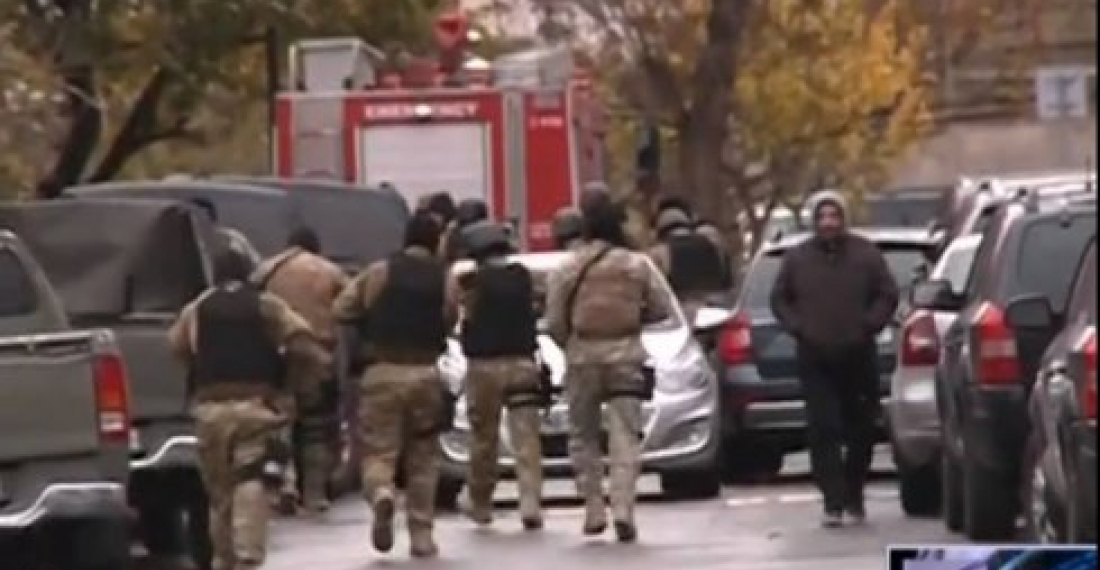
(Обновлено 2) Грузинские спецслужбы проводят антитеррористическую операцию

Обновление 2

В среду (22 ноября) после спец-операции, которая продолжалась около двенадцати часов, грузинским правоохранительным органам удалось обезвредить вооруженных лиц причастных к террористическим организациям. В заявлении Службы госбезопасности Грузии говорится, что трое террористов были убиты и еще один захвачен.

В ходе спец-операции был убит член специальной группы захвата грузинских сил. Трое других сотрудников правоохранительных органов Грузии получили ранения.

В заявлении Службы Госбезопасности Грузии говорится, что участники этой группировки не являются гражданами Грузии и уже несколько недель находились под наблюдением. В заявлении говориться, что они определили их и "ждут окончательного подтверждения".

По предположению грузинских СМИ, вооруженные лица являются чеченцами, сленами террористической организации "Исламское государство". Однако данная информация пока не подтверждается.

Ряд граждан Грузии чеченской национальности воевали в рядах террористической организации "Исламское государство" в Сирии в последние годы. Аналитики всегда подчеркивали возможный риск того, что с потерей контроля "Исламского государства" над своей территорией в Сирии, они вернутся в Грузию, представляя угрозу безопасности страны. Правительство Грузии в течение дня пыталось успокоить людей. Премьер-министр Георгий Квирикашвили заявил, что для жителей Тбилиси нет никакой угрозы.


Обновление 1

Власти Грузии проводят антитеррористическую операцию. В пригороде Тбилиси в эти минуты проходит спецоперация по поимке вооруженных лиц причастных к террористическим группам. В ходе спецоперации тяжелое ранение получил сотрудник полиции Грузии. 

Жители соседних квартир на улице Габриэль Салоси эвакуированы.

Следите за обновлениями

источник: commonspace.eu

фото: Жители многоквартирного дома в пригороде Тбилиси были эвакуированы в ходе антитеррористической операции, развернутой в среду, 22 ноября 2017 года.
 

Related articles

Editor's choice
News
The British prime minister says Europe must "stand on its own two feet" when it comes to defence

The British prime minister says Europe must "stand on its own two feet" when it comes to defence

The UK will deploy a carrier strike group, led by the aircraft carrier HMS Prince of Wales to the Arctic and the High North as part of efforts to bolster security against Russian threats. British prime minister, Sir Keir Starmer announced the deployment in a speech on Saturday (14 February) at the Munich Security Conference. Europe must be ready to fight to protect its people, values, and way of life,  Sir Keir told the Conference. Starmer also called for deeper links and cooperation, including economic ties, between the UK and EU. The PM stressed the continent must "stand on its own two feet" when it comes to defence commitments. "We must build our hard power, because that is the currency of the age," he told the conference. (Click image to read the full story).

Popular

Editor's choice
Interview
Thursday Interview: Murad Muradov

Thursday Interview: Murad Muradov

Today, commonspace.eu starts a new regular weekly series. THURSDAY INTERVIEW, conducted by Lauri Nikulainen, will host  persons who are thinkers, opinion shapers, and implementors in their countries and spheres. We start the series with an interview with Murad Muradov, a leading person in Azerbaijan's think tank community. He is also the first co-chair of the Action Committee for a new Armenian-Azerbaijani Dialogue. Last September he made history by being the first Azerbaijani civil society activist to visit Armenia after the 44 day war, and the start of the peace process. Speaking about this visit Murad Muradov said: "My experience was largely positive. My negative expectations luckily didn’t play out. The discussions were respectful, the panel format bringing together experts from Armenia, Azerbaijan, and Turkey was particularly valuable during the NATO Rose-Roth Seminar in Yerevan, and media coverage, while varied in tone, remained largely constructive. Some media outlets though attempted to represent me as more of a government mouthpiece than an independent expert, which was totally misleading.  Overall, I see these initiatives as important steps in rebuilding trust and normalising professional engagement. The fact that soon a larger Azerbaijani civil society visits to Armenia followed, reinforces the sense that this process is moving in the right direction." (click the image to read the interview in full)

