This analysis was prepared for commonspace.eu by Anna Szedlacsek, Junior Research Assistant at LINKS Europe
The relationship between Russia and China has become one of the most consequential strategic partnerships in contemporary international politics. Often portrayed as an emerging anti-Western alliance, the two countries have significantly expanded their cooperation in the diplomatic, military, economic and technological spheres. Their partnership is united above all by a shared interest in reducing Western – particularly American – influence and promoting a more multipolar international order. However, describing the relationship as a fully-fledged alliance risks overstating both its cohesion and durability.
A Long History of Friendly Cooperation
The modern partnership between Russia and China began in earnest following the 1991 collapse of the Soviet Union. Facing a new unipolar world dominated by the United States, both Moscow and Beijing realized that political alignment had become a strategic necessity to counterbalance American power. In 2001, the official framework for the modern partnership was solidified with the signing of the Treaty of Good-Neighborliness and Friendly Cooperation by Russian President Vladimir Putin and general secretary of the Chinese Communist Party Jiang Zemin. This treaty formally ended decades of border tensions, established regular communication channels between their militaries, and laid the groundwork for closer diplomatic coordination.
The partnership took a new turn after Xi Jinping took office in late 2012 and Vladimir Putin returned to the Russian presidency that same year. Driven by a shared goal of contesting U.S. global influence and preserving their respective authoritarian regimes, the two leaders dramatically deepened bureaucratic and military linkages.
An Asymmetric Alignment from the Start
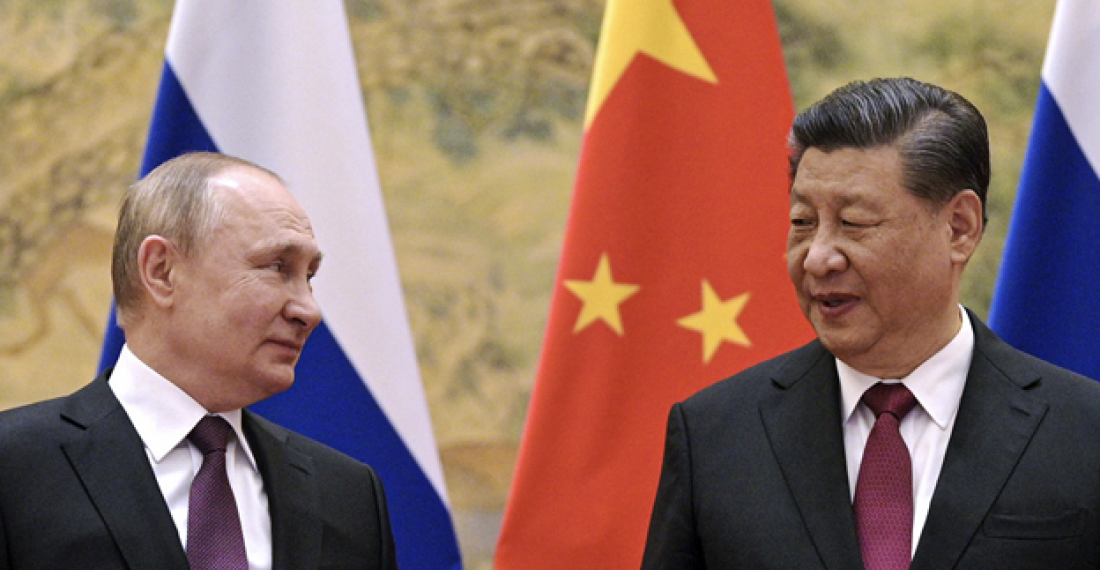
Following Russia's 2014 annexation of Crimea and the resulting Western sanctions, Russia’s economy became heavily dependent on Beijing’s support. On February 4, 2022 – just before Russia's full-scale invasion of Ukraine – Russia-China reached their all time high when Putin and Xi met in Beijing to publicly declare a "no limits" partnership with "no forbidden areas of cooperation."
Since the start of the war, Russia has overwhelmingly become the partner more dependent on the other. Faced with a new array of international sanctions, the Kremlin was forced to rely on China for goods on the G7 Common High Priority Items List, including semiconductors, integrated circuits, lithium-ion batteries, and computer numerical control (CNC) machines for metal shaping. Similarly, an analysis of recovered Russian weapons conducted by the Ukrainian Main Directorate of Intelligence (GUR) showed that the bulk of Russia’s foreign components are actually Western-made, with China funneling these Western parts to Russia through parallel imports, shell firms in jurisdictions like Hong Kong, and domestic Chinese facilities manufacturing Western designs.
China has also helped Russia boost its drone operations. Notably, under a July 2025 agreement, China reportedly trained at least 180 Russian troops on Chinese soil in drone operations and counter-drone tactics, and has assisted Russia in upgrading Iranian-designed drone systems that Moscow now produces domestically. Russia’s operations have also benefited from high-resolution satellite imagery provided to them by Chinese firms – such as Spacety China and Beijing Yunze – to identify Ukrainian targets deep into Ukrainian territory.
Lastly, China has provided the economic cushion without which Russia’s war economy would struggle to survive under Western isolation. Importantly, Beijing has dramatically expanded its purchases of discounted Russian crude oil, coal, and gas, with Russia officially becoming China's largest oil supplier in 2023, overtaking Saudi Arabia. This provided Moscow with export revenues that could be redirected into the state budget and, indirectly, its war effort.
The Limits of the “No Limits” Partnership
It is clear from the absence of security guarantees and defense pledges that Russia and China are not willing to fight each other’s wars – such as a war over Taiwan for Russia, or a direct clash with NATO for China – rendering a formal military-political alliance out of the question. This is reinforced by a lack of information sharing and military integration. With Russia limiting sensitive military transfers (such as hypersonics and next-generation aircraft) to prevent Chinese reverse engineering and intellectual property theft, and an absence of integrated command structures and shared military logistics, the two powers are best seen as practicing "parallel play"-- conducting joint drills and patrols side by side to signal unity to the West, but avoiding truly joint operations. Furthermore, the “allies” actively treat each other as intelligence targets, making a relationship based on trust impossible. For example, in 2025, a leaked memo of the Federal Security Service (FSB) of the Russian Federation revealed a “tense and dynamically developing” espionage contest, detailing Chinese agents spying on Russian military operations in Ukraine and activities in the Arctic.
China’s economic support for Russia is equally bound by limits. With Beijing fearing US secondary sanctions, major Chinese state banks routinely restrict direct transactions with Russian counterparts. The economic momentum that saw trade soar 55% between 2021 and 2025 is also losing steam: last year, bilateral trade fell by 7%, marking the first decline since 2020. Furthermore, China is unwilling to fill the gap left by European firms, with China's outward foreign direct investment (FDI) to Russia accounting for a mere 0.4% of its global total in 2023.
Lastly, with Russia’s "near abroad," Moscow's traditional security dominance in Central Asia, increasingly falling under China's Belt and Road Initiative, and a major economic and pricing deadlock over the proposed Power of Siberia 2 natural gas pipeline, further geopolitical friction points are expected to arise. It also remains to be seen how far Beijing is willing to go to support its ally when the two countries' objectives diverge: although both seek to challenge US dominance, Beijing remains far more integrated into the global economy and therefore has more to lose from prolonged instability. Therefore, China generally aims to expand its influence through economic ties and managed interdependence, whereas Russia has often pursued geopolitical leverage by abruptly breaking and disrupting the global system. China’s abstention on key UN votes condemning Russian aggression is just one example of Beijing’s carefully hedged diplomatic stance.
source: This analysis was prepared for commonspace.eu by Anna Szedlacsek, Junior Research Assistant at LINKS Europe