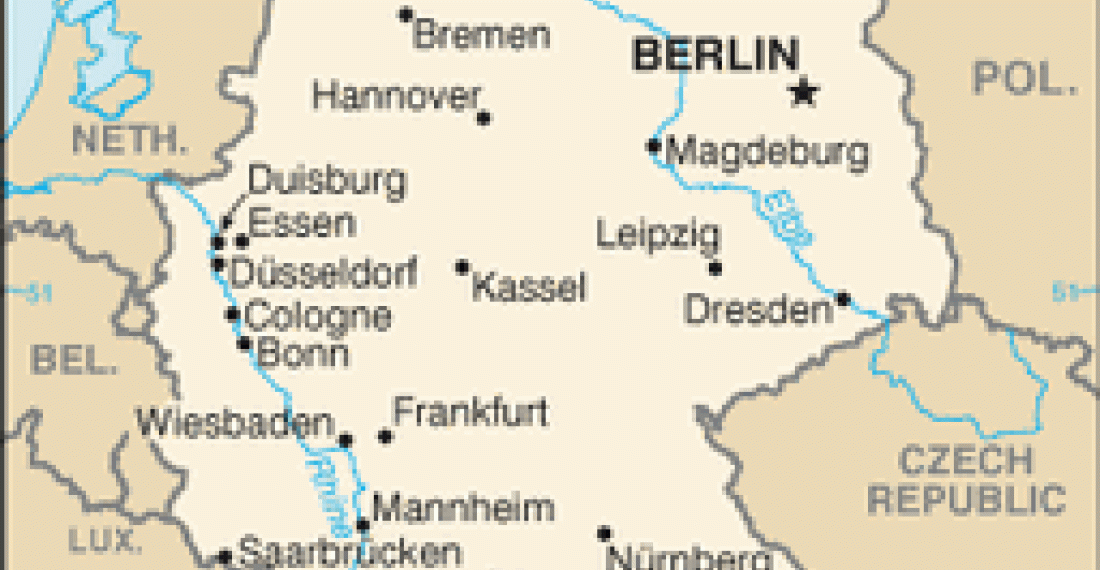
German authorities have launched a counterterrorism investigation after an airport worker discovered a drone carrying an explosive device in a restricted cargo area at Leipzig/Halle Airport late on Tuesday (August 4), prompting a temporary suspension of flight operations at one of Europe's most strategically important logistics hubs.
According to the Dresden Public Prosecutor's Office and Saxony police, the drone was found near a parked Antonov cargo aircraft operated by Ukraine. Bomb disposal specialists deployed a remotely operated robot to inspect the device before safely removing its detonator and neutralizing the threat. Officials said the detonator failed to function, preventing an explosion. German media, citing security officials, reported that the drone was discovered only a few meters from an Antonov cargo aircraft operated by Ukraine. The aircraft is part of the Antonov fleet that has been operating from Leipzig/Halle since Russia's full-scale invasion of Ukraine in 2022, after the destruction of Antonov's main base at Hostomel Airport near Kyiv.
Leipzig has since become a crucial operating hub for Antonov Airlines, including NATO's Strategic Airlift International Solution (SALIS) programme, which provides participating countries with access to Antonov transport aircraft for military logistics and heavy cargo flights. Leipzig/Halle is also used by the German armed forces and serves as DHL's largest European cargo hub, making it an important transit point for shipments linked to Ukraine.
The security alert forced Leipzig/Halle Airport to halt operations temporarily, diverting several incoming flights. During the disruption, a DHL cargo aircraft that had aborted its landing reportedly struck an unidentified object while climbing away from the airport. The aircraft landed safely in Hanover, where inspectors found damage to its nose. Authorities are investigating whether the airborne collision is connected to the drone incident.
Saxony Interior Minister Armin Schuster described the discovery as a "very serious security incident," while Germany's Interior Minister Alexander Dobrindt interrupted his vacation to travel to Leipzig for consultations with security officials. Authorities have not announced any arrests, but security services are reportedly treating the case as a suspected attempted attack.
The incident is not the first instance of sabotage targeting European infrastructure at the airport. Leipzig/Halle was previously linked to a July 2024 parcel fire involving an explosive device at a DHL facility, an attack that German intelligence later attributed to Russian operatives. Moscow denied involvement. Following the latest incident, Ukraine's ambassador to Germany, Oleksii Makeiev, suggested Russia could be responsible, though investigators have not identified any suspects and Russia's embassy in Berlin had not commented as of Wednesday (August 5) evening.
Source: commonspace.eu with International Business Times UK (London) and Politico.eu (Brussels).