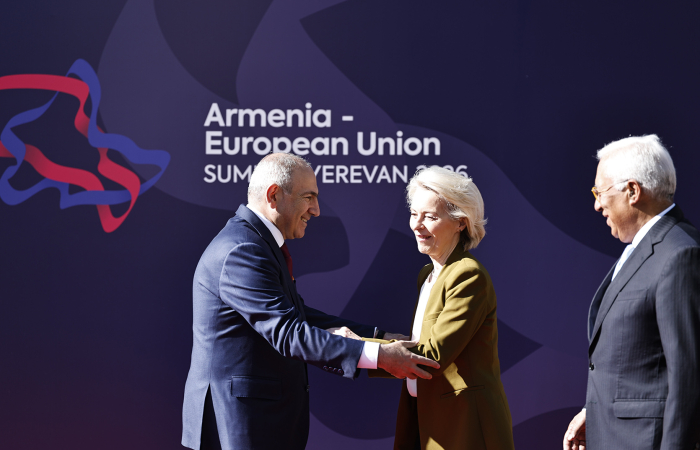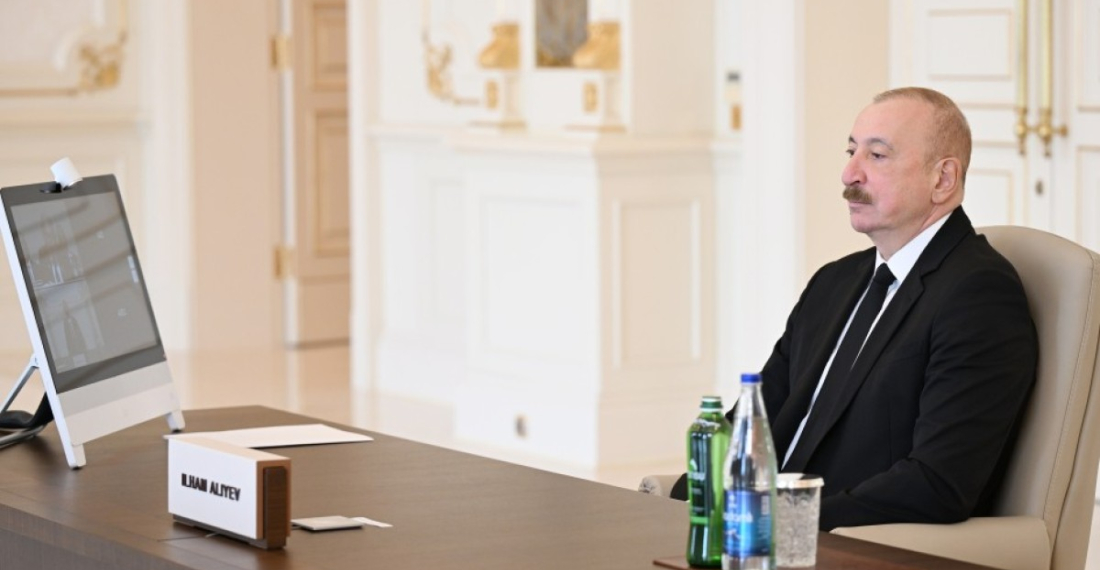
On Monday (4 May), President of Azerbaijan, Ilham Aliyev, addressed European Political Community Summit through a video link. The message echoes a strong criticism of a 30 April resolution issued by the European Parliament, which was very badly received in Baku. The EU Ambassador was summoned to the Foreign Ministry, and the Azerbaijan Parliament cut off all contacts with the European Parliament and withdrew from the Euronest programme. Find our previous reporting on the resolution here.
Here is the full-text of President Aliyev's address, as reported by the Azeri-Press Agency (APA):
Good morning and greetings from Baku. First of all, I would like to express my gratitude to President Costa for the invitation to address the eight EPC Summit.
During President Costa’s visit to Azerbaijan less than two months ago, we discussed my participation in the summit and agreed that I would join in a video format. I would also like to inform the audience that during my meeting with Mr. President Costa and President von der Leyen in Tirana a year ago, they asked for my opinion about the idea of organizing the May 2026 Summit in Armenia. I supported that. In my turn, I asked, in order to preserve a balanced approach, to hold one of the next summits in Azerbaijan. The proposal was accepted. So, I invite the members of the EPC to Azerbaijan in May 2028. By the way, Armenia also supported our candidacy. This is a clear indication that peace between Azerbaijan and Armenia is a reality. We have lived in peace for only nine months, and we are learning to live in peace.
Last August in Washington, at the White House, the leaders of Armenia and Azerbaijan signed a Joint Declaration. President Trump, as was already mentioned, also signed it as a witness. The foreign ministers of Armenia and Azerbaijan initialed the text of the peace agreement. For us—and I am sure for our Armenian partners—peace is achieved. After peace was achieved, Azerbaijan unilaterally lifted all transit restrictions imposed on Armenia at the beginning of the 1990s. To date, 28,000 tons of cargo have been delivered to Armenia through the territory of Azerbaijan. Azerbaijan went even further: we started supplying our oil products—gasoline and diesel—to Armenia for the first time, thus initiating trade relations. So far, 12,000 tons of our oil products have been exported to Armenia.
Another achievement of peace is connectivity. The Trump Route for International Peace and Prosperity will connect Azerbaijan with its exclave Nakhchivan; moreover, this route will be part of the Middle Corridor. Both Armenia and Azerbaijan already see the practical benefits of peace. Taking this opportunity, I would like to express my gratitude to the European Commission for its position on the Armenia–Azerbaijan peace process.
But unfortunately, not all European institutions demonstrate the same approach. Among them are the European Parliament and the Parliamentary Assembly of the Council of Europe (PACE). Azerbaijan has been a member of the Council of Europe since January 2001. By the way, I, as the then head of the Azerbaijani delegation and a member of parliament, was one of the active members of PACE. Our delegation was never under any restrictions in the Council of Europe until January 2024. In September 2023, Azerbaijan put an end to separatism in Garabagh. We ourselves implemented the four UN Security Council resolutions adopted in 1993, which remained on paper for 30 years. Four months after that, PACE imposed sanctions on our delegation. Unfortunately, double standards are today a kind of modus operandi for PACE. Azerbaijan’s territorial integrity has the same value as that of any other country. And in this issue, double standards are unacceptable.
Now, regarding the European Parliament, this body, instead of supporting the peace process, prefers to sabotage it. Since May 2021, six months after the end of the Second Garabagh War, until April 30, 2026, the European Parliament has adopted 14 resolutions full of insults and lies about Azerbaijan. Just imagine—14 resolutions in five years is a kind of obsession. The last one was adopted only four days ago, deliberately right before the summit. Instead of addressing fundamental problems of some member states, such as xenophobia, Islamophobia, antisemitism, migration, competitiveness, and homelessness, the European Parliament targets Azerbaijan, spreading slander and lies. And the reason is that Azerbaijan restored its territorial integrity and sovereignty, put an end to separatism, and brought war criminals to justice. In response, the Parliament of Azerbaijan on May 1st decided to officially suspend cooperation with the European Parliament in all areas, cease participation in the activities of the EU–Azerbaijan Parliamentary Cooperation Committee, and initiate procedures for the termination of membership in the Euronest Parliamentary Assembly. Taking into account that during EPC summits we openly exchange our views and concerns, I just wanted to inform our colleagues about what is happening in this respect so that there will be no misinformation or manipulation following this decision.
In conclusion, I would like to congratulate Prime Minister Pashinyan on the EPC Summit in Armenia and say that, despite all the efforts of those who want to hinder the process, Azerbaijan is committed to the peace agenda, and the remarks of my Armenian colleague clearly demonstrate that. I wish the summit success. Thank you.
Source: commonspace.eu with the Public Radio of Armenia and the Azeri-Press Agency (APA)