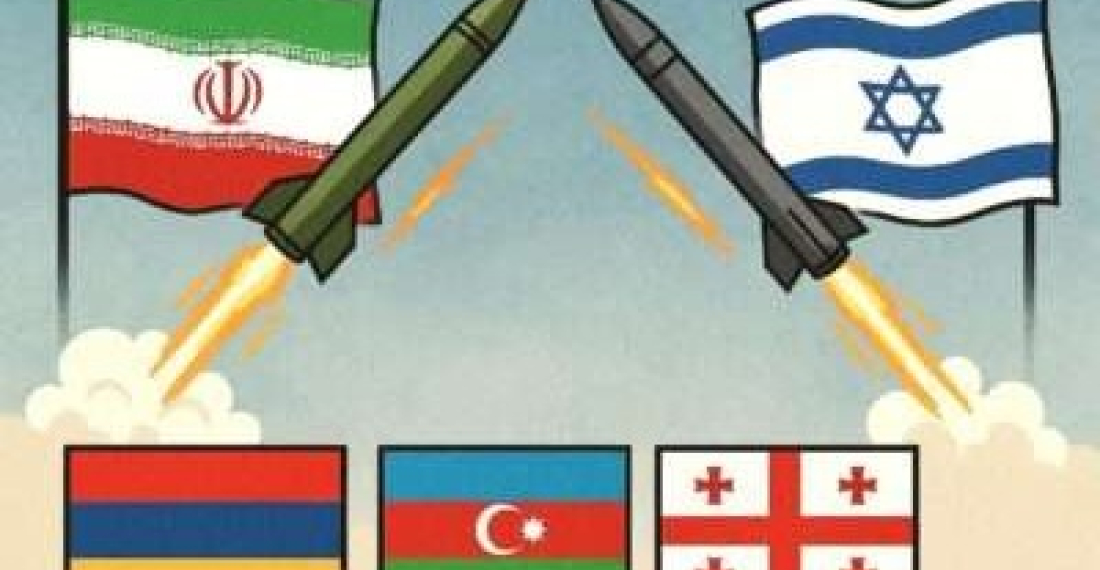
On 28 February, Israel and the United States launched strikes against Iran, to which Iran responded with retaliatory strikes against Israel and US military facilities in neighbouring countries. This has engulfed much of the Middle East in conflict, with Saudi Arabia, Kuwait, Bahrain, UAE, Qatar, and Oman reporting Iranian missile strikes. Iran’s key strategic position between West Asia, linking the Gulf, the Levant, Central Asia, and the Indian Ocean, effectively means that the conflict has a global impact on power balances, energy markets, oil prices, nuclear diplomacy, trade, and transit routes. Some of these effects will probably dial down if a ceasefire is achieved in the region; however, most effects will leave a mark on the international community in the years to come.
When it comes to the South Caucasus, the war in Iran has affected both the relatively fragile security environment in the region and the broader geopolitical and economic stability.
The effects of the Middle East war on Azerbaijan:
Azerbaijan, which shares a long border with Iran and has close historical and religious ties with its neighbour, has been directly affected by the conflict. On Thursday (5 March), a drone struck the passenger terminal of Azerbaijan’s Nakhchivan International Airport, while a second fell near a school in the village of Shakarabad in the Babek district during class hours. Four civilians were reportedly injured.
Heated discussions followed, with Azerbaijan’s President Ilham Aliyev condemning the attack as an “act of terror” and announcing on Friday (6 March) that staff from Azerbaijan’s embassy in Tehran and its consulate in Tabriz would be withdrawn. Iran responded that it was not behind the attack and that further investigations would be conducted. This has reduced some of the tensions with Azerbaijan, which dispatched humanitarian aid to Tehran on Tuesday (10 March). However, while some of the tensions have eased, relations between Baku and Tehran remain tense.
Könül Khalilova argues in an article for the BBC that “Iran is home to an estimated 20-25 million ethnic Azeris, who make up its largest minority group and are concentrated in the north-west along the Azerbaijan border.” One concern is that if the conflict continues to escalate, pressure will increase along the border as people attempt to flee the war. In addition, the ethnic Azeri minority continues to play an important role in Iran, a subject that has long been sensitive in relations between Tehran and Baku, with Iranian authorities often concerned about the potential implications for the country’s internal stability. Shortly after the drone crash, President Aliyev made a comment that got the Islamic Republic thinking: “The independent Azerbaijani state today is a source of hope for many Azerbaijanis in Iran”. Könül Khalilova argues that such a statement sent a message: “Any attempt to pressure Azerbaijan militarily or diplomatically could result in a response from Baku, including one that affects Iran’s internal stability.” While tensions have subsided with Tehran conducting investigations regarding the attack, Baku will keep a close eye on the situation.
Regarding the economic impacts of the war, Vugar Bayramov, a member of the Milli Majlis, argues that Azerbaijan is likely to be only minimally affected, as Iran accounts for around 1.3% of Azerbaijan’s foreign trade turnover, making it a relatively small trading partner. Azerbaijan also maintains a negative trade balance with Iran, meaning it imports more from Iran than it exports. The war could therefore disrupt some imports from Iran, but the impact on Azerbaijan’s exports is expected to be minimal. Moreover, the effect on imports is also likely to remain limited, as Azerbaijan can diversify its supply from other countries.
The effects of the Middle East war on Armenia:
Armenia also shares a border with Iran and faces a similar risk from debris or misfired drones. While this has not happened, the risk cannot be excluded. According to The Armenian Weekly, Armenia faces immediate strategic challenges arising from the war in the Middle East, including potential disruptions to energy transit routes, border management pressures, economic connectivity, external geopolitical pressures, and possible migration risks.
Ivan Tchakarov, an analyst at GlobalSource, finds that “Armenia conducts about 14.8% of its total trade turnover with Iran, the Gulf countries and Israel combined, making it the most exposed among the three economies [Armenia, Georgia, Azerbaijan]”. In addition, Armenia heavily relies on transit routes through Iran to reach external markets. In fact, up to 25% of Armenia’s foreign trade passes through Iranian territory. While Iran’s ambassador to Armenia said on Monday (9 March) that economic cooperation continues despite the war, trade analysts believe that prolonged conflict could affect supply chains and imports.
The effects of the Middle East war in Georgia:
Georgia does not share a border with Iran; however, in recent years, Georgia Dream has grown closer to the Islamic Republic, especially after it began distancing itself from the European Union.
Georgia plays an important role in regional transit corridors and energy infrastructure. The Baku–Tbilisi–Ceyhan (BTC) pipeline runs from Azerbaijan’s Caspian Sea oil fields through Georgia to Turkey’s Mediterranean port of Ceyhan and is one of the most important energy corridors linking the Caspian region to global markets. Israel is a big beneficiary of this pipeline, with a significant share of its crude oil being transported through it.
On Tuesday (10 March), an adviser to the commander of Iran’s Islamic Revolutionary Guard Corps (IRGC) hinted at targeting oil pipelines that support states that are considered by the Islamic Republic the “enemy”. Georgia Today reported on Thursday (5 March) that a potential attack on the BTC pipeline “would have serious implications not only for Israel’s energy security but also for regional stability and global oil markets”. For Georgia, the BTC pipeline is an important project, and any attempt to strike the pipeline would have an effect on the economy of the country, but also its relations with Iran, which Tbilisi increasingly regards as a partner as its relations with the West have cooled.
All in all, the three countries in the South Caucasus will inevitably be affected by the spillover effects of the war in the Middle East. Some have already been affected, and some will have to find ingenious ways to mitigate potential economic challenges. However, this may also offer an opportunity for the South Caucasus. The three countries could coordinate arrangements regarding trade and energy to at least decrease economic hardships.
Source: This briefing was first published on Caucasus Concise on 12 March 2026