The South Caucasus managed the geopolitical rivalries surrounding it remarkably well in 2025. Despite intensifying global competition and conflicts raging beyond its borders, the region avoided major military escalation and even made notable progress toward stability. For the first time in more than three decades, there were no deadly interstate clashes among the three South Caucasus countries. Instead, pragmatic diplomacy, economic connectivity projects, and cautious foreign policies helped prevent regional tensions from spiraling into violence.
Yet only a few months later, this fragile stability is now under serious strain as the region finds itself geographically caught between two most dangerous conflicts in the world. To the north, the war between Russia and Ukraine continues with no clear political settlement in sight. To the south, the confrontation between Iran and Israel and the United States, has intensified through missile strikes, drone warfare, and retaliatory operations that risk expanding into a broader regional war. Together, these two conflicts are reshaping the security environment surrounding the South Caucasus.
Recent developments between Iran and Azerbaijan illustrate how quickly tensions from the southern front can spill into the region. On March 5, Iranian-made Arash-2 drones struck targets in Azerbaijan’s Nakhchivan Autonomous Republic, hitting the international airport and crashing near a secondary school during class hours. Azerbaijani authorities described the incident as a terrorist attack and stated that the drones were launched from Iranian territory, while Tehran denied responsibility and announced an investigation. The episode marks one of the most serious security incidents between the two neighbors in recent years and raises the risk that the expanding Middle Eastern conflict could open a new front to the north.
The attack also occurred against the backdrop of already strained relations between Baku and Tehran. Azerbaijan has repeatedly stressed that its territory will not be used by any country to launch attacks against Iran, a position reiterated by Azerbaijani officials only days before the incident. Nevertheless, Iranian officials and media outlets affiliated with the Islamic Revolutionary Guard Corps (IRGC) have increasingly accused Azerbaijan of indirectly supporting Israel, pointing in particular to alleged use of Azerbaijan’s airspace by the Israeli drones during the 12-day war in June 2025. Such narratives have gradually shifted from rhetorical accusations to arguments that could justify more confrontational policies toward Azerbaijan.
The roots of mistrust between the two countries are multilayered. Iran has been always critical of Azerbaijan’s close relations with Israel. Tehran has also been concerned by the potential implications of Azerbaijan’s rise as a prosperous and independent state for the situation concerning its ethnic Azerbaijani minority. After the Second Karabakh War in 2020, these tensions rose to the unprecedented levels with escalatory military exercises and sharp rhetoric along the border. The 2023 terrorist attack against Azerbaijan’s embassy in Tehran – an incident Baku has long believed involved Iranian security structures – further deepened suspicions. Although both governments attempted to repair relations afterward, the latest drone strike has dealt a serious blow to that fragile rapprochement.
Iran’s political leadership has sought to calm bilateral tensions by stressing that the Nakhchivan drone incident was not a deliberate act by Tehran. In a phone call with Azerbaijani President Ilham Aliyev, Iranian President Masoud Pezeshkian insisted that the incident “had no connection with Iran” and pledged to investigate the matter, while acknowledging the importance of closely examining how it occurred before drawing conclusions. Iranian Foreign Minister Seyed Abbas Araghchi similarly conveyed concern to his Azerbaijani counterpart Jeyhun Bayramov and noted that Tehran and its military authorities had launched a probe into the episode.
These engagements reflect official assurances that Iran does not seek conflict with its northern neighbor and has no policy of waging war against Azerbaijan. Yet this rhetoric sits uneasily alongside the growing role of the Islamic Revolutionary Guard Corps (IRGC) and other hardline elements in Iran’s security apparatus. As commanders with substantial autonomy have acquired greater operational influence under Iran’s decentralized defense structures, the ability of political leaders to restrain military actors has become more uncertain. This gap between official diplomatic messaging and the behavior of empowered regional forces contradicts Tehran’s assurances and complicates efforts to defuse tensions. Threats expressed by these radical groups against Azerbaijan following the Nakhchivan drone strike underscore the ongoing risk that the tensions could spiral into broader escalation.
Thus, while Azerbaijan currently stands at the epicenter of these tensions, the broader regional implications extend to its neighbors as well. Armenia and Georgia face their own set of challenges as the geopolitical environment around them grows more volatile. Armenia shares a direct border with Iran and maintains important economic and energy ties with Tehran. Georgia, meanwhile, plays a central role in regional transit corridors and energy infrastructure linking the Caspian basin with European markets. Prolonged instability could place both countries in a difficult position, forcing them to navigate competing pressures while trying to preserve economic stability and diplomatic balance.
Ultimately, the South Caucasus now finds itself in an increasingly precarious position. With war continuing to the north and a widening confrontation unfolding to the south, the region is no longer merely adjacent to global conflicts; it is geographically wedged between them. However, the reassuring messages delivered by Iranian leaders to the Azerbaijani side during their recent telephone conversations offer hope that the situation will remain under control, provided that the military (i.e., the IRGC) remains firmly under the authority of the political leadership in Tehran.
source: This op-ed was prepared for commonspace.eu by Dr Vasif Huseynov, a Senior Advisor at the Center of Analysis of International Relations (AIR Center) and Adjunct Lecturer at Khazar University in Baku, Azerbaijan.
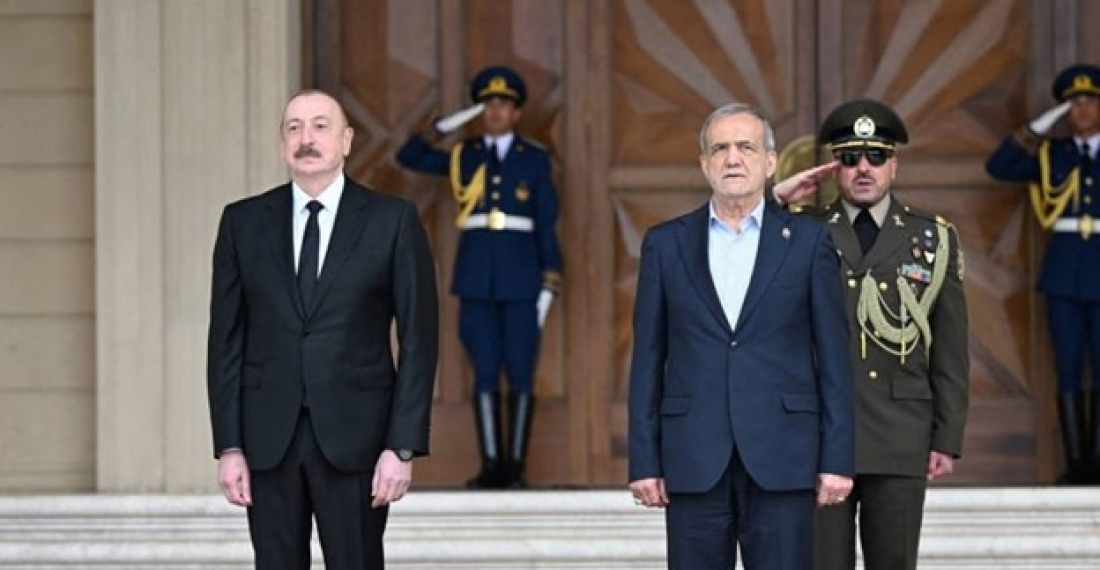
photo: Iranian president Masoud Pezeshkian with president Ilham Aliyev of Azerbaijan during a recent visit to Baku