


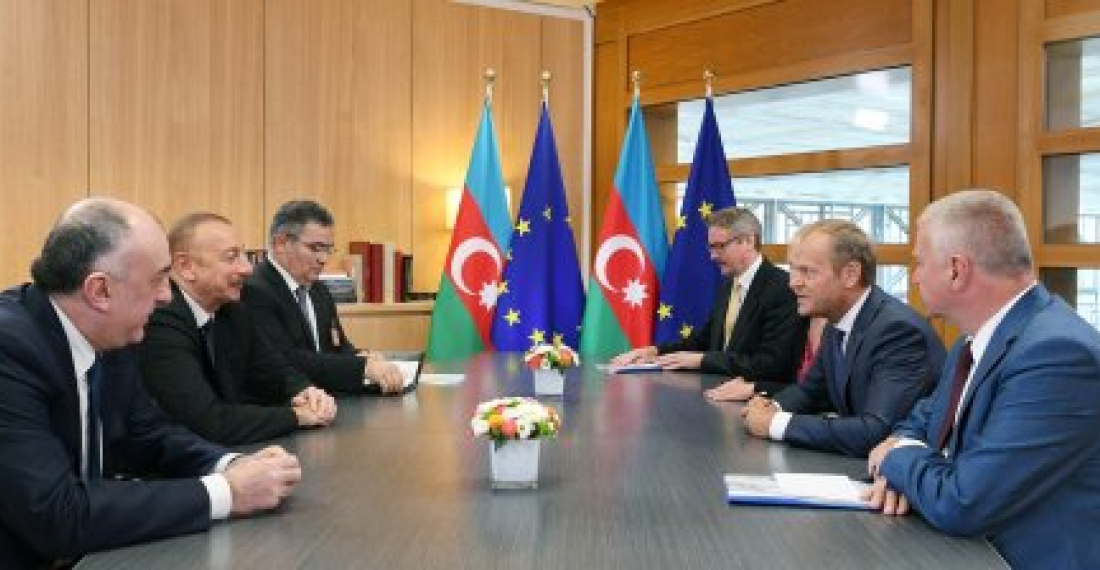
Алиев провел переговоры с официальными лицами ЕС в Брюсселе

Президент Азербайджана Ильхам Алиев провел переговоры с высшим руководством Европейского Союза в Брюсселе. В среду (11 июля) Алиев встретился с Президентом Европейского Совета Дональдом Туском.

Позднее президент Алиев и президент Туск присутствовали на завершении переговоров по приоритетам партнерства между ЕС и Азербайджаном между Верховным представителем Европейского Союза по иностранным делам и политике безопасности / вице-президентом Европейской комиссии Федерикой Могерини и главой МИД Азербайджана Эльмаром Мамедъяровым.

В заявлении Европейской службы внешних действий говорится, что приоритеты партнерства представляют собой важный шаг в отношениях между ЕС и Азербайджаном, поскольку они определяют общие приоритеты политики, которые будут определять и укреплять партнерство в ближайшие годы. Сохраняя верность принципу дифференциации отношений ЕС со странами в своем восточном районе, четыре основных направления сотрудничества в рамках приоритетов партнерства отражают те, которые определены в рамках «Восточного партнерства», а именно:

Укрепление институтов и благое гос-управление; Это включает в себя борьбу с коррупцией, реформу государственного управления и создание потенциала для борьбы с преступностью и терроризмом;

Экономическое развитие и рыночные возможности; Это включает в себя устойчивую диверсификацию экономики, поддержку членства в ВТО и улучшение деловой и инвестиционной среды;

Связность, энергоэффективность, окружающая среда и климатические действия; Основываясь на успешном сотрудничестве в области энергетики и значительном прогрессе, достигнутом в Южном газовом коридоре, это включает поддержку способности Азербайджана функционировать как торговый, логистический и транспортный узел, нормативная помощь, устойчивое управление ресурсами;

Мобильность и контакты между людьми; Это включает в себя поддержку образования и человеческого капитала и предоставление больших возможностей для граждан ЕС и Азербайджана встретиться и поделиться опытом.

"Приоритеты партнерства также будут служить основой для нашего финансового сотрудничества на 2018-2020 годы", - говорится в заявлении. "В рамках приоритетов партнерства ЕС и Азербайджан подтверждают свою приверженность амбициозной и всеобъемлющей повестке дня. В повестке дня будут отражены ценности и принципы Политики европейского соседства, включая соблюдение прав человека, демократию, верховенство закона и диалог с гражданским обществом. Наряду с продолжающимися переговорами о новом двустороннем соглашении заключение приоритетов партнерства свидетельствует о явном намерении укрепить отношения между ЕС и Азербайджаном, чтобы принести позитивные результаты на благо народа Азербайджана и Европейского Союза. Приоритеты партнерства теперь будут официально одобрены Европейским Союзом и Азербайджаном, и затем уже будут приняты".

источник: commonspace.eu по материалам пресс-службы Европейской службы внешних действий

фото: Президент Азербайджана Ильхам Алиев в ходе встречи с Президентом Европейского Совета Дональдом Туском в Брюсселе, 11 июля 2018 года (фото предоставлено пресс-службой президента Азербайджана).
Related articles

Editor's choice
News
Borrell tells the European Parliament that the situation in Afghanistan was critical, but the EU will remain engaged

Borrell tells the European Parliament that the situation in Afghanistan was critical, but the EU will remain engaged

Borrell underlined that the European Union will make every effort to support the peace process and to remain a committed partner to the Afghan people. "Of course, we will have to take into account the evolving situation, but disengagement is not an option.  We are clear on that: there is no alternative to a negotiated political settlement, through inclusive peace talks.
Editor's choice
News
Germany accuses Russia of cyberattacks and disinformation campaign

Germany accuses Russia of cyberattacks and disinformation campaign

The German government holds Russia responsible for a cyberattack on German air traffic control, and for targeted disinformation campaigns before the last federal election. According to the German Foreign Office in Berlin, the incidents could be clearly attributed to the Russian military intelligence service, the GRU. In response, the Russian ambassador to Berlin was summoned to the Foreign Ministry. "We have been observing a massive increase in threatening hybrid activities by Russia for some time now," a spokesperson for the Foreign Ministry stated. These range from disinformation campaigns and espionage to cyberattacks and sabotage attempts. The aim is to divide society, sow distrust, and undermine confidence in democratic institutions. The spokesperson added that with these actions, Russia is "very concretely threatening our security, not only through its war of aggression against Ukraine, but also here in Germany."  The Foreign Ministry spokesperson explained that the cyberattack on air traffic control in August 2024 was clearly attributed to the hacker collective "APT28," known as "Fancy Bear," and to the responsibility of the Russian military intelligence service, the GRU. Furthermore, it could now be "conclusively stated" that Russia had attempted "to influence and destabilize both the last Federal election and the ongoing internal affairs of the Federal Republic of Germany." There was "absolutely irrefutable evidence" for this". The so-called "Storm 1516" campaign, which has been running since 2024, is allegedly backed by "reliable information" that the Moscow-based think tank "Center for Geopolitical Expertise" is behind it. The Center is also said to be supported by Russian military intelligence. Its primary aim is to influence democratic elections in the West. (Click the image to read more).

Popular

Editor's choice
News
Germany accuses Russia of cyberattacks and disinformation campaign

Germany accuses Russia of cyberattacks and disinformation campaign

The German government holds Russia responsible for a cyberattack on German air traffic control, and for targeted disinformation campaigns before the last federal election. According to the German Foreign Office in Berlin, the incidents could be clearly attributed to the Russian military intelligence service, the GRU. In response, the Russian ambassador to Berlin was summoned to the Foreign Ministry. "We have been observing a massive increase in threatening hybrid activities by Russia for some time now," a spokesperson for the Foreign Ministry stated. These range from disinformation campaigns and espionage to cyberattacks and sabotage attempts. The aim is to divide society, sow distrust, and undermine confidence in democratic institutions. The spokesperson added that with these actions, Russia is "very concretely threatening our security, not only through its war of aggression against Ukraine, but also here in Germany."  The Foreign Ministry spokesperson explained that the cyberattack on air traffic control in August 2024 was clearly attributed to the hacker collective "APT28," known as "Fancy Bear," and to the responsibility of the Russian military intelligence service, the GRU. Furthermore, it could now be "conclusively stated" that Russia had attempted "to influence and destabilize both the last Federal election and the ongoing internal affairs of the Federal Republic of Germany." There was "absolutely irrefutable evidence" for this". The so-called "Storm 1516" campaign, which has been running since 2024, is allegedly backed by "reliable information" that the Moscow-based think tank "Center for Geopolitical Expertise" is behind it. The Center is also said to be supported by Russian military intelligence. Its primary aim is to influence democratic elections in the West. (Click the image to read more).

