The days when Armenia was considered an outpost of Russia are long gone.
Prime Minister Nikol Pashinyan has sought new relations with both the European Union and the United States. Relations with Brussels have peaked to new heights, with even talk of EU membership. And no lobbying by the powerful Armenian diaspora in the US could achieve that historical moment on 8 August in the White House, when Pashinyan and Azerbaijani president Aliyev, not only set the stage for peace between their two countries, but also opened the way for a new relationship with the United States.
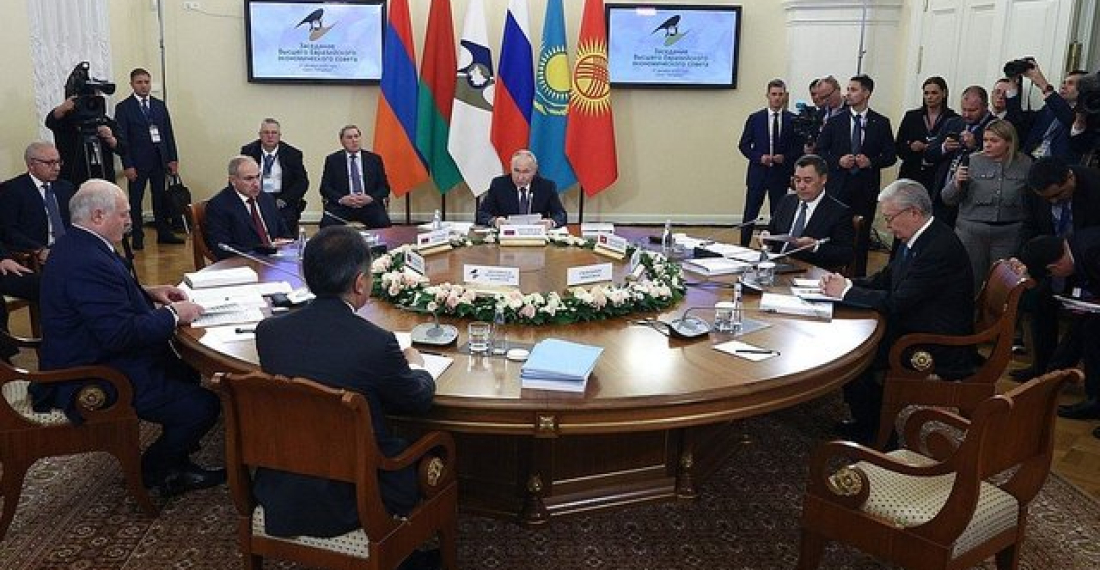
But Pashinyan has been able to do all this whilst at the same time keeping the relations with Russia warm. Armenia remains an active member of the Russia-led Eurasian Economic Union (EAEU). In December, Pashinyan participated in Eurasian Economic Union (EAEU) meetings in Moscow and St. Petersburg.
Johnny Melikyan, Senior Research Fellow at the Orbeli Centre in Yerevan summed up the visit this way:
The recent December 2025 visits of Armenian Prime Minister Nikol Pashinyan to Russia highlighted a practical and interest-based stage in Armenian–Russian relations. Rather than symbolism, the agenda was dominated by concrete issues of economic cooperation, connectivity, trade, and participation in Eurasian integration formats.
This is Johnny Melikyan's comment in full.
In December, PM Pashinyan participated in Eurasian Economic Union (EAEU) meetings in Moscow and St. Petersburg. He joined sessions of the Eurasian Intergovernmental Council and the Supreme Eurasian Economic Council, emphasizing balanced integration, respect for sovereignty, digitalization, services, and trade diversification. Pashinyan highlighted expanding EAEU ties with global partners, welcomed regional transport progress, and reaffirmed commitment to constructive, mutually beneficial cooperation. He also took part in the informal CIS leaders’ summit discussing strengthening cooperation among members.
The recent December 2025 visits of Armenian Prime Minister Nikol Pashinyan to Russia highlighted a practical and interest-based stage in Armenian–Russian relations. Rather than symbolism, the agenda was dominated by concrete issues of economic cooperation, connectivity, trade, and participation in Eurasian integration formats.
During the meeting with President Vladimir Putin in St. Petersburg, particular attention was paid to the restoration and development of transport communications, including rail links and broader regional connectivity. Both sides showed readiness to focus on workable solutions that expand Armenia’s access to markets, reduce logistical costs, and promote greater predictability in the South Caucasus. These discussions also reflected a shared understanding that economic interdependence and functioning infrastructure are key to long-term stability.
Equally important were the multilateral meetings within the framework of the Eurasian Economic Union. Armenia continues to be an active member of the EAEU, using this platform to deepen trade, energy, industrial, and digital cooperation. Eurasian Union remains one of Armenia’s main export destinations and investment channels, and active participation in its activities allows Yerevan to defend national economic interests and promote mutually beneficial initiatives. Discussions on removing internal barriers, improving transport corridors, and coordinating macroeconomic policy are of direct practical relevance for Armenian businesses and workers.
Overall, the December visits underline that Armenia and Russia retain a broad agenda of strategic partnership, laying on pragmatic cooperation. Despite existing disagreements in some areas, both sides are interested in maintaining working dialogue, expanding mutually advantageous economic projects, and using the EAEU mechanisms to support growth and connectivity.
Source: Johnny Melikyan is Senior Research Fellow at the Orbell Centre in Yerevan
photo: The leaders of the EAEU states at their meeting on 21 December 2025 (picture courtesy of the press service of the president of Russia).