


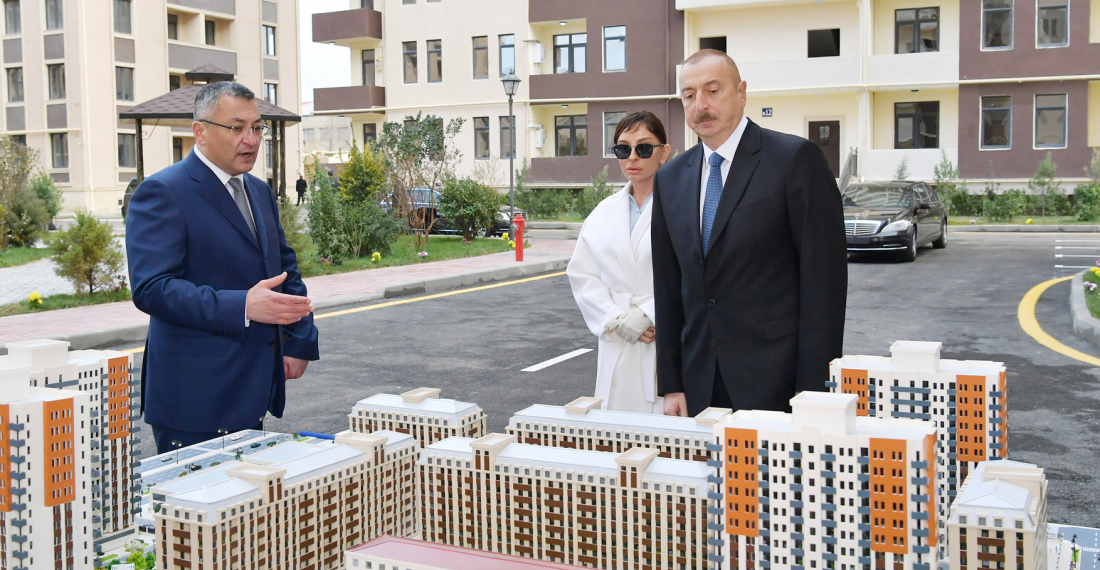
Азербайджан строит новый жилой квартал для беженцев и вынужденных переселенцев в Сумгаите

Азербайджан продолжает предпринимать шаги для решения проблем большого числа беженцев и внутренне перемещенных лиц (ВПЛ). В четверг (27 декабря) президент Ильхам Алиев открыл новый жилой квартал в городе Сумгаит, недалеко от столицы Баку.

Строительство комплекса, в котором будут размещены 1005 семей беженцев и вынужденных переселенцев, началось в марте 2017 года. В комплексе площадью 4 га построенно 12 зданий, в том числе четыре восьмиэтажных здания и четыре 15-этажных здания. В квартал также входят школы, детские сады, игровой зал, полицейские участки и другие необходимые объекты инфраструктуры.

Согласно информации, размещенной на сайте президента Азербайджана, все квартиры полностью меблированы и оснащены кухонной мебелью и подключены к централизованной сети Интернет и телевидения. Среди 1005 квартир в комплексе 167 это однокомнатные квартиры, 536 двухкомнатные и 302 с тремя спальнями и четырьмя спальнями.

Председатель Государственного комитета по делам беженцев и вынужденных переселенцев Ровшан Рзаев ознакомил президента Алиева и его жену с недавно построенным комплексом.

Сотни тысяч азербайджанцев были перемещены в 1990-х годах в результате конфликта в Нагорном Карабахе и вокруг него. Изначально они жили в ужасных условиях в Баку и других частях страны, но правительство за последнее десятилетие потратило значительные суммы денег, чтобы обеспечить беженцам и вынужденным переселенцам надлежащим жильем. Позиция правительства Азербайджана заключается в том, что предоставляемое им жилье носит временный характер, и что конечная цель беженцев и вынужденных переселенцев - вернуться в места, откуда они были перемещены в результате конфликта.

источник: commonspace.eu

фото: в Сумгаите, Азербайджан, председатель Государственного комитета по делам беженцев и вынужденных переселенцев Ровшан Рзаев ознакомил президента Алиева и его жену с недавно построенным комплексом для беженцев и вынужденных переселенцев, 27 декабря 2018 года.
 

Related articles

Editor's choice
News
The British prime minister says Europe must "stand on its own two feet" when it comes to defence

The British prime minister says Europe must "stand on its own two feet" when it comes to defence

The UK will deploy a carrier strike group, led by the aircraft carrier HMS Prince of Wales to the Arctic and the High North as part of efforts to bolster security against Russian threats. British prime minister, Sir Keir Starmer announced the deployment in a speech on Saturday (14 February) at the Munich Security Conference. Europe must be ready to fight to protect its people, values, and way of life,  Sir Keir told the Conference. Starmer also called for deeper links and cooperation, including economic ties, between the UK and EU. The PM stressed the continent must "stand on its own two feet" when it comes to defence commitments. "We must build our hard power, because that is the currency of the age," he told the conference. (Click image to read the full story).

Popular

Editor's choice
Interview
Thursday Interview: Murad Muradov

Thursday Interview: Murad Muradov

Today, commonspace.eu starts a new regular weekly series. THURSDAY INTERVIEW, conducted by Lauri Nikulainen, will host  persons who are thinkers, opinion shapers, and implementors in their countries and spheres. We start the series with an interview with Murad Muradov, a leading person in Azerbaijan's think tank community. He is also the first co-chair of the Action Committee for a new Armenian-Azerbaijani Dialogue. Last September he made history by being the first Azerbaijani civil society activist to visit Armenia after the 44 day war, and the start of the peace process. Speaking about this visit Murad Muradov said: "My experience was largely positive. My negative expectations luckily didn’t play out. The discussions were respectful, the panel format bringing together experts from Armenia, Azerbaijan, and Turkey was particularly valuable during the NATO Rose-Roth Seminar in Yerevan, and media coverage, while varied in tone, remained largely constructive. Some media outlets though attempted to represent me as more of a government mouthpiece than an independent expert, which was totally misleading.  Overall, I see these initiatives as important steps in rebuilding trust and normalising professional engagement. The fact that soon a larger Azerbaijani civil society visits to Armenia followed, reinforces the sense that this process is moving in the right direction." (click the image to read the interview in full)

