


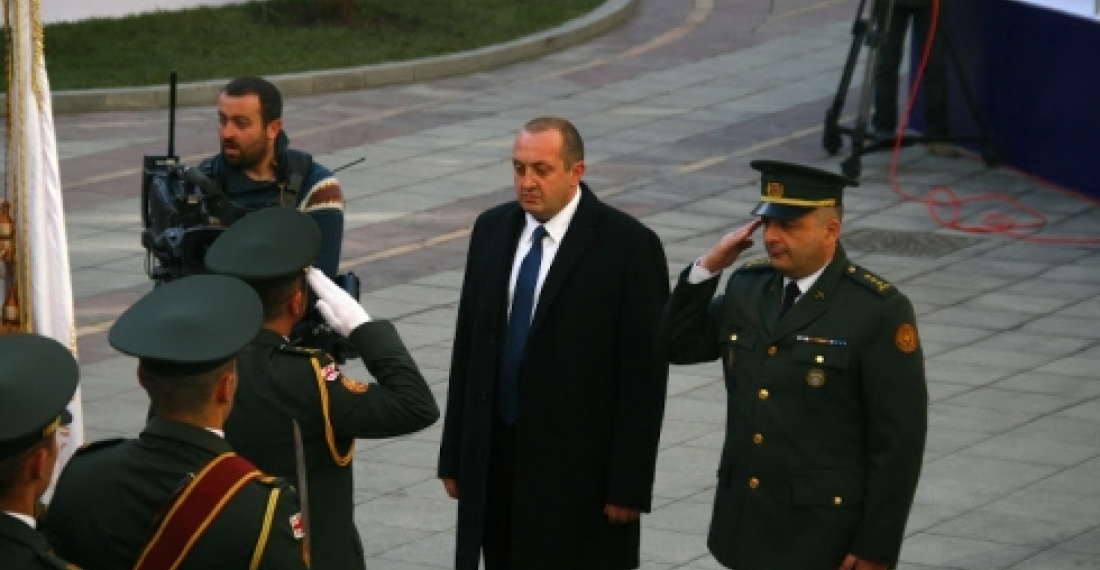
Маргвелашвили в своей инаугурационной речи смешивает прагматизм с романтикой.

Георгий Маргвелашвили сегодня был приведен к присяге в качестве четвертого президента Грузии на церемонии, которая состоялась во дворе здания парламента в Тбилиси. Церемония стала заключительным актом долгого и нередко напряженного процесса перехода власти от Михаила Саакашвили и его Единого национального движения к новому правительству во главе с коалицией Грузинская Мечта. Архитектор всего этого процесса, премьер-министр Бидзина Иванишвили также присутствовал на церемонии инаугурации нового президента, которого он предложил общественности, и кто впоследствии был избран на президентских выборах в октябре. Эти выборы рассматриваются международными наблюдателями как лучшие из когда-либо прошедших на Южном Кавказе за последние два десятилетия.

После приведения к присяге Маргвелашвили обратился к собравшимся высокопоставленным лицам, в том числе представителям многих иностранных государств. Его речь была смесью прагматичной политики с романтикой, ссылаясь на богатую историю Грузии и ее культуру.

Маргвелашвили обратился к сепаратистским образованиям Абхазии и Южной Осетии и призвал их объединиться с Грузией в создании современного и демократического государства. Он напомнил о стратегическом партнерстве Грузии с Соединенными Штатами и о Соглашение об ассоциации с Европейским Союзом.

Маргвелашвили также подчеркнул региональную роль Грузии. Он заявил:

"У Грузии миссия исторической значимости, стать центром для сотрудничества, диалога и согласия между Европой и Азией.

Вот почему мы приписываем специальное значение развитию отношений со странами Черного и Каспийского морей и Центральной Азии, содействуем транснациональным проектам в сотрудничестве с этими странами, а также обеспечиваем мир и экономическое развитие в регионе.

Хорошо сбалансированная региональная политика Грузии должна служить объединительным интересам на Кавказе. Это имеет жизненно важное значение для дальнейших экономических и дипломатических отношений с соседней Арменией, Азербайджаном и Турцией.

Несмотря на сложную ситуацию, с который мы столкнулись сегодня и параллельную интеграцию в европейские и евро-атлантические структуры, мы подтверждаем нашу приверженность к дальнейшему диалогу с Россией и укреплению доверия на пути решения проблем, существующих сегодня. Этот диалог будет строиться с строгим соблюдением национальных интересов Грузии, то есть уважение к нашим международно признанным границам и принцип территориальной целостности и суверенитета".

Источник: commonspace.eu

Фото: Президент Маргвелашвили с поочетным военным караулом до его приведения к присяге в качестве президента Грузии, Тбилиси 18 ноября 2013 года.
Related articles

Editor's choice
News
European leaders outline position on current situation in the Middle East

European leaders outline position on current situation in the Middle East

The leaders of the 27 member states of the European Union met in Brussels on Thursday, 19 March 2026, to discuss the current global situation, and, in particular, the crisis in the Gulf, and the wider Middle East. EU leaders adopted conclusions on Ukraine, the Middle East, competitiveness and the single market, European defence and security, migration, multilateralism, strengthening Europe's democratic resilience, protecting children online, the EU's eastern regions and Dniester river. The leaders also met UN Secretary-General António Guterres to discuss the geopolitical situation and multilateralism. In their decision the EU leaders said, "Developments in Iran and the wider region threaten regional and global security. The European Council calls for de-escalation and maximum restraint, the protection of civilians and civilian infrastructure and full respect of international law by all parties, including the principles of the United Nations Charter and international humanitarian law. In this regard, it calls for a moratorium on strikes against energy and water facilities." The statement adds, "The European Union will continue to protect its security and interests, working with regional and global partners to counter the impact of the ongoing hostilities. The European Union and its Member States are taking all necessary steps to ensure the safety of EU citizens in the region, including by providing conditions for their safe departure." (Click the image above to read more).

Popular

Editor's choice
Interview
Thursday Interview: Murad Muradov

Thursday Interview: Murad Muradov

Today, commonspace.eu starts a new regular weekly series. THURSDAY INTERVIEW, conducted by Lauri Nikulainen, will host  persons who are thinkers, opinion shapers, and implementors in their countries and spheres. We start the series with an interview with Murad Muradov, a leading person in Azerbaijan's think tank community. He is also the first co-chair of the Action Committee for a new Armenian-Azerbaijani Dialogue. Last September he made history by being the first Azerbaijani civil society activist to visit Armenia after the 44 day war, and the start of the peace process. Speaking about this visit Murad Muradov said: "My experience was largely positive. My negative expectations luckily didn’t play out. The discussions were respectful, the panel format bringing together experts from Armenia, Azerbaijan, and Turkey was particularly valuable during the NATO Rose-Roth Seminar in Yerevan, and media coverage, while varied in tone, remained largely constructive. Some media outlets though attempted to represent me as more of a government mouthpiece than an independent expert, which was totally misleading.  Overall, I see these initiatives as important steps in rebuilding trust and normalising professional engagement. The fact that soon a larger Azerbaijani civil society visits to Armenia followed, reinforces the sense that this process is moving in the right direction." (click the image to read the interview in full)

