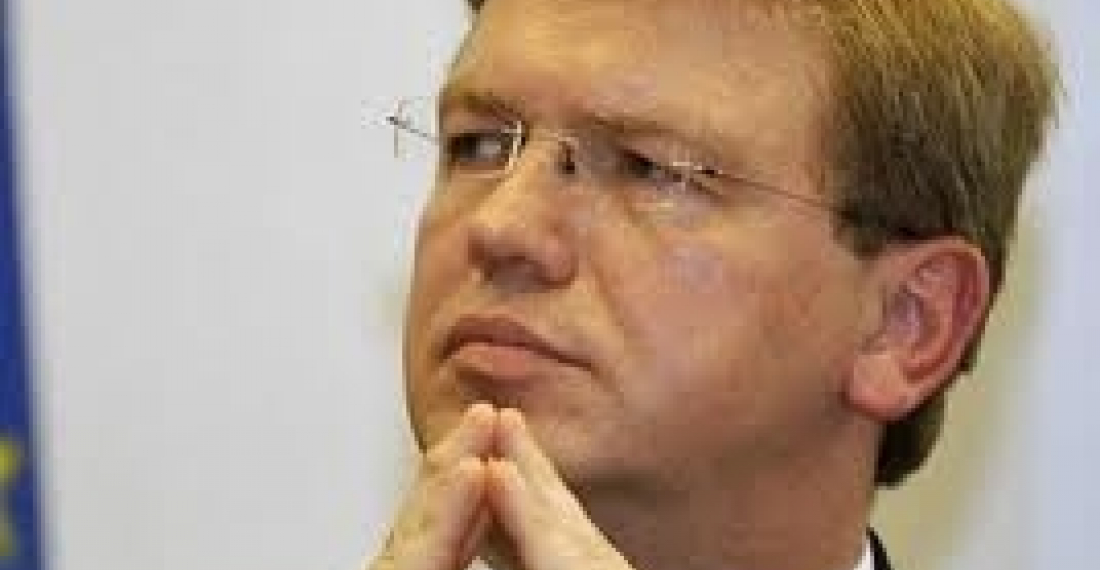
Штефан Фюле:

Евросоюз стремится усилить степень вовлеченности в дело разрешения конфликта в Нагорном Карабахе и готов предоставить необходимые финансовые средства для содействия урегулированию конфликта и восстановления региона. Об этом в интервью радиостанции «Свобода» заявил европейский комиссар по вопросам расширения и политики Восточного партнерства Штефан Фюле.

По его словам, в настоящее время ЕС выделяет все больше средств на мероприятия по укреплению доверия между сторонами, будь то в Приднестровье или Карабахе. “Но это только первый шаг, и Брюссель может сделать больше, так как сегодня возможности внешнего ведомства Евросоюза расширились, а желание и готовность урегулировать проблему увеличились”, - подчеркнул Фюле.

Он добавил, что Евросоюз уже взял на себя очень активную роль в вопросе урегулирования другого конфликта по соседству – Приднестровского, и готов сделать те же шаги в отношении нагорно-карабахского конфликта.

Фюле подчеркнул, что при всем этом вопрос изменения действующего формата Минской группы ОБСЕ не обсуждается. “Не думаю, что мы имеем дело с заменой того или иного члена Минской группы. Считаю, что на этом этапе именно стороны конфликта и Минская группа ОБСЕ должны создать условия для большего участия Евросоюза. Однако с нашей стороны есть готовность, а также возможность увеличения способностей”, - отметил комиссар.

По мнению европейского чиновника, Евросоюз сейчас и в будущем, может, кроме мероприятий по укреплению доверия между сторонами, подготовить пакет реального содействия, когда стороны придут к окончательному соглашению.

“Этот пакет будет включать мероприятия, которые будут способствовать социальному и экономическому развитию. При необходимости Евросоюз может также восстановить инфраструктуры, чтобы связать определенные регионы с другими странами”, - заключил еврокомиссар.

Related articles

Editor's choice
News
The British prime minister says Europe must "stand on its own two feet" when it comes to defence

The British prime minister says Europe must "stand on its own two feet" when it comes to defence

The UK will deploy a carrier strike group, led by the aircraft carrier HMS Prince of Wales to the Arctic and the High North as part of efforts to bolster security against Russian threats. British prime minister, Sir Keir Starmer announced the deployment in a speech on Saturday (14 February) at the Munich Security Conference. Europe must be ready to fight to protect its people, values, and way of life,  Sir Keir told the Conference. Starmer also called for deeper links and cooperation, including economic ties, between the UK and EU. The PM stressed the continent must "stand on its own two feet" when it comes to defence commitments. "We must build our hard power, because that is the currency of the age," he told the conference. (Click image to read the full story).

Popular

Editor's choice
Interview
Thursday Interview: Murad Muradov

Thursday Interview: Murad Muradov

Today, commonspace.eu starts a new regular weekly series. THURSDAY INTERVIEW, conducted by Lauri Nikulainen, will host  persons who are thinkers, opinion shapers, and implementors in their countries and spheres. We start the series with an interview with Murad Muradov, a leading person in Azerbaijan's think tank community. He is also the first co-chair of the Action Committee for a new Armenian-Azerbaijani Dialogue. Last September he made history by being the first Azerbaijani civil society activist to visit Armenia after the 44 day war, and the start of the peace process. Speaking about this visit Murad Muradov said: "My experience was largely positive. My negative expectations luckily didn’t play out. The discussions were respectful, the panel format bringing together experts from Armenia, Azerbaijan, and Turkey was particularly valuable during the NATO Rose-Roth Seminar in Yerevan, and media coverage, while varied in tone, remained largely constructive. Some media outlets though attempted to represent me as more of a government mouthpiece than an independent expert, which was totally misleading.  Overall, I see these initiatives as important steps in rebuilding trust and normalising professional engagement. The fact that soon a larger Azerbaijani civil society visits to Armenia followed, reinforces the sense that this process is moving in the right direction." (click the image to read the interview in full)