


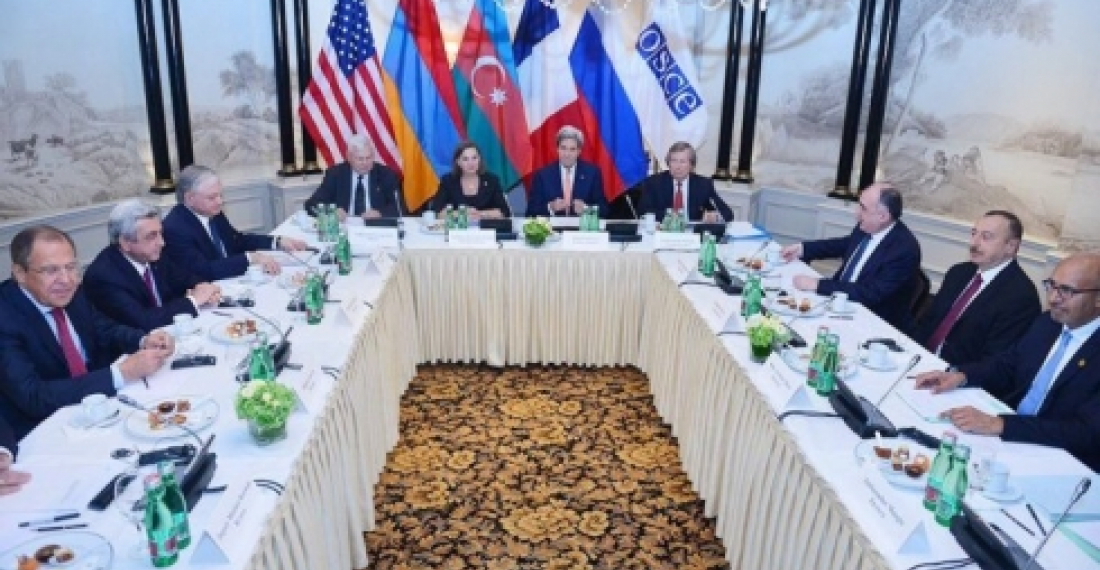
Прекращение огня следует соблюдать - Алиев и Саргсян

В понедельник вечером, в Вене, президенты Армении и Азербайджана договорились о соблюдении прекращения огня в Нагорном Карабахе и механизме по проведению расследований инцидентов.

"В целях снижения рисков продолжения насилия они дали согласие на завершение в кратчайшие сроки работы над механизмом ОБСЕ по проведению расследований инцидентов", говорится в заявлении ОБСЕ, опубликованном сразу после встречи.

Серж Саргсян и Ильхам Алиев встречались впервые после боевых действий в начале апреля, в результате которых погибли десятки людей с обеих сторон, что стало самыми ожесточенными столкновениями в регионе с 1994 года. Государственный секретарь США, Джон Керри, и министр иностранных дел России, Сергей Лавров, также принимали участие во встрече наряду с госсекретарем по европейским делам Франции, Арлем Дезир.

"Президенты также согласились на расширение офиса личного представителя действующего председателя ОБСЕ", говорится в заявлении Минской Группы. "Кроме того, Ильхам Алиев и Серж Саргсян договорились продолжать обмен информацией о пропавших без вести под эгидой МККК с учетом обязательств, принятых президентами в ходе Парижского саммита в октябре 2014 года."

Сопредседатели трех стран Минской группы - Джеймс Уорлик, Игорь Попов и Пьер Андрие - также приняли участие в ходе встречи, также как и Анжей Каспршик, личный представитель председателя ОБСЕ в офисе. Ранее в тот же вечер, президенты Алиев и Саргсян провели двусторонние встречи с Могерини, верховным представителем Европейского Союза по иностранным делам.

В ходе боев между 2 и 5 апреля были убиты десятки солдат и гражданских лиц, когда наконец 5 апрелся при посредничестве России было достигнуто устное соглашение о прекращений боевых действий. После этого стороны ежедневно сообщали о нарушениях и жертвах в результате этих нарушений.

Президенты двух стран договорились о том, что следующий раунд переговоров состоится в июне, с целью возобновления переговоров о всеобъемлющем урегулировании.

"Они подтвердили, что у данного конфликта не может быть военного решения. Сопредседатели настаивают на важности соблюдения соглашения о прекращении огня от 1994 и 1995 годов. Президенты подтвердили свою приверженность прекращению огня и мирному урегулированию конфликта", говорится в заявлении ОБСЕ .

источник: commonspace.eu по материалам агентств

фото: Встреча в Вене между президентами Армении и Азербайджана, 16 мая 2016 года.

 

Related articles

Editor's choice
News
Azerbaijan-Armenia Internet Transit Deal Marks New Step in Regional Connectivity

Azerbaijan-Armenia Internet Transit Deal Marks New Step in Regional Connectivity

Azerbaijan and Armenia have signed an agreement allowing the mutual transit of international internet traffic, creating a direct telecommunications link between the two countries for the first time since the collapse of the Soviet Union. The deal, announced on 17 June by AzerTelecom and Telecom Armenia, is intended to improve route diversity and network resilience in the South Caucasus. The development follows a gradual process of normalisation of relations between Baku and Yerevan. Notably, Azerbaijan has repeatedly identified the restoration of transport and communication links as a key component of a future peace settlement. Since the initialling of a peace agreement during a summit in Washington in August 2025, the two sides have taken several important steps, including progress on border delimitation and the easing of certain transit restrictions. The telecommunications agreement is also significant because it was negotiated by private operators rather than government officials. Industry observers note that commercial infrastructure projects can create long-term economic ties and mutual dependencies that are more difficult to reverse than political declarations.

Popular

Editor's choice
Interview
Thursday Interview: Murad Muradov

Thursday Interview: Murad Muradov

Today, commonspace.eu starts a new regular weekly series. THURSDAY INTERVIEW, conducted by Lauri Nikulainen, will host  persons who are thinkers, opinion shapers, and implementors in their countries and spheres. We start the series with an interview with Murad Muradov, a leading person in Azerbaijan's think tank community. He is also the first co-chair of the Action Committee for a new Armenian-Azerbaijani Dialogue. Last September he made history by being the first Azerbaijani civil society activist to visit Armenia after the 44 day war, and the start of the peace process. Speaking about this visit Murad Muradov said: "My experience was largely positive. My negative expectations luckily didn’t play out. The discussions were respectful, the panel format bringing together experts from Armenia, Azerbaijan, and Turkey was particularly valuable during the NATO Rose-Roth Seminar in Yerevan, and media coverage, while varied in tone, remained largely constructive. Some media outlets though attempted to represent me as more of a government mouthpiece than an independent expert, which was totally misleading.  Overall, I see these initiatives as important steps in rebuilding trust and normalising professional engagement. The fact that soon a larger Azerbaijani civil society visits to Armenia followed, reinforces the sense that this process is moving in the right direction." (click the image to read the interview in full)


