Mertz surprise visit to Kyiv, and increased German support for Ukraine, is a potential game-changer, writes Dennis Sammut, in this week's "Monday Commentary".
German Chancellor, Friedrich Merz, made a surprise visit to Ukraine over the weekend. He visited the Ukrainian capital, Kyiv, on Sunday and called on Russian President Vladimir Putin to stop his "barbaric attacks" and end what he called a "senseless war."
This was the fourth such visit to Ukraine by a German chancellor since the full-scale Russian invasion began in February 2022.
Merz predecessor, Olaf Scholz, visited twice during his three-year tenure, while Merz himself first travelled to Kyiv in May 2025 – just four days after taking office. He was accompanied on that occasion by French President Emanuel Macron, Polish Prime Minister Donald Tusk and former British Prime Minister Keir Starmer.
Merz visit to Kyiv this weekend came at a very significant moment, and was full of symbolism, but not only. It was very significant also in terms of content.
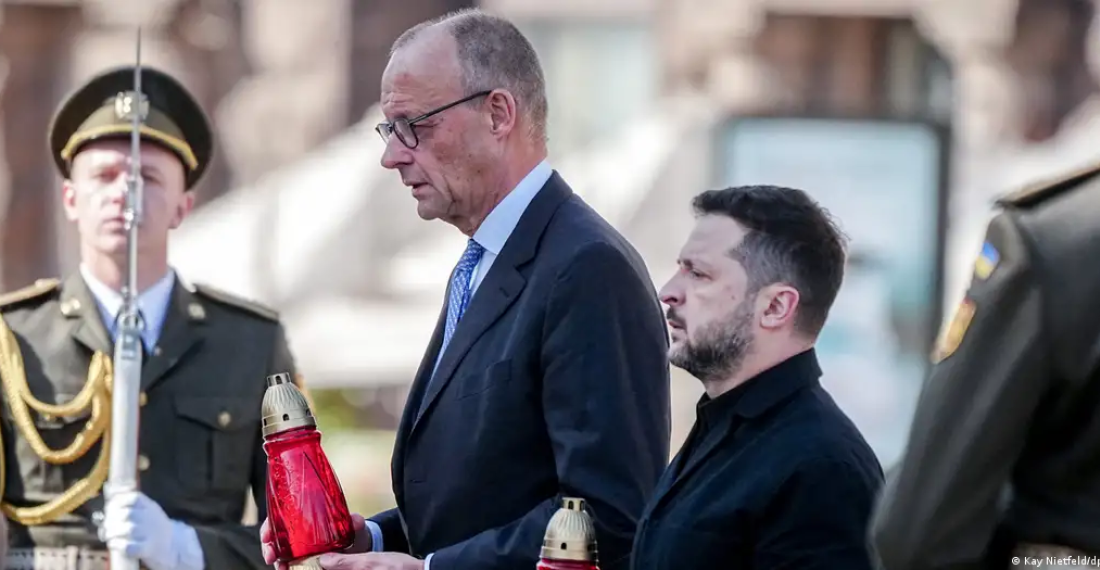
Merz visited the badly damaged building of Ukraine's Academy of Sciences, where at least two people died in a drone strike last week. He also paid tribute to fallen Ukrainian soldiers.
Merz arrived in Kyiv by train early on Sunday morning, accompanied by the German Economy Minister and a delegation of leading figures from German business, including executives from Siemens Energy, Hensoldt, Diehl Defence and Quantum Systems.
"If Russia is not stopped, it will turn its war machine against us sooner or later," Merz said upon arrival. During the visit of the German Chancellor, air raid sirens blared across the Ukrainian capital throughout the morning, as Kyiv's mayor announced one of the city's bridges had been hit by a Russian drone.
Germany has already been one of the biggest supporters for Ukraine, both bilaterally, and in a European context. During the visit, Merz pledged further military and energy assistance, announcing a German support package worth more than €1.3 billion.
The package includes €1 billion in military aid and €350 million for energy sector repairs ahead of winter.
Ukraine president Zelenskyy said the two countries had reached 15 agreements worth more than €8.5 billion, covering defence cooperation, production, procurement and joint projects in Ukraine.
According to German government sources, the planned cooperation includes the development and delivery of thousands of interceptor drones capable of countering the fast, jet-powered drones Russia increasingly deploys against Ukrainian infrastructure.
The plans also envisage expanding production of long-range weapons capable of striking targets more than 1,000 kilometers away.
Merz emphasized that the partnership would also benefit Germany, with companies from both countries developing technology to strengthen their security.
"German and Ukrainian companies are jointly developing technologies that benefit both countries. That makes us safer and stronger," he said.
Merz visit sends a clear message to Moscow
The visit came just hours after the Russian Foreign Ministry warned foreign diplomats and other visitors to avoid the Ukrainian capital, and military and government buildings in particular.
In recent days, Russia attacked several civilian targets in Kyiv, including bridges across the Dnipro River, as well as energy infrastructure.
Merz: 'If Germany wavers, Europe wavers; if Europe wavers, Ukraine wavers”
Sunday's visit comes just days after Merz had assured Ukraine of Germany's support, despite isolated resistance and criticism at home. Merz said earlier
'If Germany wavers, Europe wavers; if Europe wavers, Ukraine wavers”
The German broadcaster Deutsche Welle said that “Germany remains Ukraine's most important backer, both militarily and financially, but state elections in September saw significant gains for parties at both ends of the political spectrum who are critical of expenditure on Ukraine: the far-right Alternative for Germany (AfD) in Saxony-Anhalt and Mecklenburg-Western Pomerania and the socialist Left Party in Berlin.”
Speaking before his visit to Ukraine, Merz called out in particular "the AfD and their Russian backers" and promised Ukraine that Germany would not be divided.”
Merz visit and Germany’s stronger support is a game-changer
The visit of the German Chancellor to Ukraine this weekend came at a crucial moment for Ukraine and for Europe. Germany's strong and tangible support for Ukraine can be a game-changer,
Source: Dr Dennis Sammut is the Director of LINKS Europe and Managing Editor of commonspace.eu