Mediators from Pakistan and Qatar have been desperately trying to salvage the US-Iran agreement, outlined in a Memorandum of Understanding, that over the last few days looked increasingly as if it was falling apart. After Iran tried to assert its control over the Strait of Hormuz, firing at ships that had ignored its claims, the US bombed targets in Iran. Iran subsequentlky bombed US military facilities in Bahrain, Kuwait, Qatar and Jordan.
But the last twelve hours have been quieter, and observers believe that the mediators - Pakistan and Qatar have persuaded the two beligerents to stop shooting and return to diplomacy. Fighting immediately impact the precarious oil market.
It was announced that the US Strategic Petroleum Reserve has hit its lowest level since 1983, due to growing tensions with Iran and global supply concerns.
President Trump acknowledged to reporters on Wednesday that any time the US strikes Iran, oil prices jump. And they did.
The reserve fell by 6.2 million barrels in the week ending July 3 to 319.5 million barrels – its lowest level since the Reagan administration.
In the Gulf, there is increasing concern on the fragility of the US-Iran agreement.Zeidon Alkinani, founding director of the Arab Perspectives Institute, says Gulf states are conducting efforts to ensure diplomacy ends the US war on Iran as soon as possible.
“In the long term, we might be seeing different schools of thought and imagining a future relationship with Iran, a future relationship with the US, or imagining new transnational alliances from the regional perspective,” Alkinani told Al Jazeera.
Considerations would include how to achieve more deterrence for Iranian and Israeli expansionism, and how to curb too much reliance on the United States, he added.
“Others might want to continue things as they were to ensure that the conflicts were to end,” said Alkinani.
source: commonspace.eu, with BBC (London) and Al Jazeera (Doha), and agencies
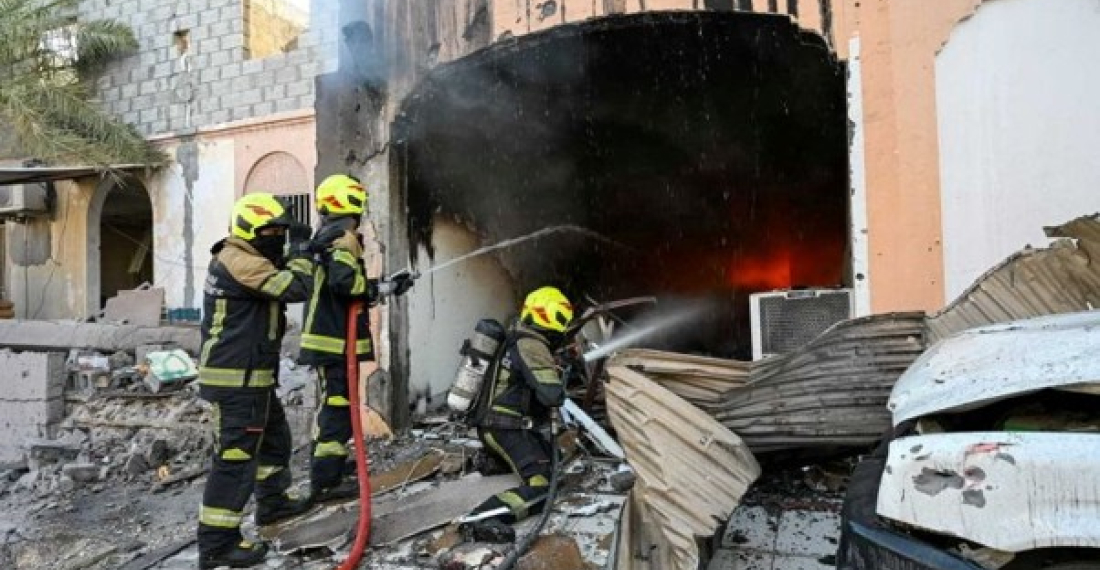
photo: Fire fighters deal with the fallout from a drone in Bahrain