In recent weeks, regional attention has largely focused on Armenia and Azerbaijan. In Armenia, the EU summits drew a lot of international attention, and the parliamentary elections, which are taking place in just three days, are being closely watched by Russia, the EU, the US, Turkey, Azerbaijan, and Iran. The UN World Urban Forum, held at the end of May in Baku, brought a lot of attention to Azerbaijan, and only yesterday (2 June), Azerbaijan's Energy Minister Parviz Shahbazov held a high-level meeting with Cristina Lobillo Borrero, Director of the Energy Platform and International Relations Group at the European Commission’s Directorate-General for Energy, to discuss strategic energy sector cooperation.
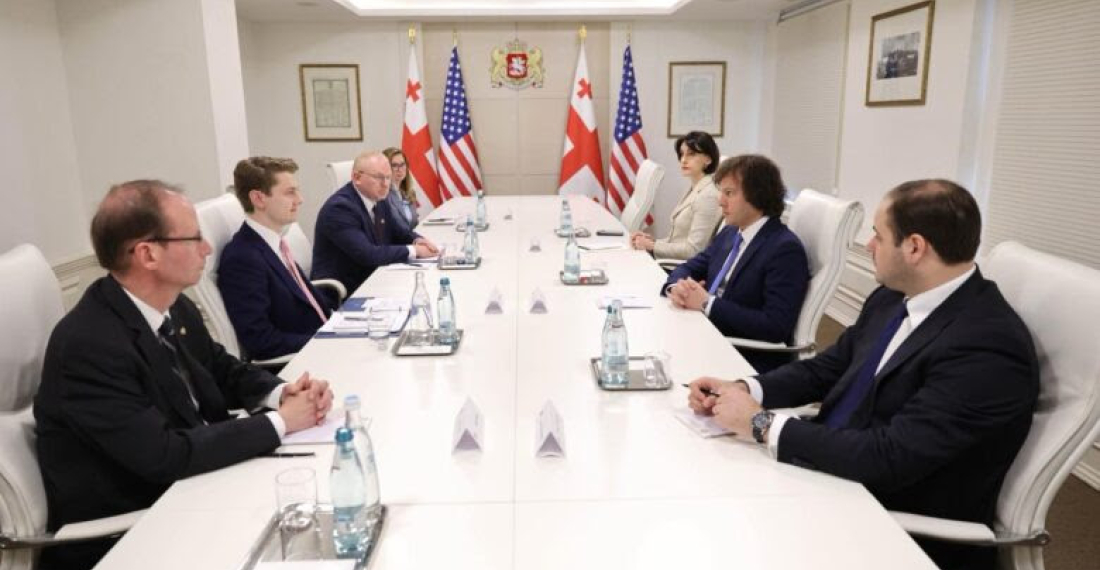
Meanwhile, Georgia, the third country in the South Caucasus, should not be overlooked despite the current focus on its neighbours. Important developments are also taking place there. A U.S. State Department delegation visited Tbilisi from 24–29 May and met with representatives of the Georgian Dream government, opposition parties, business leaders, and religious figures, including Patriarch Shio III, the new head of the Orthodox Church in Georgia. The delegation included Charles Yockey, Special Assistant to the U.S. Secretary of State, and Peter Andreoli, Director of the Office for Russian and Caucasian Affairs at the U.S. State Department.
On Monday (1 June), the U.S. Embassy in Tbilisi stated that the meeting focused on “a path forward for improving bilateral relations” and that the US delegation insisted that for a sustainable partnership, the Georgian government needs “a stable domestic political climate that facilitates opposition engagement”. The statement also said that Trump’s administration remains interested in “realiz[ing] the potential of the bilateral relationship”; however, work would need to be done regarding “making Georgia a credible partner,” particularly when it comes to the business environment. While economic and business issues featured prominently in the discussions, increased support for civil society organizations or NGOs was not addressed. This remains consistent with the Trump administration’s reduced interest in civil society initiatives and the broader scaling back of USAID engagement. However, its effects in Georgia are increasingly being felt, especially as Georgian Dream’s restrictive policies continue to shape the operating environment for civil society and independent institutions.
The latest of these restrictive policies is the implementation of a new department within Georgia’s Interior Ministry to combat “hate speech”. Mamuka Mdinaradze, one of the leaders of the ruling Georgian Dream party, argued that the main function of the department is to “systematically monitor hate speech, abusive campaigns and aggressive communication in the public sphere, as well as ensure an appropriate legal response.” At first glance, this may sound like a positive aspect; however, Chair of the Georgian Young Lawyers’ Association, Tamar Oniani, argues that this development is not just about combating hate speech but about controlling dissent and criticism of the government. Many critics argue that this essentially creates an institution whose main job would be to censor criticism of the government.
In addition, according to statements from Georgian Dream representatives, this department would also monitor social media and “the alleged offender will automatically be brought to court as a defendant.”, as reported by Beka Chedia for Jamestown. This is problematic as a lot of the critical voices express their views on platforms such as Facebook. Such a move would decrease the space for critical political debate.
Georgian Prime Minister Irakli Kobakhidze, in a statement on 1TV Georgia, defended the department, arguing that it will protect Georgian society from what he defined as “pseudo-liberal ideology, aimed at sowing hatred in society”. Beka Chedia, writing for the Jamestown, argues that this represents a classic strategy by the country’s ruling elite of framing potentially controversial policies as necessary for national security. Once an issue is framed in this way, it becomes considerably more difficult for opponents to challenge it without appearing to act against the national interest.
This department is another step in the deterioration of press freedom, and it comes only a couple of weeks after the Media Freedom Rapid Response team warned that “Georgia has experienced one of the most rapid and serious deteriorations of press freedom ever seen in an EU member state or candidate country”.
Source: This briefing was prepared by the editorial team of Commonspace.eu