Kyrgyzstan deals with EU sanctions
As Viktor Orbán’s government suffered a landslide defeat in Hungary last month, one of the main questions was how Prime Minister Péter Magyar’s new and much more pro-EU government would affect the EU’s ability to enact punitive measures against Russia, in particular the severity of sanctions that it could apply to the Kremlin and those indirectly supporting its war effort in Ukraine. With Hungary no longer stonewalling these efforts, the EU adopted its 20th sanctions package against Russia on the 24th of April. For the first time, the EU has used its ‘anti-circumvention’ tools and applied them to Kyrgyzstan. These are secondary sanctions on countries helping the Kremlin bypass the primary sanctions imposed upon it as a consequence of the full-scale invasion of Ukraine. While individual Kyrgyz as well as other Central Asian banks and entities have been targeted before, this is the first time they have been applied to an entire country. Kyrgyzstan’s imports of European dual-use technologies, in particular telecommunications equipment and metalworking machinery, far exceed its domestic demand and are being re-exported to Russia, according to EU Sanctions Envoy David O’Sullivan. This is also greatly facilitated by Ruble-backed cryptocurrency, allowing re-export transactions with Russian entities to better circumvent sanctions, which is why Kyrgyz cryptocurrency company TengriCoin has also been included, along with two major Kyrgyz banks. While this re-export business is surely profitable for Kyrgyz companies, it remains to be seen whether this sanctions package will have any immediate noticeable effect on the Kyrgyz economy. Past EU sanctions have already been criticised by the Kyrgyz government, with President Sadyr Japarov previously describing EU sanctions against individual Kyrgyz entities as “baseless” and interfering in internal affairs. First Deputy Cabinet Chair of Kyrgyzstan, Daniyar Amangeldiev, also pointed out that sweeping sanctions against Kyrgyzstan will have consequences for its image on the global stage. Regardless, the EU has now pushed through its 20th sanctions package, which is undoubtedly an escalation from previous iterations and presents a difficult situation for the Kyrgyz government to navigate. So far, Kyrgyzstan has responded by calling for transparent talks with the European Commission, and is reportedly in direct consultations with the EU, as well as US and UK officials, who have also levied their own sanctions against Kyrgyz entities. It is important to note that when it comes to third-party sanctions circumvention vis-à-vis Russia, Kyrgyzstan is definitely not the greatest offender, with Türkiye and China passing far greater volumes of sanctioned goods to Russia. It seems that the EU is using the 20th sanctions package and its focus on Kyrgyzstan as a test case to see how well its anti-circumvention tools work, and possibly also make an example out of a sanction-circumventing country that does not have the same reciprocal leverage over the EU that larger and more intertwined economies such as Türkiye and China may have.
Erdoğan visits Astana
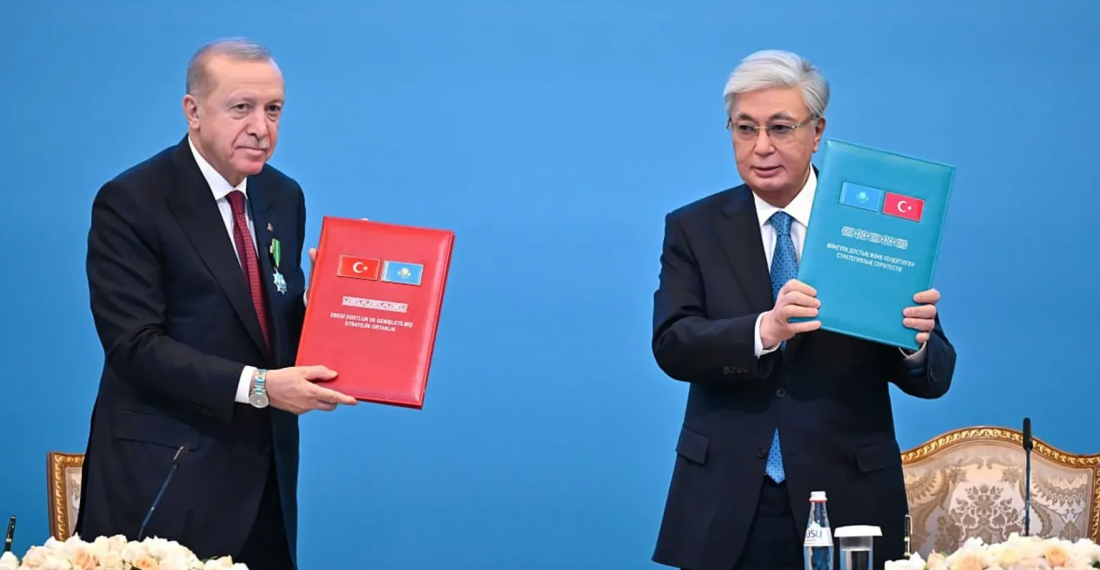
Escorted by Kazakh fighter jets and received by a symbolic honour guard, Turkish President Recep Tayyip Erdoğan touched down in Astana on 14 May to attend the 6th Türkiye-Kazakhstan High-Level Strategic Cooperation Council meeting as well as the Informal Summit of the Organization of Turkic States (OTS). The visit is an important one for Kazakhstan and is yet another indicator of the country’s efforts to continue expanding upon its ‘multi-vector’ foreign policy, which was covered in the last newsletter (INSERT LINK). The previous newsletter detailed Kazakhstan’s efforts to balance its deepening US relationship with its existing connections to Russia and China, as well as the Kazakh government’s involvement in the ‘Trump Route for International Peace and Prosperity’ (TRIPP) as part of its efforts to increase its involvement and influence in the wider region. Erdoğan’s visit now presents an opportunity for Kazakhstan to continue building upon its (near) regional ties, which Tokayev’s government is sure to capitalise on.
Kazakhstan has managed to craft an advantageous and clever agenda for President Erdogan’s visit that effectively kills two birds with one stone while progressing its aforementioned objective of deepening regional connections and influence. President Kassym-Jomart Tokayev will be able to directly address deepening bilateral connections with his Turkish counterpart. This is reflected in the agenda, which includes transport links, energy security, logistics, trade, investment, and defence industry cooperation. Strong ties and deepening trade relations with a large economy in regional proximity not only provide opportunities for overall economic growth but also serve to offset greater geopolitical risks it is currently indirectly exposed through its larger neighbours (Russia and China). The potential consequences of these risks are currently best demonstrated by Russia’s recent closure of the Druzhba pipeline exporting Kazakh crude to the EU (also covered in the last newsletter). The closure could be due to a multitude of different reasons: the result of damaged Russian infrastructure due to Ukrainian strikes, potentially as a political ploy to pressure Ukraine’s European backers, or possibly even as a way for Russia to put pressure on the reliability of Kazakh crude exports to reestablish the primacy of its own energy exports. Regardless of the reason, although Kazakhstan suffered exposure to the Druzhba closure, it was initially able to shrug it off due to exporting most of its oil through the Caspian Pipeline Consortium (CPC). Unfortunately for Kazakhstan, this route also runs through Russia, and its infrastructure has already been repeatedly targeted by Ukraine. Therefore, Kazakhstan’s energy exports need to be backed up by further redundancies. In this regard, President Erdoğan’s visit could not come at a better time. The Turkish President highlighted the importance of the Trans-Caspian International Transport Route (TITR), more widely known as the ‘Middle Corridor,’ and described it as a “modern-day equivalent of the Silk Road”, going on to say that Türkiye will continue to promote the corridor with Kazakhstan for “transporting energy resources to the West”. Promises from both governments to increase bilateral trade volume and foreign investment also followed, overall indicating that the talks went well and that both sides are keen to deepen their bilateral economic relationship, but also play a key role together in facilitating global trade between East and West.
The other event set up in time for President Erdoğan’s visit was the Informal Summit of the Organization of Turkic States held in Turkistan, Kazakhstan, described by OTS as the spiritual centre of the Turkic world. The summit included Heads of State of OTS member and observer states, as well as the OTS Secretary General. According to the OTS, the Informal Summit will revolve around important “areas of cooperation in the rapidly evolving digital era” including artificial intelligence, digital innovation, as well as emerging technologies for economic growth, public services, and regional connectivity. This digital theme of the summit seems to be an effort by Kazakhstan to give the OTS a more concrete economic role than it has in the past. To be clear, the OTS does outline economic cooperation as a main objective, and has introduced several mechanisms to stimulate cooperation, such as a Turkic Chamber of Commerce and Industry and a Turkic Investment Fund, but intra-OTS trade ultimately only accounts for a fraction of the total combined external trade volume of members and observers. Kazakhstan seems to be prioritising digitalisation as a way to better connect OTS members, which also echoes its recently unveiled national ‘Digital Qazaqstan’, a strategy heavily driven by artificial intelligence and looking to modernise and better connect the economy through rapid digitalisation. Kazakhstan’s Deputy Prime Minister and Economy Minister, Serik Zhumangarin, identified OTS cooperation as a main foreign economic objective and underlined the potential of further cooperation by citing the market of over 170 million people that make up the OTS countries. Zhumangarin called for the OTS to move from declarations to concrete projects and called attention to the importance of more resilient and sustainable transport routes between east and west. The OTS summit is also underpinned by a business forum, held on 13 May, involving state representatives, financial institutions, business representatives, and chambers of commerce from OTS states. Kazakhstan’s efforts to host the OTS summit during Erdoğan’s visit, while concurrently organising the business forum, demonstrate how Tokayev’s government not only pursues strong bilateral ties with its regional neighbors, but also looks to promote overall regional integration in Central Asia and beyond the Caspian when the opportunity to do so arises. Ultimately, as trade routes and passages both north (Druzhba, CPC) and south (Hormuz) of Kazakhstan become contested or are shut off entirely, this week’s visit from Turkey demonstrates that Kazakhstan’s multi-vector foreign policy consists of more than just courting the biggest geopolitical players, but also prioritises regional connectivity and mutual prosperity as a defence against increasing global instability.
Source: This commentary was first published on Central Asia Concise on 15 May 2026. Check the whole issue here. Subscribe for free here.