Cooperation between the UN and the Gulf Cooperation Council (GCC): Briefing and Adoption of a Presidential Statement
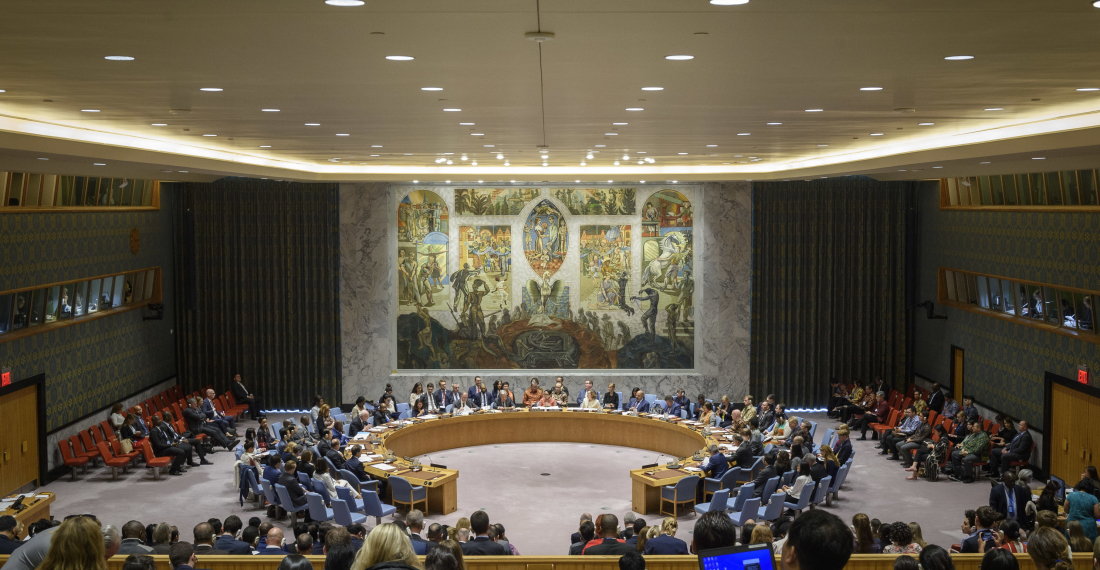
On Thursday (2 April), the Security Council held a high-level briefing focusing on the Gulf Cooperation Council (GCC). Bahraini Minister of Foreign Affairs Abdullatif bin Rashid Al Zayani is expected to chaired the meeting, which is one of the signature events of Bahrain’s April Council presidency. Briefings were made by UN Assistant Secretary-General for the Middle East, Asia and the Pacific in the Departments of Political and Peacebuilding Affairs and Peace Operations (DPPA-DPO) Mohamed Khaled Khiari and GCC Secretary-General Jasem Mohamed Al-Budaiwi.
A Bahrain authored presidential statement was adopted.
The GCC is a regional, intergovernmental organisation comprising six member states, including Council member Bahrain as well as Kuwait, Oman, Qatar, Saudi Arabia, and the United Arab Emirates (UAE). Established in 1981, the organisation is a platform for cooperation on political, economic, and sociocultural issues affecting the Arab states of the Gulf
The briefing is the first Council meeting focused on cooperation between the UN and the GCC. Bahrain circulated a concept note ahead of the meeting, outlining its core objectives. These included: to encourage a durable partnership between the UN and the GCC that systematically contributes to regional and international peace, security, and post-conflict stabilisation; to promote more effective, regionally informed multilateral responses to emerging threats; and to create structured channels for information-sharing, joint analysis, and coordination between global and regional mechanisms to advance common objectives of peace and security.
Certain other aspects of the negotiations on the draft presidential statement were also apparently challenging. It seems that the primary point of contention was language relating to the escalation in the Middle East caused by the joint Israeli-US strikes on Iran on 28 February. In the zero draft, the penholder proposed text that strongly condemned Iran’s retaliatory attacks on the GCC countries and Jordan, directly referencing the resolution2817 of 11 March on the matter that was presented by Bahrain on behalf of these countries. The relevant paragraph also included language that reaffirmed the importance of maritime security and the freedom of navigation and stressed that “any disruption to vital waterways may have implications for international trade and global economic stability”, an apparent reference to the ongoing Strait of Hormuz crisis.
During the negotiations on resolution 2817, China and Russia apparently criticised the draft text for being unbalanced and for failing to consider the root causes of the conflict. In response, Russia circulated an alternative draft, which was more general than Bahrain’s and did not name individual countries. Co-sponsored by 136 member states, Bahrain’s resolution was eventually adopted with 13 votes in favour and two abstentions (China and Russia). Russia’s draft resolution failed to be adopted, garnering only four affirmative votes (China, Russia, Pakistan, and Somalia).
It seems that the same dynamics were evident during the negotiations on the draft presidential statement. China and Russia apparently raised reservations over the language concerning the Middle East crisis, requesting modifications to the relevant paragraph. In the first revised text, Bahrain apparently retained the zero draft’s language that directly alluded to Iran’s attacks and resolution 2817; however, the text was slightly modified to also reference resolution 552 of 1 June 1984, which demanded that Iran cease attacks on commercial ships to and from the ports of Kuwait and Saudi Arabia. This appeared to be the penholder’s attempt to preserve the paragraph’s original formulation and intent, as similar language on threats against Gulf countries, including to their freedom of navigation, was included in resolution 552. However, it seems that China and Russia expressed concerns over the paragraph, requesting further amendments to the text.
To facilitate consensus among Council members, the penholder softened the relevant paragraph’s language in the second revised text, removing all direct references to Iran’s attacks on the GCC countries and Jordan. In doing so, Bahrain apparently replaced it with text that recalled previous relevant Council resolutions, including resolution 2817 and resolution 552, that “take into consideration the importance of the Gulf region to international peace and security and its vital role to the stability of the world economy”.
Despite such revisions, China and Russia nevertheless raised concerns, expressing reservations over references to resolution 552 and resolution 2817. In an apparent compromise, the final draft of the presidential statement does not incorporate any direct references to Iran’s attacks against the Gulf countries, nor does it mention the two resolutions. The penholder also removed all language that underscored the importance of freedom of navigation and noted the implications of any disruption to vital waterways for international trade and global economic stability. The toned-down final version of the relevant paragraph simply recalls the Council’s previous relevant resolutions, “which take into consideration the importance of the Gulf region to international peace and security and its vital role to the stability of the world economy”.
Language concerning thematic areas—such as climate as well as WPS, YPS, and tolerance—was also toned down in some other instances. Regarding WPS and YPS elements, it seems that the penholder proposed language in the zero draft that acknowledged the important role of women and youth in sustaining peace and security and encouraged joint efforts by the UN and the GCC to promote the WPS and YPS agendas. Some Council members, such as the US, apparently requested modifications to the relevant paragraph, citing reservations over references to both agendas. It seems that these members also asked for the removal of all climate-related language in the text, including references to sustainable development and environmental pressures. This was also the case for language related to tolerance, with several members expressing a preference to remove any references to the matter. France apparently suggested replacing the reference to “tolerance” with the term “human rights”, but this did not get incorporated into the agreed presidential statement.
It appears that a compromise was reached regarding language related to WPS and YPS. The final draft encourages “the joint efforts by the UN and the GCC to promote the full, equal and meaningful participation of women and youth in promoting peace and security” in line with resolution 1525 of 31 October 2000 on WPS and resolution 2250 of 9 December 2015 on YPS. References to tolerance and climate were not retained in the final revision of the draft presidential statement, however.
source: commonspace.eu with Security Council Report (New York).