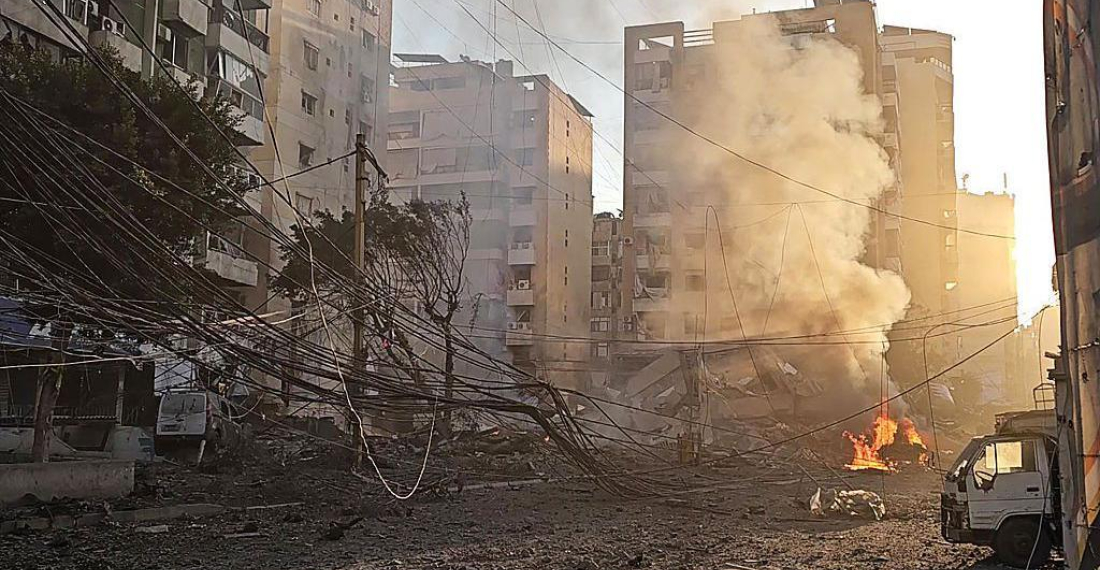
On Saturday (28 February) the United States and Israel launched a new war, attacking Iran, even though talks between the US and Iran were on-going in Geneva, and Omani mediators thought that an agreement between the two was within reach. In the first engagement of the new war the US and Israel, targeted and killed Ayatollah Khamanei, Iran’s Supreme Leader, and many other Iranian senior officials.
The war has raged on for the last few days, and has spread quickly to other countries in the region. It is clear we are at the beginning of something big. This is not a local conflict. It is a conflict with global ramifications, and we are only at the start.
A war with unclear objectives
The war has unclear objectives from the two countries that initiated it. Stopping Iran from becoming a nuclear power is one, yet everything suggests that this objective could be reached with negotiations; a second objective is to take out Iran’s military capability, including missiles and drones. The current military campaign will dent Iranian capability, but will not eliminate it. The third objective which was the highlight on Saturday, but has become less pronounced since is “regime change”.
On its part, the Islamic Republic of Iran has one objective – the survival of the system that was put in place after the 1979 revolution. The Supreme Leader will be replaced, as will officials that have been killed. But the system wants to show that it is more durable than mere mortals.
Trump had been told by many, including friends and associates, not to start the war. But the American leader has been emboldened by “successes”, such as his adventure in Venezuela, and was persuaded by Israel’s Netanyahu, who has his own agenda, and ignored all advice and opened “Pandora’s box”. What will come out we can only guess. One thing is sure: the Middle East will never be the same again. The impact on the Gulf states will be huge; for them this is the nightmare scenario. It is turning out worse than they had ever imagined.
Iran
Iran is a country with a long history, and a complex societal fabric. It has a population of over ninety million. According to the US Library of Congress, 65% are Persians (also including Gilaks and Mazenderanis, 16% Azerbaijanis, 7% Kurds, 6% Lurs, 2% Arabs, 2% Balochis, 1% Turkic tribal groups (such as Qashqai), and non-Persian, non-Turkic groups (less than 1%). Whilst Persians provide the core of the population, they are constantly concerned that outsiders will use this diversity to undermine the country’s unity and territorial integrity. This deeply held concern is considered in the present situation too.
Shia Islam
Shia Islam is followed by about 10% of all Muslims, numbering at an estimated 200–260 million followers worldwide as of 2025. Shia Muslims form a majority of the population in Iran, Iraq and Azerbaijan, as well as about half of the citizen population of Bahrain. There are also large Shia communities in Yemen, Saudi Arabia, Lebanon, Turkey, Kuwait, Saudi Arabia, Pakistan, Afghanistan and India.
In Iran, Shia Islam is the basis of the state, and the country is ruled by the Shia clergy, who control all aspects of society.
Ayatollah Khamanei has the last laugh
The war opened with the assassination of the Iranian Supreme Leader, Ayatollah Khamanei. Khamanei had been Supreme Leader since 1987, and was both the spiritual leader of all Shias and temporal leader of Iran. But at 86, he was old and frail.
On 28 February he was sitting in his office in Tehran, despite the threat of an imminent US attack. Many had speculated that he had been spirited away to a secret bunker. Apparently Khamanei refused to go. He insisted on following his routine. Khamanei wanted to die as a martyr, and Trump obliged. This fatalism is at the heart of Shia Islam. It explains Iranian stubbornness and resilience. It is something that Americans, and especially Trump, fail to factor in.
No doubt the fact that there will be a new Supreme Leader – only the third since 1979 – will bring some changes to Iran. But the Islamic Republic is a system regardless of who is at the top.
The future
It is very difficult to predict the future in such a volatile situation as has emerged since Saturday. There are no simple explanations or solutions.
But it is likely that the Islamic Republic will endure. The system may, in order to survive, update itself. This is necessary and overdue. But it will not happen under American and Israeli aerial fire.
The Gulf will never be the same again. The relations between Iran and the Gulf countries will be poisoned for a long time. Most GCC countries have the financial cushion to help them pull out of the present crises. But money on this occasion, may not be enough.
The war will also impact the Trump administration. This may prove a gamble too far for the American president.
But for all three, we are only at the beginning. And this story is only just starting, so in truth, anything can happen.
source: Monday commentary is written for commonspace.eu by Dr. Dennis Sammut, Director of LINKS Europe, and Managing Editor of commonspace.eu