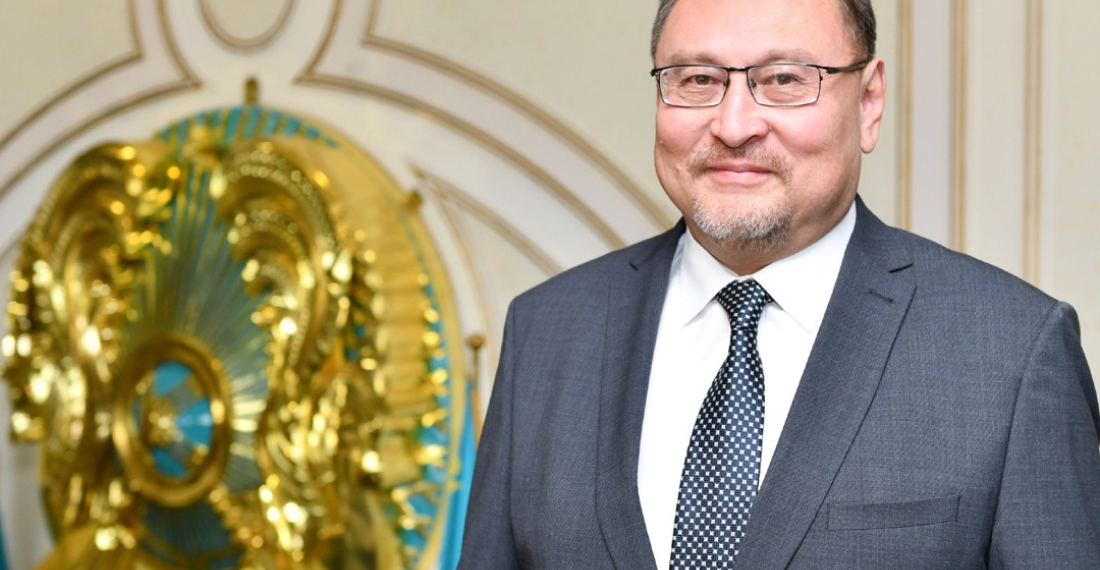
His Excellency Mr. Akan Rakhmetullin is the Ambassador of the Republic of Kazakhstan to the Kingdom of the Netherlands and Permanent Representative to the Organisation for the Prohibition of Chemical Weapons (OPCW). A career diplomat with more than three decades of experience across bilateral and multilateral postings, he has represented Kazakhstan at the United Nations (UN) and the Organization for Security and Co-operation in Europe (OSCE), and played a central role in shaping the country’s multi-vector foreign policy and engagement with international institutions.
Speaking to commonspace.eu, Ambassador Rakhmetullin reflected on his experience of representing a newly independent state in the 1990s, Kazakhstan’s ongoing domestic reform agenda, and how internal political changes shape the country’s external posture. He also discussed opportunities for deeper cooperation with Europe, particularly in energy, technology, and agriculture, defended the relevance of multilateral institutions under growing political strain, and explained why Kazakhstan continues to pursue a multi-vector foreign policy aimed at maintaining balanced relations with major powers.
“I have always felt that, of course, there are big countries and smaller countries, less developed and developed countries, but they are all equal. They should all be on the same footing, equally seated and equally respected. This has been my constant and strong impression: that we are equal.”
Read the full interview below:
Welcome, Your Excellency. You began your career in the early years of Kazakhstan’s independence. Looking back, what was the most profound lesson you learned as a young diplomat representing a new state, and how has that experience shaped your approach to diplomacy today?
For me, this is really a challenging question, because I experienced different areas from the very beginning of my career. I started my work in 1993, soon after the Soviet Union collapsed. My first posting was to Pakistan as a consular officer. I served there for two years, working as a consular visa officer. I saw many things happening there. I was issuing visas for Pakistan and Afghan citizens travelling to Kazakhstan and to our region. After I came back, and after graduating from the Diplomatic Academy, I shifted from the consular sphere and started working in multilateral diplomacy, in particular with the United Nations, which led me to New York as a young diplomat.
What I felt during these two tenures, in Pakistan and in New York, was how very closely connected countries and continents are. There is no global or regional issue that pertains only to a single region. My feeling was that all diplomats, all peoples, and all nations are very close to each other, because when you work in diplomacy, you always try to find contacts, promote the interests of your country, and understand the interests of your partner countries.
My impression was that even as a young diplomat, we understood that each country is unique, and each country deserves to be heard and listened to. Each state has its strategic and national interests, but these should not come at the expense of others. This is what we call multilateralism — one country, one voice — meaning that each country has its sovereign right, under international law and the rule of law, to be present in the international arena and to promote its own interests.
This gave me quite a strong foundation, both from working in bilateral diplomacy and then in multilateral diplomacy. Knowing a country personally — its interests, including national and regional interests, whether political, trade-related, or economic — and at the same time seeing that country represented at the United Nations and promoting the same interests in a different way, gave me an understanding from both the inside and the outside. This pertains to every country, I think.
Since then, I have always felt that, of course, there are big countries and smaller countries, less developed and developed countries, but they are all equal. They should all be on the same footing, equally treated and equally respected. This has been my constant and strong impression: that we are equal.
Next, I’d like to move on to Kazakhstan’s widespread reform agenda, which aims to reduce the centralisation of power, strengthen parliamentary oversight, and improve accountability within the government. How do these internal political reforms translate, in your view, into changes in Kazakhstan’s external posture?
I have thought about this question before, and I have spent time considering how we can translate what is going on internal ground into our external context. If I may briefly outline what is happening: political reform, constitutional reform, and legal reform — the amended constitution is, in fact, almost a new constitution. It reflects the demands of the current circumstances and momentum, and we decided to use this momentum to improve our basic law.
The reforms are aimed at strengthening the rule of law and empowering people as human beings, with all their rights, freedoms, and liberties. At the same time, as you rightly mentioned, there is decentralisation of power. The new post of Vice-President is being introduced, meaning that the president will delegate some of his power, particularly in the representative sphere — in parliament, in government, and in some cases in external communication — to the Vice-President .
This gives the president the opportunity to concentrate more on the domestic agenda. It also spreads power to at least two people who will be involved in promoting Kazakhstan’s international agenda.
Apart from that, we are changing our bicameral parliament into a unicameral parliament. It is currently composed of two chambers, but after the constitutional reform, it will become a single-chamber parliament, which we will name the Kurultay, meaning the National Council.
There are several reasons for this. One is that our statehood is still relatively young. If we compare ourselves with European countries, we are still in the process of developing our statehood. It has proved its viability, but there is always room for improvement and refinement. These constitutional reforms aim to improve people’s lives, protect their rights, and strengthen the legal framework.
One of the main reasons for moving to a unicameral parliament is to speed up the process of adopting legislation. The world is changing rapidly, and our political system needs to be more responsive to these changes. We need to make the work of parliament less cumbersome and more result-oriented, and more responsive to the needs of the people.
If we translate this into the external domain, I would say that the main task of diplomats — not only Kazakh diplomats, but diplomats everywhere — is to ensure that national and strategic interests are protected and promoted in the international arena, and to gain support from partners. Our task today is to gain support from external friends and partners for the reforms we are implementing domestically. What we do internally inevitably has repercussions externally, in terms of investment flows and in informing institutions and partners that Kazakhstan is moving forward in further liberalisation and democratisation.
On that note of foreign partnerships, where do you see the most concrete opportunities to deepen European cooperation with Kazakhstan over the next few years, whether in security, energy, or other areas?
There are many opportunities to expand cooperation. The main idea is to diversify our export routes and our economic development. Historically, during Soviet times, Kazakhstan functioned as a stockpile or warehouse of raw materials such as oil, gas, hydrocarbons, and other resources, which were sent abroad for processing and then returned as finished products.
We understand that we cannot rely on hydrocarbons forever. These resources will eventually be depleted, and we must think about future generations. We need strategies to replace full reliance on oil and gas. While energy remains important and we derive revenue from it, we cannot depend on it indefinitely.
That is why we are very interested in diversifying our economy. European countries, particularly the Netherlands, are very successful in renewable energy and alternative energy sources, and we are keen to cooperate in this area. Beyond energy, we want to move towards digitalisation, artificial intelligence, and high value-added production — similar to what many Gulf countries are doing as they transition away from resource-based economies.
We also want to process our raw materials domestically, rather than exporting them in crude form. This would significantly increase value added and competitiveness in international markets. This is why cooperation with countries like the Netherlands, which have strong technological expertise, is so important.
Agriculture is another area of interest. The Netherlands is much smaller than Kazakhstan, yet it is one of the world’s major agricultural exporters. Kazakhstan faces challenging climatic conditions — what we call “risky agriculture” — with sharp continental climate patterns. By adopting advanced technologies, including greenhouses, artificial intelligence-supported agriculture, water-saving systems, and modern fertilisers, we can significantly increase crop yields while conserving water, which is a scarce resource for us.
I recently visited a high-tech greenhouse centre, so called horticenter - and was impressed by how technology can increase yields from around 8–10 kilograms of tomatoes per square metre in open fields to 80–100 kilograms per square metre in controlled environments, using the same amount of water. This kind of technology could be transformative for Kazakhstan.
This is precisely the area where we can have very strong and concrete cooperation. Kazakhstan has vast natural resources and a large territory. At the same time, we have a well-educated and capable human capital base. When foreign investors come to Kazakhstan, they find not only these advantages, but also a legal and regulatory environment that has been significantly updated and modernised. The legislation and incentives for foreign investors are increasingly sophisticated, and investors can feel that their interests are protected, with good prospects for stable returns and long-term engagement.
Beyond economic and trade cooperation, I would also highlight political cooperation. From the very beginning of Kazakhstan’s independence, we had to think carefully about how to position ourselves in international affairs — how to move forward, what choices to make, and how to shape our foreign policy. At that time, Kazakhstan was encouraged by different countries to align with one bloc or another. However, the most viable and ultimately the only sustainable solution was to pursue what we call a multi-vector or multidimensional foreign policy: maintaining friendly relations with everyone and being hostile to none.
This approach has justified itself over time, and history has shown that it was the right choice. Today, we do not have tensions or confrontations with any particular country. On the contrary, we maintain constructive relations even with countries that may have difficult relations with one another. We have built strategic, respectful, and mutually beneficial partnerships, and this is the model we also seek to maintain and further develop with European countries.
I wanted to go in a slightly different direction, because you are also the Permanent Representative to the OPCW and have held several posts in multilateral institutions. At a time when these institutions are facing growing political pressures, what reforms or changes do you believe are needed to ensure that they remain effective, impartial, and credible in the future?
This is really a million -dollar question. I do not think that we should focus primarily on institutional reform as such, or on what kind of reform would be needed to make organisations like the OPCW less politicised. We first need to ask what or who actually makes these organisations politicised. It is not the organisations themselves — not the Director-General, the Secretariat, or any professional bodies within them. It is the participating states.
When states have contradictions and controversies with one another, they inevitably try to promote their own interests through these organisations and to hold countries they have issues with to account. This increases tensions and leads to the perception that the organisation itself is politicised. In reality, it is not the organisation that is politicised, but the relations among its member states.
This applies not only to the OPCW, but to many other organisations, including the United Nations. These institutions are essentially mirrors of what is happening in the world. If countries have unresolved conflicts or disputes at the bilateral or regional level, these tensions are reflected at the multilateral level.
It is therefore difficult to speak about the politicised nature of organisations themselves. What we are really witnessing is the politicised nature of relations between and among member states. Once countries resolve their disagreements, this will immediately be reflected in the work of these organisations.
We know that some countries accuse others of using chemical weapons, and those countries reject these accusations. In the end, who suffers? The international order suffers, and people suffer — those who are subjected to the use of chemical substances. This is why countries must find ways to follow a pattern of dialogue rather than confrontation. Without this shift towards dialogue, multilateral institutions will continue to be accused of politicisation and of failing to fulfil their mandates. But again, this is not about the organisations themselves — it is about their members.
Final question, to close the interview. After decades in public service, what continues to motivate you personally? And what gives you the greatest optimism about Kazakhstan’s role in the world over the next decade?
On a personal level, what continues to motivate me is the opportunity to meet new people. I spent a long time working in multilateral diplomacy at the United Nations and the Organization for Security and Co-operation in Europe, and now, as a bilateral diplomat, I have the opportunity to learn more and to understand bilateral relations in much greater depth. It is not only about relations between states, but about understanding countries themselves: their history, how they developed, and what they have become. The Netherlands, for example, has a very rich history, including dramatic periods, and its development offers valuable lessons.
Personally, what I gain from this work is a sense of continuous learning — learning about new countries, new people, and everything connected with them: technology, culture, education, sports, and many other aspects of life.
As for Kazakhstan’s role, I would not say that we have a unique or special role. Kazakhstan is one of a group of countries that can be described as middle powers. We do not possess nuclear weapons or weapons of mass destruction, and we do not command a huge share of global gross domestic product (GDP). But we do possess goodwill and political will, and we are ready to work with others to promote the values of a better and more peaceful world, and to ensure a better future for coming generations.
At a time when major powers have disputes and disagreements with one another, Kazakhstan and other middle powers can sometimes serve as mediators. Our geographical location places us between major partners and neighbours such as Russia and China, while at the same time we maintain good relations with the European Union, the United States, and other parts of the world. As I said at the beginning, our approach is to make friends with everyone and be hostile to none.
This means that we can use our potential and our capacity to help mitigate contradictions and outstanding issues among larger powers, to increase understanding, and to foster mutual respect. Kazakhstan is always ready to provide a platform for dialogue for countries facing serious conflicts and to support efforts aimed at reducing tensions. This, I would say, is one possible role Kazakhstan can play.