


Меню

Monday Commentary: Armenians and Azerbaijanis are carving a new South Caucasus

For many years, the international community was telling the governments of Armenia and Azerbaijan to prepare their populations for peace. Instead, they prepared them for war, which eventually came in 2020, followed by a period of uncertainty. In the last year the two sides turned the page. In March 2025 they agreed the elements of a peace agreement. On 8 August, at a historic meeting in the White House, this agreement was initialed. Since then, the two sides have taken huge, unprecedented steps to achieve peace and reconciliation.

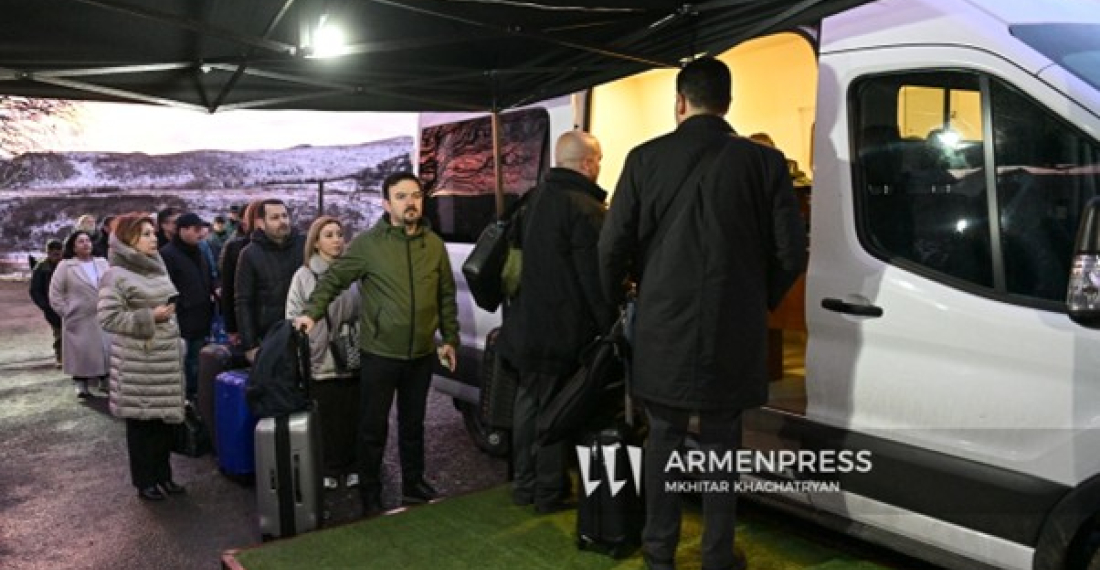
On 13 February, twenty Azerbaijani civil society experts walked across the border with Armenia, presented their passports at an Armenian border checkpoint and entered Armenia, to be welcomed by 20 Armenian counterparts, with who they spent the next two days discussing future regional peace and co-operation.

The symbolism and importance of this event is huge. Even if you accept that this was a tightly choreographed affair, managed by the two governments, its importance is unquestionable.

There will now be a “return” event. The 20 Armenians involved in the process will go to Azerbaijan.

Peace Bridge

The arrival of the large Azerbaijani group in Armenia was in the framework of the “Peace Bridge”, which started taking shape in October of last year. This has two characteristics, which make it special, relevant and ground breaking.

The first is that the initiative not only has government backing, but has two important “patrons” – presidential adviser in Azerbaijan, Hikmet Haciyev; and Armenian National Security Council Secretary, Armen Grigoryan. These two men did most of the heavy lifting behind the scenes to get the peace process on the right track. So there is a bit of a haze between track 1 and track 2, but in this case it is all for the better.

The second important element, is that this is an all-local initiative. There is no foreign funding; no external NGO, or any other outside involvement. This is hugely significant and important.

One also needs to commend the transparency of the process. The names of those participating on both sides were published.

“Mission accomplished”, or a lot of it is. Now it is time to move on!

I have been involved in Armenia-Azerbaijan relations for more than three decades: we supported dialogue between MPs, officials, journalists, young people, civil society etc etc. Most of the time it has been a thankless task, and we were attacked and criticized often by both sides, but we persisted. We pushed confidence-building measures, even though some were dead against them.

On 13 February 2026, when the Azerbaijani group from “Peace Bridge” walked confidently across the border into Armenia, I could say that our job, as a conflict-resolution organization, was done.

There is no conflict anymore between Armenia and Azerbaijan. Armenians and Azerbaijanis, at official level, and at civil society level, are talking directly to each other without intermediaries.

This is something to be celebrated.

That part of our work is done, and we should be happy and satisfied. We contributed as much as anyone so that the sides could reach this point. Now its time to move on.

Of course success brings responsibility. Those involved in “Peace Bridge”, and those behind them, are now the key movers amongst the populations at large of Armenians and Azerbaijanis, where there remains a lot of mistrust and skepticism, and where there are still many spoilers, many backed by Russia. So “Peace bridge” has a lot of work ahead.

We enter a new era.

LINKS Europe has always been more than a conflict resolution organization. My team, and I personally, remain committed to the Caucasus region, and its future. Our work will adapt to the new reality as the region stops being a war-thorn area on the periphery of Russia, and becomes a hub between Europe, Central Asia and the Middle East. It is an exciting moment, and we are glad we are also part of the conversation in this new South Caucasus.  

source: Dennis Sammut is the Director of LINKS Europe Foundation, and Managing Editor of commonspace.eu.

photo: 20 Azerbaijanis queuing to have their passports stamped at an Armenian checkpoint, as they arrive for a meeting of Peace Bridge on 13 February 2026. (Image courtesy of ARMENPRESS, Yerevan)
Related articles

Editor's choice
News
Kazakhstan votes in referendum on important constitutional changes

Kazakhstan votes in referendum on important constitutional changes

Voting is taking place on Sunday (15 March)  in Kazakhstan in a nationwide referendum on a new draft Constitution. According to the Central Referendum Commission of Kazakhstan, 12,046,617 citizens are eligible to participate in the referendum. 359 international observers and 206 foreign journalists were accredited to monitor the referendum in order to ensure the transparency of the voting process. International organizations monitoring the referendum include the Organization for Security and Cooperation in Europe, the CIS, the Shanghai Cooperation Organization, the Organization of Turkic States, and the Organization of Islamic Cooperation. The Central Referendum Commission must announce the final results of the vote within seven days after the referendum. A total of 10,401 polling stations are operating inside and outside the country to organize voting. 71 of them were opened at diplomatic missions in 54 countries. If citizens support the proposed changes, the new Constitution will enter into force on July 1, 2026. After that, elections for a new parliament are planned in the country, and these elections are expected to be organized by the end of August. The position of vice president will be implemented after the formation of the new parliament. The referendum is the fifth in the history of independent Kazakhstan and may lead to the adoption of a new fundamental law that will determine the direction of the country's political and legal development in the coming years. The Referendum is being held at the initiative of the President of Kazakhstan Kassym-Jomart Tokayev and envisages the implementation of large-scale constitutional reforms in the country. According to the submitted draft, approximately 84 percent of the text of the Constitution has been updated and new articles and sections have been developed. The question on the ballot paper asks, "Do you accept the new Constitution of the Republic of Kazakhstan?" Voters express their position by answering "for" or "against" this question. Currently, the Constitution adopted on August 30, 1995, is in force in Kazakhstan. Since its adoption, the document has been repeatedly amended and supplemented. The latest amendments entered into force in September 2022. However, the scale of the proposed reforms necessitated the preparation of a new Constitutional document. Thus, the amendments cover approximately 84 percent of the text of the existing basic law. The draft of the new Constitution was presented to the public in early February 2026. After the document was published, the country's citizens were given more than a month to familiarize themselves with it and discuss the proposed changes. (Click the picture to read more)

Popular

Editor's choice
Interview
Thursday Interview: Murad Muradov

Thursday Interview: Murad Muradov

Today, commonspace.eu starts a new regular weekly series. THURSDAY INTERVIEW, conducted by Lauri Nikulainen, will host  persons who are thinkers, opinion shapers, and implementors in their countries and spheres. We start the series with an interview with Murad Muradov, a leading person in Azerbaijan's think tank community. He is also the first co-chair of the Action Committee for a new Armenian-Azerbaijani Dialogue. Last September he made history by being the first Azerbaijani civil society activist to visit Armenia after the 44 day war, and the start of the peace process. Speaking about this visit Murad Muradov said: "My experience was largely positive. My negative expectations luckily didn’t play out. The discussions were respectful, the panel format bringing together experts from Armenia, Azerbaijan, and Turkey was particularly valuable during the NATO Rose-Roth Seminar in Yerevan, and media coverage, while varied in tone, remained largely constructive. Some media outlets though attempted to represent me as more of a government mouthpiece than an independent expert, which was totally misleading.  Overall, I see these initiatives as important steps in rebuilding trust and normalising professional engagement. The fact that soon a larger Azerbaijani civil society visits to Armenia followed, reinforces the sense that this process is moving in the right direction." (click the image to read the interview in full)

