On January 14, 2026, Armenia and the United States jointly announced the publication of the Trump Route for International Peace and Prosperity (TRIPP) Implementation Framework, representing a concrete follow-up to the August 8 agreements aimed at operationalizing the planned multimodal transit route across Armenian territory. The Framework outlines how TRIPP will be established to create unimpeded, multimodal transit connectivity linking Azerbaijan’s main territory with its Nakhichevan exclave, enhancing regional trade, stability, and integration while advancing sovereignty, territorial integrity, and reciprocal benefits. It sets out the objectives of TRIPP for all parties: for the U.S., expanded markets and critical supply-chain connectivity; for Armenia, an enhanced role as a transit and economic hub, foreign investment attraction, institutional capacity building, and expanded export potential; and for the region, peace, prosperity, and improved connectivity.
Mariam Khurshudyan an expert at the Orbelli Centre in Yerevan looks at an eventful year in US-Armenian relations.
She says that TRIPP represents a potentially meaningful step toward enhanced connectivity and cooperation, offering opportunities for economic development and regional engagement. At the same time, its long-term significance will depend on careful implementation, sustained political commitment, and the ability to manage regional sensitivities. In conclusion, Armenian diplomacy has succeeded in elevating what could have remained a narrowly bilateral or technical arrangement into a matter of broader international relevance. By anchoring the process in a multilateral context and engaging global partners, Yerevan positioned the initiative as part of a wider conversation on connectivity, stability, and economic cooperation in the South Caucasus and beyond. While the project’s ultimate impact will depend on implementation and regional dynamics, this diplomatic approach has modestly increased Armenia’s international engagement and contributed to a broader range of external partnerships.
Read her analysis in full:
One Year of the U.S.–Armenia Strategic Partnership: Key Milestones and Outlook
On January 14, 2025, just days before Donald Trump Jr. would take office, Minister of Foreign Affairs of Armenia Ararat Mirzoyan and US Secretary of State Anthony Blinken signed the Strategic Partnership Charter in Washington, D.C. At a time of profound geopolitical transformation for Armenia, this landmark Charter both signaled the beginning of a new era in Armenia-US relations and sparked worries about whether the next administration would uphold these Biden-era commitments. Marking one year of the signing of this document, it is an opportune time to move beyond its symbolism and evaluate the tangible achievements of Armenian-American relations.
I. January 14 Strategic Partnership
This document, which heralded a strategic partnership, politically strengthened Armenia’s opportunity to diversify its foreign policy and reduce its deep dependence on traditional security partners, and contributed to the development of a balanced and balancing foreign policy. On the basis of mutual recognition of sovereignty, independence, and territorial integrity, the parties committed to deepening economic and trade ties, cooperation in the fields of transport and energy, defense, and security, and to promoting efforts to strengthen democracy, justice, and inclusion, without neglecting the promotion of human ties and cultural exchanges.
Despite its diplomatic significance, critics minimized the significance of this Charter for several reasons. First, there were doubts about its practical application. In particular, the charter was signed with the outgoing administration, and the America First approach of the incoming administration indicated the administration’s commitment to American interests and a foreign policy focused on American national security. Moreover, the deepening of engagement with Armenia amid the promise of reducing foreign spending was questioned by whether Armenia could in any way be conducive to American national interests or not. Another line of criticism held that the Charter did not meaningfully elevate Armenia’s standing in U.S. policy, as similar strategic partnership charters had previously been concluded with a number of other countries, including Georgia (2009), Afghanistan (2012), Ukraine (2021), and Kazakhstan (2024). Critics justifiably pointed out that such Charters are primarily framework documents: they do not in themselves guarantee security assistance, economic investment, or political backing. Their practical value depends on follow-up mechanisms and political will.
At the same time, the period following the signing suggests that, even in the absence of highly visible breakthroughs, elements of so-called “shadow diplomacy” continued to unfold. In July 2025, preparations were finalized for the “EAGLE PARTNER 2025” joint exercise, held from August 12 to 20, involving the Armenian peacekeeping brigade, U.S. Army Europe and Africa, and the Kansas National Guard, aimed at enhancing interoperability and medical evacuation capabilities for international missions. In parallel, the U.S. Ambassador and other representatives engaged in sustained consultations with counterparts on both sides, signaling ongoing diplomatic engagement beneath the public radar. Regionally, progress was also observed in the normalization track between Armenia and Azerbaijan: in March 2025, the sides announced that the text of a peace agreement had been finalized, followed by a bilateral meeting in Abu Dhabi in July, where Prime Minister Nikol Pashinyan and President Ilham Aliyev reaffirmed bilateral negotiations as the most effective format, instructed commissions to continue demarcation work, and agreed to advance confidence-building measures. Taken together, these developments suggest that while the Charter did not immediately translate into headline-grabbing outcomes, it coincided with a period of incremental, process-oriented engagement that modestly reinforced Armenia’s diplomatic positioning.
II. August 8 Turning Point: Expanding the Partnership
Following the signing of the Strategic Partnership Charter, the bilateral momentum initially slowed as the US underwent a change in administration, creating a period of uncertainty and limited high-level follow-up. For several months, the partnership remained largely declaratory, with no visible steps taken to operationalize the commitments outlined in January. This pause persisted until August.
On August 8, in Washington, D.C., the heads of state of Armenia, Azerbaijan and the United States of America met. With President Donald J. Trump as a witness, the Agreement on the Establishment of Peace and Inter-State Relations between the Republic of Armenia and the Republic of Azerbaijan was initialed. Additionally, the three leaders signed a Joint Declaration on the results of the meeting. The fourth provision of the latter stated that “The Republic of Armenia will work with the United States of America and mutually determined third parties, to set forth a framework for the ‘Trump Route for International Peace and Prosperity’ (TRIPP) connectivity project in the territory of the Republic of Armenia.”
Furthermore, three memoranda of understanding (MOUs) between Armenia and the US were signed. Engagement, hence, resumed in a more substantive MOUs covering multiple areas of cooperation (with a one-year operative period; renewable up to three additional years). The three MOUs clarified that the agreements do not create legal obligations or funding commitments and will be coordinated through designated points of contact with regular consultations. The first MOU covered the Crossroads of Peace Initiative: it established a framework for cooperation focused on infrastructure modernization, border security, cyber defense, and capacity building, including the exchange of best practices and training. The second MOU established a framework of cooperation under the Strategic Partnership Charter to develop secure semiconductor supply chains, advance artificial intelligence applications, and strengthen export control practices, through private sector engagement, academic partnerships, technology transfer, workforce development, and investment in Armenia’s high-tech sector. Finally, the third MOU aimed at cooperation to strengthen the resilience, security, and modernization of Armenia’s energy sector, supporting its transition to a low-carbon and internationally integrated energy system, and fostering private investment, civil nuclear collaboration, critical infrastructure protection, workforce capacity building, and regional energy cooperation. Thus, the first significant efforts were made to translate the strategic framework into concrete action.
The Armenian government presented the events in the light of an already established peace on the ground. Certain concerns, however, remained. The trust deficit between Armenia and Azerbaijan, Aliyev’s continuous “corridor” rhetoric and demand for constitutional change, the issue of Armenian prisoners of war, the commitment to the removal of third-party monitoring (largely regarding the EU civilian observers), the dropping of international legal cases, and the risk of potential opposition from Iran and Russia further insinuated disbelief and skepticism among many, that these agreements are mere illusion and will not have any tangible results. In the absence of mechanisms to restore the rights of ethnic Armenians forcibly displaced from Nagorno-Karabakh and hold Azerbaijan accountable for its war crimes, the situation was seen as a unilateral concession by Armenia, and TRIPP as a sole rebranding of the so-called “Zangezur corridor.”
III. Following Up on August 8
Following the high-profile signing of the August 8 documents at the White House, many skeptics initially dismissed the agreements as being too vague or symbolic to effect real change in the South Caucasus. However, recent developments suggest that beneath the diplomatic rhetoric, substantial groundwork is being laid to transform these promises into a tangible reality. Ambassador Kristina Kvien has emphasised that the U.S. administration views these documents not as a final destination, but as a roadmap for a multi-decadal strategic presence.
A primary driver of this implementation is the $145 million in initial support announced by the United States shortly after the summit. This funding is not merely a grant but a foundational investment intended to seed a joint U.S.-Armenian management structure; a portion of these funds is allocated specifically for border security and modernization.
In the realm of energy and high technology, the "vague" outlines of the August 8 agreements have quickly crystallized into specific projects. One of the most significant follow-ups is the commencement of formal dialogues regarding the "123 agreement" for civil nuclear cooperation. This legal framework is crucial for Armenia to diversify its energy sector and reduce its historical reliance on specific actors. In this context, Armenia’s publicly stated intention to construct a new nuclear power plant further underscores the relevance of this dialogue, as it offers a concrete direction for potential cooperation and a platform for long-term technical, regulatory, and investment engagement that could meaningfully strengthen Armenia’s energy resilience.
Furthermore, the technological landscape of the region is being reshaped by private-sector engagement. Rather than just discussing digitalization in theory, the U.S. Department of Commerce has already approved high-tech licensing for American fast-growing AI startup Firebird Inc. to export Nvidia Blackwell processors and Dell AI servers for a data center in Armenia. It is expected that the data center will go live in the second quarter of 2026 (with a $500 million initial investment project).
On December 17, 2025, Armenia and the United States held the inaugural meeting of their bilateral working group to advance the outcomes of the August 8 Peace Summit, reviewing progress on key memoranda of understanding and agreeing to timely follow-up on concrete expert-level results.
IV. Marking the First-Year of Strategic Partnership
On January 14, 2026, Armenia and the United States jointly announced the publication of the Trump Route for International Peace and Prosperity (TRIPP) Implementation Framework, representing a concrete follow-up to the August 8 agreements aimed at operationalizing the planned multimodal transit route across Armenian territory. The Framework outlines how TRIPP will be established to create unimpeded, multimodal transit connectivity linking Azerbaijan’s main territory with its Nakhichevan exclave, enhancing regional trade, stability, and integration while advancing sovereignty, territorial integrity, and reciprocal benefits. It sets out the objectives of TRIPP for all parties: for the U.S., expanded markets and critical supply-chain connectivity; for Armenia, an enhanced role as a transit and economic hub, foreign investment attraction, institutional capacity building, and expanded export potential; and for the region, peace, prosperity, and improved connectivity.
The Framework does not impose any legal obligations, rather provides a structure for implementation, including the establishment of a TRIPP Development Company with a majority U.S. stake and Armenian oversight (initially 74 % to the United States and 26 % to Armenia, with a mechanism to eventually bring Armenia’s share closer to parity). This company will be responsible for planning, designing, building, operating, and maintaining TRIPP infrastructure, which may encompass rail, road, energy, digital, and supporting infrastructure, and may establish special purpose vehicles for specific components. The Framework also reaffirms Armenia’s full sovereignty over its territory, including border control, customs, taxes, and law enforcement, and envisages capacity-building support and modern border management practices in cooperation with U.S. technical assistance.
The document heavily emphasized respect for Armenia’s full sovereignty over all project areas within Armenia’s sovereign territory and established that the TRIPP Development Company will function with “U.S. controlling stake and Armenian oversight of reserve matters.”
Building on the latest document, commentary from the Atlantic Council, framed the arrangement as one that offers mutual strategic and political benefits. From the U.S. perspective, it allows the administration to demonstrate a tangible economic return on diplomatic engagement in the South Caucasus by opening new opportunities for American companies. For Armenia, the agreement can be presented as a mechanism to attract high-quality Western infrastructure investment aligned with the Crossroads of Peace initiative, strengthening the country’s role as a regional transport hub while preserving sovereignty over its territory. The commentary notes that “the coming implementation of the TRIPP route looks like a major success in the Trump administration’s commercially focused foreign policy, and it is a model of constructive partnership that the White House should use elsewhere around the world.”
V. Challenges and Opportunities Ahead
While the TRIPP and its implementation framework present a range of political, legal, and operational risks, they also open up a set of concrete opportunities. Beyond their immediate technical scope, these arrangements have the potential to shape longer-term economic connectivity, institutional cooperation, and regional engagement. Assessing these opportunities alongside the risks allows for a more balanced understanding of the project’s prospective value and its place within Armenia’s broader strategic and development objectives. The opportunities that this project presents are the following:
- Establishes a structured, rules-based framework for transit and infrastructure cooperation, reducing ad-hoc arrangements and uncertainty.
- Enhanced transit routes could stimulate trade, logistics, and services, supporting Armenia’s long-term economic diversification.
- The involvement of international mechanisms increases transparency and may improve investor confidence in large-scale infrastructure projects.
- Regularized cooperation and technical coordination can contribute to incremental trust-building between parties, even in the absence of full political normalization.
- Strengthens Armenia’s role as a potential regional transit and connectivity hub, aligning with broader initiatives aimed at regional integration.
- Clear oversight structures allow Armenia to retain regulatory authority while engaging in cooperative infrastructure management.
- Successful implementation could open avenues for broader collaboration in trade facilitation, energy, and digital infrastructure.
Nonetheless, the TRIPP and its implementation framework are not short of some risks:
- Ambiguity in operational terms, particularly regarding what constitutes “unimpeded” transit, creates potential for differing interpretations and future disputes.
- There is an asymmetry in reciprocity, as the Meghri route would involve international management, while Armenia’s access through Azerbaijan may remain under full Azerbaijani control.
- Trust deficit with Azerbaijan, given its record of revising or violating agreements, its demands for constitutional changes in Armenia and the “Western Azerbaijan” rhetoric raise concerns about long-term compliance.
- Domestic legitimacy challenges could undermine the political sustainability of the project.
- There is a need for careful attention to the broader regional context, taking into account Armenia’s existing economic, energy, and trade relationships, as well as the sensitivities of neighboring states, to ensure that operational arrangements align with regional interests and do not generate security or political concerns.
- There are implementation capacity risks, including Armenia’s ability to regulate, monitor, and oversee a complex, multinational infrastructure project.
The project represents a potentially meaningful step toward enhanced connectivity and cooperation, offering opportunities for economic development and regional engagement. At the same time, its long-term significance will depend on careful implementation, sustained political commitment, and the ability to manage regional sensitivities. In conclusion, Armenian diplomacy has succeeded in elevating what could have remained a narrowly bilateral or technical arrangement into a matter of broader international relevance. By anchoring the process in a multilateral context and engaging global partners, Yerevan positioned the initiative as part of a wider conversation on connectivity, stability, and economic cooperation in the South Caucasus and beyond. While the project’s ultimate impact will depend on implementation and regional dynamics, this diplomatic approach has modestly increased Armenia’s international engagement and contributed to a broader range of external partnerships.
Source: Mariam Khurshudyan is an Expert at the Yerevan-based Orbeli Centre
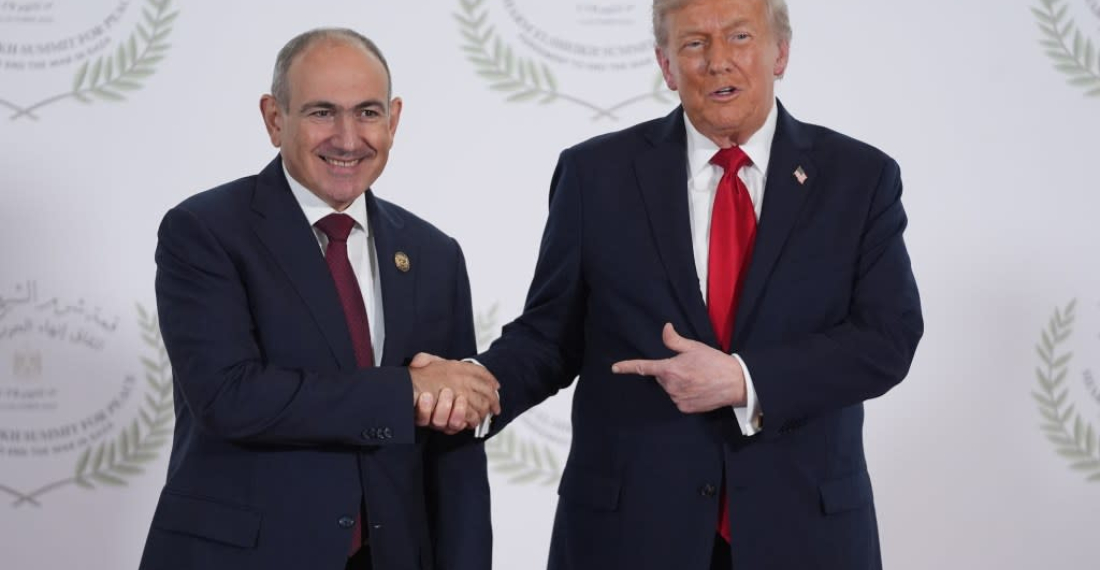
photo: US president Trump, with Armenian prime minister Nikol Pashinyan