


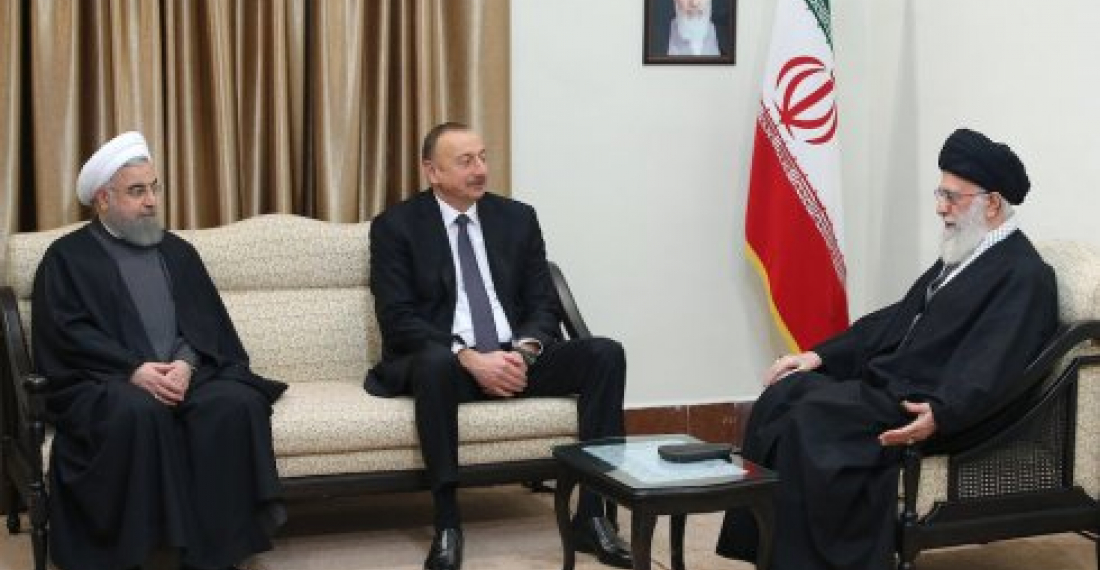
Президент Ирана высоко ценит отношения с Азербайджаном, считая их "дружескими, братскими и стратегическими"

Президенты Ирана и Азербайджана приветствовали хорошие отношения между двумя странами и сообщили, что они с нетерпением ждут расширения сотрудничества. В воскресенье, с официальным визитом в Тегеран прибыл президент Азербайджана Ильхам Алиев, где его приветствовали президент Ирана Рухани и другие высокопоставленные должностные лица. Позже он встретился с верховным лидером Ирана аятолла Али Хамен. Это уже третий официальный визит президента Азербайджана в Иран.

Президент Ирана назвал ирано-азербайджанские отношения "дружескими, братскими и стратегическими", и сказал, что они достаточно сильно развились за последние три года. Стороны недавно подписали ряд соглашений, и еще два соглашения были парафированы в ходе визита.

Иранские СМИ со ссылкой на президента Алиева приводят его слова: "Наши отношения построены на древней истории, культуре и общей религии. На этой прочной основе мы установили очень хорошее сотрудничество. Наши политические отношения находятся на высоком уровне, и мы поддерживаем друг друга во всех международных организации".

В настоящее время Иран и Азербайджан работают над рядом крупных совместных проектов, в том числе мега-проект по развитию железнодорожного сообщения, который соединит Индию, Иран, Центральную Азию, Россию и Европу, что Алиев назвал "историческим и важным" шагом, который принесет пользу всему региону. Коридор, как ожидается, соединит Северную Европу с Юго-Восточной Азией через их территории. По предварительным оценкам, общая мощность железнодорожной дороги будет 1,4 миллиона пассажиров и 5-7 миллионов тонн грузов в год.

источник: commonspace.eu по материалам агентств

фото: Президент Азербайджана Ильхам Алиев в Тегеране с аятолла Али Хаменеи и президентом Роухани (фото любезно предоставлено Tehran times)


Related articles

Editor's choice
News
Russian attacks against Ukrainian civilians continue

Russian attacks against Ukrainian civilians continue

Rescuers in Ukraine are continuing their search for survivors in the wreckage of a big shopping centre hit by Russia on Friday. Sixteen people were killed and 130 injured when two drones hit the busy centre in Kryvyi Rih in quick succession in what is known as a double-tap strike. Four people are still missing. The search and rescue operation could last for another two days. President Volodymyr Zelensky condemned the "cynical and despicable" attack in which the second drone targeted emergency workers. The sides exchanged more fire overnight, with Ukrainian attacks said to have killed at least four people in Russia, including two children, and three people reported dead by Kyiv as a result of Russian strikes. The death toll from Friday's attack reached 16 after another body was retrieved from the rubble overnight, said Dnipropetrovsk regional head Oleksandr Hanzha. "We're doing everything possible to speed up... the search and rescue operation," he told Ukrainian TV on Saturday morning. (click image tio read more)

Popular

Editor's choice
Interview
Thursday Interview: Murad Muradov

Thursday Interview: Murad Muradov

Today, commonspace.eu starts a new regular weekly series. THURSDAY INTERVIEW, conducted by Lauri Nikulainen, will host  persons who are thinkers, opinion shapers, and implementors in their countries and spheres. We start the series with an interview with Murad Muradov, a leading person in Azerbaijan's think tank community. He is also the first co-chair of the Action Committee for a new Armenian-Azerbaijani Dialogue. Last September he made history by being the first Azerbaijani civil society activist to visit Armenia after the 44 day war, and the start of the peace process. Speaking about this visit Murad Muradov said: "My experience was largely positive. My negative expectations luckily didn’t play out. The discussions were respectful, the panel format bringing together experts from Armenia, Azerbaijan, and Turkey was particularly valuable during the NATO Rose-Roth Seminar in Yerevan, and media coverage, while varied in tone, remained largely constructive. Some media outlets though attempted to represent me as more of a government mouthpiece than an independent expert, which was totally misleading.  Overall, I see these initiatives as important steps in rebuilding trust and normalising professional engagement. The fact that soon a larger Azerbaijani civil society visits to Armenia followed, reinforces the sense that this process is moving in the right direction." (click the image to read the interview in full)

