


Анализ: Коронавирус ставит Армению перед трудными вызовами

В этом анализе для commonspace.eu Бениамин Погосян рассказывает о том, как Армения до сих пор справлялась с пандемией коронавируса, и рассматривает возможное массовое воздействие пандемии на экономику.

Пандемия COVID-19 поставила перед правительствами в мире две серьезные проблемы одновременно. Они должны сдерживать вирус посредством широкомасштабного социального дистанцирования, чтобы предотвратить неконтролируемый рост инфицированных людей и крах системы здравоохранения. Между тем, каждый день, который проходит практически без экономической активности, оказывает огромное давление на бизнес и способствует возможному социальному и финансовому краху. Армения столкнулась с той же дилеммой.

Первый случай COVID-19 был выявлен в Армении 1 марта. До этого казалось, что Армения находится далеко от глобальных потрясений, вызванных пандемией. В качестве меры предосторожности правительство Армении отменило безвизовый режим с Китаем в конце января и закрыло сухопутную границу между Арменией и Ираном 24 февраля. Школы, университеты и детские сады были закрыты 2 марта и вновь были открыты 9 марта, так как не было новых случаев. Однако через десять дней COVID-19 начал распространяться в геометрической прогрессии. 16 марта правительство объявило чрезвычайное положение на один месяц и отложило конституционный референдум 5 апреля.

24 марта была объявлена ​​неделя почти полной изоляции, которая была продлена до 13 апреля. Гражданам разрешается покидать свои квартиры только для того, чтобы купить еду или лекарства. Каждый человек должен иметь при себе удостоверение личности, заполнять и хранить специальную форму с указанием своего адреса, адреса назначения, цели пребывания на улице, а также времени выхода и возвращения. Автомобили не могут перевозить более 2 человек, включая водителя. В последние дни на главных автомагистралях страны были размещены полицейские контрольно-пропускные пункты, что значительно препятствовало движению между Ереваном и регионами. Парламент Армении 31 марта 2020 года принял поправки, дающие властям широкие полномочия по надзору за использованием данных мобильных телефонов для отслеживания случаев заболевания коронавирусом. Закон требует, чтобы телекоммуникационные компании предоставляли властям телефонные данные всех своих клиентов, включая номера телефонов, а также место, время и дату их звонков и текстовых сообщений. Власти будут использовать эти данные для мониторинга, изоляции или самоизоляции, а также для индентификации лиц, инфицированных COVID-19, или же тех, кто был в тесном контакте с инфицированными людьми. По состоянию на 6 апреля в Армении зарегистрировано 833 случая и 8 смертей, 62 человека выздоровели.

Отношение общества к вспышке и действиям правительства неоднозначны. Многие признают необходимость строгого социального дистанцирования, но некоторые обвиняют правительство в первоначальном слабом ответе, особенно упоминая решение премьер-министра начать свою кампанию по референдуму по поправкам к Конституции 10 марта и тот факт, что кампания была отменена только в 12 марта, через день после того, как ВОЗ объявила COVID-19 глобальной пандемией. Еще одно спорное решение не отменять прямые рейсы Милан - Ереван, осуществляемые Ryanair - компания недавно вошедшая на армянский рынок в январе 2020 года, а первый Милан - Ереван полет состоялся 14 января. Ryanair сама остановила все международные рейсы в и из Италия, начиная с 14 марта. Парламентская оппозиция и многие представители гражданского общества подверглись резкой критике из-за закона о цифровом слежении от 31 марта, и за него проголосовала только правящая фракция «Мой шаг».

В период с 1 по 15 марта Армянская церковь продолжала проводить открытые литургии. Несмотря на то, что чрезвычайное положение еще не было объявлено, это решение вызвало некоторую критику в адрес церкви. Некоторые круги защищали Церковь, обвиняя критиков в умышленных попытках дискредитировать армянские национальные традиции и самобытность. Однако сразу же после объявления чрезвычайного положения 16 марта Его Святейшество Гарегин II, Верховный Патриарх и Католикос Всех Армян, приказал проводить все литургии за закрытыми дверями без участия прихожан. Решение также отменило службу «Благословение детей» в Вербное воскресенье (5 апреля) и службу «Благословение будущих матерей» в праздник Благовещения Пресвятой Девы Марии (7 апреля).

Массовое влияние на экономику Армении

Одновременно вспышка COVID-19 начала оказывать давление на экономику Армении. В Армении в последние три года наблюдался довольно сильный рост ВВП: 7,5 процента в 2017 году; 5,2 процента в 2018 году; и 7,6 процента в 2019 году. Среди основных факторов экономического роста в 2019 году были 32-процентный рост экспорта медного концентрата и 14,7-процентный рост туризма. Сейчас, из-за вспышки COVID-19, и резкого снижения цен на нефть в марте 2020 года как внутренняя, так и внешняя среда экономики Армении резко ухудшились.

Чрезвычайное национальное положение и изоляция привели к фактическому приостановлению экономики Армении. Российский рубль потерял почти 15 процентов своей стоимости в результате падения цен на нефть. Это делает армянский экспорт менее конкурентоспособным на российском рынке, который остается главным направлением для армянского экспорта. Вероятно, Армения также столкнется с сокращением денежных переводов из России в 2020 году. В 2019 году в Армению было отправлено почти два миллиарда долларов США, и на Россию пришлось 1 миллиард 55 миллионов. Это также окажет значительное негативное влияние на экономику Армении.

Между тем, из-за ограничений на поездки по всему миру, мировой туристический сектор столкнется с худшим годом за последние десятилетия. Это означает, что в 2020 году Армения потеряет один из ключевых столпов своего экономического роста. Одновременно экономический спад, вызванный вспышкой коронавируса, уже спровоцировал снижение цен и спроса на медь. Цена на медь на Лондонской бирже металлов в начале апреля 2020 года составляла 4860 долларов США за тонну по сравнению с 6000 долларов США за тонну в начале января 2020 года.

Таким образом, экономика Армении одновременно переживает множество негативных тенденций: резкое падение туристического сектора; снижение цен на медь; сокращение денежных переводов из России; и сокращение экспорта на его основной рынок. Закрытие потока пассажиров на сухопутных границах с Грузией и Ираном, единственными двумя действующими сухопутными границами Армении, и осложнения для грузовых перевозок окажут дополнительное негативное влияние.

Несколько отечественных и международных организаций уже предсказали снижение роста ВВП в Армении. Правительство предполагало рост экономики на 2020 год на 4,9 процента, но в начале апреля, согласно оценке Центрального банка Армении, этот показатель составил всего 0,7 процента; Азиатский банк развития сообщил о росте ВВП на 2,2 процента; и оценка Fitch Ratings роста ВВП в 2020 году была на уровне 0,5 процента. Однако все эти оценки основаны на данных за февраль - середину марта 2020 года и не могут считаться полностью надежными из-за быстро развивающейся ситуации.

Правительство Армении уже одобрило 9 проектов экономического и социального стимулирования, направленных на смягчение последствий кризиса. Четыре проекта экономического стимулирования предусматривают вложение 300 миллионов долларов в экономику. Правительство будет покрывать проценты по кредитам для нескольких малых и средних предприятий. Что касается проектов социальной поддержки, то единовременный платеж на основе шкалы тестирования средств будет перечисляться тем семьям, где родители либо потеряли работу в период с 13 по 25 марта 2020 года, либо являются безработными. В последнем случае каждый ребенок в возрасте до 18 лет получит единовременный платеж в размере 53 долларов США, а родители, которые оба потеряли зарегистрированную работу или один из них потерял зарегистрированную работу, а другие вообще не имеют работы, получат единовременный платеж в размере 200 долларов США на каждого ребенка до 14 лет. Сотрудники компаний, которые прекратили свою деятельность из-за введенных ограничений, а также индивидуальные предприниматели, которых много в основном в секторах, связанных с туризмом, таких как гостиницы, хостелы, кафе и рестораны, получат единовременную выплату в размере 136-276 долларов США.

Однако, поскольку, скорее всего, ограничения, связанные с COVID-19, будут продолжаться в течение нескольких месяцев, а возвращение к нормальной жизни можно ожидать только в середине или конце лета, многие армяне столкнутся с ухудшением своего уровня жизни.

Армения не сможет избежать экономического спада, и ключевой вопрос заключается в том, чтобы предотвратить повторение ситуации 2009 года, когда в Армении в результате финансового кризиса 2007-2008 годов наблюдалось снижение ВВП на 14,4 процента. В данном сценарии любые результаты, которые будут ниже 10% снижения ВВП в 2020 году, могут восприниматься как своего рода успех.

источники: Этот анализ был подготовлен для commonspace.eu Бениамином Погосяном, основателем и председателем Центра политических и экономических стратегических исследований в Ереване.

 

Latest

Editor's choice
Monday Commentary
Monday Commentary: PEACE IN OUR TIME?

Monday Commentary: PEACE IN OUR TIME?

Making peace between Armenia and Azerbaijan was never going to be simple, nor easy, nor quick. It is taking time, writes Dennis Sammut in this Monday Commentary. “There is a sense of realism coming from the leaders of the two countries – President Ilham Aliyev of Azerbaijan and prime minister Nikol Pashinyan of Armenia, that frankly, is necessary and welcome”, he writes. At a time when conflicts are raging all over the world – from Ukraine to the Gulf, from Africa to South Asia, the prospect that Armenia and Azerbaijan had finally, after decades of conflict that left thousands of dead and many more displaced, decided on embarking on a journey of peace was welcomed. Peace between Armenia and Azerbaijan can be top-down up to a point. Both leaders have spent political capital preparing for a peace deal. But both are aware that their people are not ready for peace yet. In fact, in Armenia, most of the elite are negative toward a peace deal with Azerbaijan. Pashinyan needs time to persuade his countryfolk. That is why 2031 is realistic. Ilham Aliyev runs a tighter shop, but he is also not immune to public opinion. Every time someone hits a landmine in Karabakh, which unfortunately happens often, peace comes into question. Which is why Aliyev chooses to sound hardline, more often than not. In pursuing the peace agenda, both Aliyev and Pashinyan need to proceed cautiously. But they are right in making peace the central issue in their agenda. It is the main issue, and the one that will define them in history. So forward, cautiously but resolutely! In pursuing the peace agenda, Aliyev and Pashinyan need to be supported clearly and unambiguously. There are too many people in Baku and Yerevan who are sitting on the sides, waiting. The international community is not doing enough. It is time to be counted. Otherwise, the spoilers will win, and the region will go back to its bad habits. (Click the image to read the full commentary).
Editor's choice
News
Ukraine Peace Talks Set to Expand as Russia and Europe Clash Over Post-war Security

Ukraine Peace Talks Set to Expand as Russia and Europe Clash Over Post-war Security

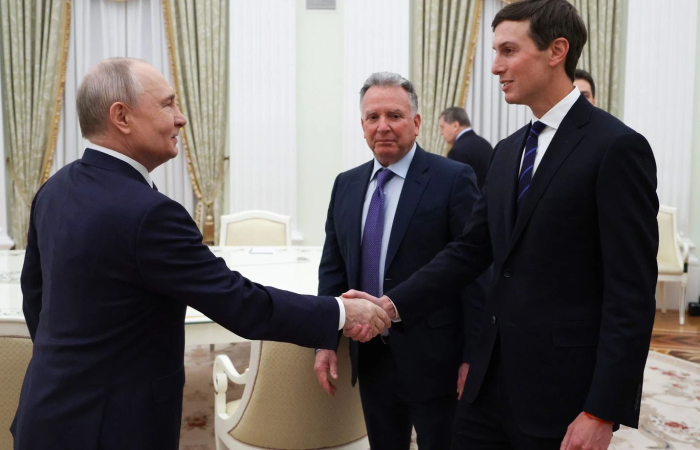
Ukraine and Russia could see European countries join the next round of peace negotiations, following talks between US special envoys Steve Witkoff and Jared Kushner and Russian President Vladimir Putin in Moscow on Thursday (November 12). However, conflicting positions over European military involvement, Ukraine’s territorial future and the continent’s security arrangements highlight the difficulties facing the diplomatic process. Speaking after the meeting, Witkoff said European participation would be an important development, describing the countries concerned as key partners. Kushner also indicated that Washington had noticed a shift in European attitudes and believed their involvement would not obstruct progress. In a statement published on X, he said the expanded discussions would address broader European security arrangements alongside territorial disputes between Russia and Ukraine. The US envoys subsequently travelled to Dublin, where they met Ukrainian President Volodymyr Zelenskyy during a European summit. Zelenskyy welcomed the possibility of European participation and expressed hope that the negotiations would include measures to reduce tensions and establish ceasefires. He also reiterated the importance of European representation in decisions concerning the continent’s security. Moscow, however, has offered a more cautious interpretation of the proposed expansion. Putin's aide, Yuri Ushakov, suggested that European countries should first reconsider their military assistance to Kyiv, arguing that their current actions demonstrated an unwillingness to pursue peace. Putin similarly called on Washington to work with its European allies to establish whether they genuinely wanted peace or continued confrontation with Russia. The Russian president also rejected the prospect of European peacekeeping troops being deployed to Ukraine following a potential agreement, describing such a presence as a continuation of the war. His position reflects wider disagreements over the future European security architecture, with Moscow seeking discussions on the continent's broader security arrangements, while European leaders insist that such negotiations cannot replace a settlement of the war. Simultaneously, Zelenskyy raised concerns about disruptions to Starshield, the US-made satellite communications service used by Ukrainian forces. He described Washington’s discussions with Moscow about Europe's future security as unusual and warned against decisions that could undermine Ukraine's sovereignty. Despite the diplomatic activity, fighting continued. Russian drone attacks killed two people in Ukraine's Sumy region and injured five in Rivne, while a separate attack in Russia's Belgorod region killed one person and injured four. Ukrainian agricultural company Kernel Holding also suspended operations at all its oilseed extraction facilities following repeated Russian attacks.

Popular

Editor's choice
Monday Commentary
Monday Commentary: European-Azerbaijan relations need an intensive and multifaceted dialogue that is frank and honest

Monday Commentary: European-Azerbaijan relations need an intensive and multifaceted dialogue that is frank and honest

Last week I visited Baku, Azerbaijan. My visit was relatively short, but very intensive, and had many meetings with stakeholders and colleagues. When I arrived in Baku first time in 1996,  Azerbaijan was a different country: weak, poor, and shaken by defeat in war. For thirty year the Karabakh issue dominated the agenda: the political agenda but also the popular mindset. Now, thirty years later, Azerbaijan has returned to Karabakh, and peace with Armenia is on the horizon. It is a new era for Armenia-Azerbaijan relations, for the South Caucasus, but also for Europe.  But we cannot be complacent: the Peace agreement has been initialed but not signed; borders remain closed; TRIPP is ambitious but remains an idea; and there are spoilers who want to turn the clock back. We must not allow them, and in this Europe and Azerbaijan must work together. Europe’ vanguard organization is the European Union – it is a free union of 27 member states; it is a strong global economic force, and increasingly a diplomatic and military force too. But it remains “work in progress” and can often appear dysfunctional. It often lacks collective and institutional memory. In its dealings with Azerbaijan the EU has made many mistakes – not least opening the delegation here late – in 2008. It sometimes appears condescending. Some utterances from the European Parliament and from some quarters in some member states are not understandable even for me. They irritate the Azerbaijanis, but serve no other purpose But Azerbaijan has also not handled relations with the EU well. It has failed to respond when the hand of friendship reached out; and it confused irritating actions, sometimes by well-meaning people; sometimes by outright spoilers, with strategic action. In short, EU-Azerbaijan relations have suffered from a lack of proper dialogue. This dialogue must be frank, honest and multi-faceted involving different segments of society on both sides.   Is Azerbaijan Europe? When Azerbaijan applied to join the Council of Europe in the 1990s, there were some who opposed, saying this was not Europe. I was one of the people who argued that Armenia and Azerbaijan may be on the periphery of the continent geographically, but were European in essence. Certainly their elites. During the discussion on 4 September in Baku, my friend Farhad Mammedov, mentioned that Azerbaijan is not interested in joining the EU, and was now close to the Central Asian countries in the 5 plus 1 format. Neither things mean that Azerbaijan is not Europe. There are several European countries that are not in the EU, and do not want to be, for example Norway and Switzerland. Iceland has recently voted to stay out of the EU. The UK was a member and left. Europe is bigger than the EU, and the holding of the European Political Community summit in Baku in 2027 proves that. Despite all the rhetoric, I never heard the president of Azerbaijan  saying that Azerbaijan is not Europe, nor have I heard any European president say it either. Not wanting to join the EU and forging close relations with neighbouring regions does not make Azerbaijan any less European. It is only logical that when Europeans talk to Azerbaijan they talk like family. The conversation is often frank. It must also be honest, and Europeans need always to remember this too. A frank, honest and multi-faceted dialogue A frank, honest and multifaceted dialogue will contribute to relations between Azerbaijan and the rest of Europe: it will avoid misperception, which unfortunately is very common on both sides; it will provide a forum where problems can be discussed and resolved, and it will increase mutual trust, so that together common problems can be addressed. (click image to read the full Monday Commentary)
Editor's choice
Monday Commentary
Monday Commentary: “The barren rocks of Aden” and “These lands of Yemen are so ruthless”

Monday Commentary: “The barren rocks of Aden” and “These lands of Yemen are so ruthless”

There are two early 20th-century tunes that mark foreign attempts to occupy and “pacify” Yemen. The Scottish tune “The barren rocks of Aden” marks the mobilisation of Highland soldiers, enlisted to be deployed to the Yemeni port of Aden, that in 1837 became the last colony to be incorporated into the British Empire. The tune talks of the harshness of the terrain, but is celebratory, It was even played as a farewell tune to Sir William Luce at the parade in Sharjah celebrating his end as “British Viceroy” in the Middle East in 1966. The second tune is an Anatolian lament. As Ilker Sezer reminded us this weekend, in his weekly feature on “Turkiye Today”, it “mourns the tragic fate of Ottoman soldiers dispatched to the harsh, remote deserts of Yemen during the fall of the empire, young men who marched away from their villages and never returned home. Most of their names, and numbers, were never recorded. Yet, their fate left a mark on the Turkish psyche.” Subsequent invaders have discovered that Yemen is a grave that cannot be overcome by the strength of modern technology, and that whilst Yemeni society is splintered and divided, building a reliable alliance with Yemeni factions is difficult. These are the harsh lessons facing Saudi Arabia, as the Kingdom faces its biggest challenge in its modern history. The leadership of the Kingdom now has to respond decisively. At stake is their very credibility. This is likely to be a long and messy conflict. Saudi military objectives need to be focused: to box in the Houthis rather than destroy them. This is likely to include: (a) regaining territory lost on the Red Sea coast; (b) control over Bab el Mandeb Strait; (c) some kind of cordon sanitaire on the Saudi-Yemeni border; and if things go well (d) the capture of Sanaa. All this would not eliminate the Houthi problem, but it will contain it. In the end the Saudis will have to continue managing Yemen with a mixture of carrot and stick. For the moment, the stick is likely, but the carrot cannot be forgotten either. (click the image to read the Monday Commentary in full)

