


Алиев: Механизм по расследованию можно будет обсуждать после начала вывода армянских войск

Президент Азербайджана Ильхам Алиев сделал свой первый комментарии по поводу прошедшей в Санкт-Петербурге в начале этой недели встречи с его армянским коллегой, которая состоялась по инициативе президента России. Он заявил, что "если смысл в том, чтобы заморозить конфликт и принять какие-то дополнительные меры на линии соприкосновения, то Азербайджан, конечно, на это не пойдет".

Алиев сказал об этом на мероприятии по случаю дня Вооруженных сил Азербайджана.

Ссылаясь на встречу в Санкт-Петербурге президент Азербайджана заявил, что "Надеюсь, что данный процесс будет стремительно продолжаться. Мы вновь идем на эти переговоры, не принимая никаких условий. Переговоры должны быть осмысленными, предметными, они не должны проводиться просто для видимости, имитации. По итогам встречи в Санкт-Петербурге была принята совместная декларация. Она тоже представлена общественности. В той декларации указано все, в частности, пути решения вопроса. Наряду с этим, был также обсужден вопрос увеличения численного состава работников офиса личного представителя председателя ОБСЕ. Правда, там численность не указана. Но я могу сказать, что если сегодня в этом офисе работают 6 человек, то их число может быть увеличено максимум в 2-2,5 раза. То есть речь здесь не идет о большой миссии. Если учесть, что линия соприкосновения измеряется десятками километров, то не следует искать в этих делах другого смысла. Мандат офиса также на месте, никаких изменений нет. Просто вместо 6 будут 12, 13 или 14 человек, вот и все.

Что касается выдвинутого армянами в качестве условия применения механизма расследования инцидентов, то считаю, что на нынешнем этапе необходимости в этом нет.

Во-первых, таких механизмов нет. Никто не говорит нам конкретно, в чем они будут заключаться. В таком случает рассматривать данный вопрос сегодня было бы неправильно. Во-вторых, в чем заключается смысл этого. Если смысл в том, чтобы заморозить конфликт и принять какие-то дополнительные меры на линии соприкосновения, то Азербайджан, конечно, на это не пойдет. Это возможно в том случае, если в переговорном процессе будет продолжаться позитивная динамика, мы увидим конкретные результаты, будем знать, когда наши земли будут освобождены от оккупации. Тогда, конечно, могут быть разработаны различные механизмы и рассмотрен данный вопрос."

Ильхам Алиев сказал, что он хотел бы отметить один важный момент в заявлении, принятом в Санкт-Петербурге: "Там было отмечено, что в последнее время ситуация на линии соприкосновения стабильна, восстановлено прекращение огня и это расценивается как позитивный факт. В таком случае никакой необходимости в применении механизма расследования инцидентов не остается. То есть и это условие не было принято.

Еще раз хочу сказать, мы должны вести переговоры по сути вопроса. Захватнической политике Армении должен быть положен конец. Мы должны знать, когда начнется процесс освобождения наших земель. Этот процесс, конечно, будет. Азербайджанская сторона и я лично неоднократно говорили, что мы можем урегулировать данный конфликт только поэтапным путем, так как иначе невозможно. Армения всегда пыталась еще более осложнить ситуацию, нарушить переговорный процесс и вариант поэтапного решения. Но мы считаем, что это - самый приемлемый путь. Он может в скором времени привести к решению вопроса. Хочу еще раз отметить, что принципиальная позиция Азербайджанского государства по решению вопроса налицо. Никаких изменений в этой позиции не было и не будет."

Хочу повторить, вопрос должен найти решение в рамках территориальной целостности Азербайджана. Нагорному Карабаху никогда не будет предоставлена независимость, на исторических землях Азербайджана никогда не будет создано второе армянское государство.

Это - главный вопрос. Что же касается, статуса Нагорного Карабаха, то это дело будущего. Конечно, определенный статус может быть. В составе Азербайджана существует Нахчыванская Автономная Республика. Она имеет статус автономии. В Европе, других странах есть прогрессивный опыт и различные статусы. Однако этот статус не должен нарушать территориальной целостности нашей страны."

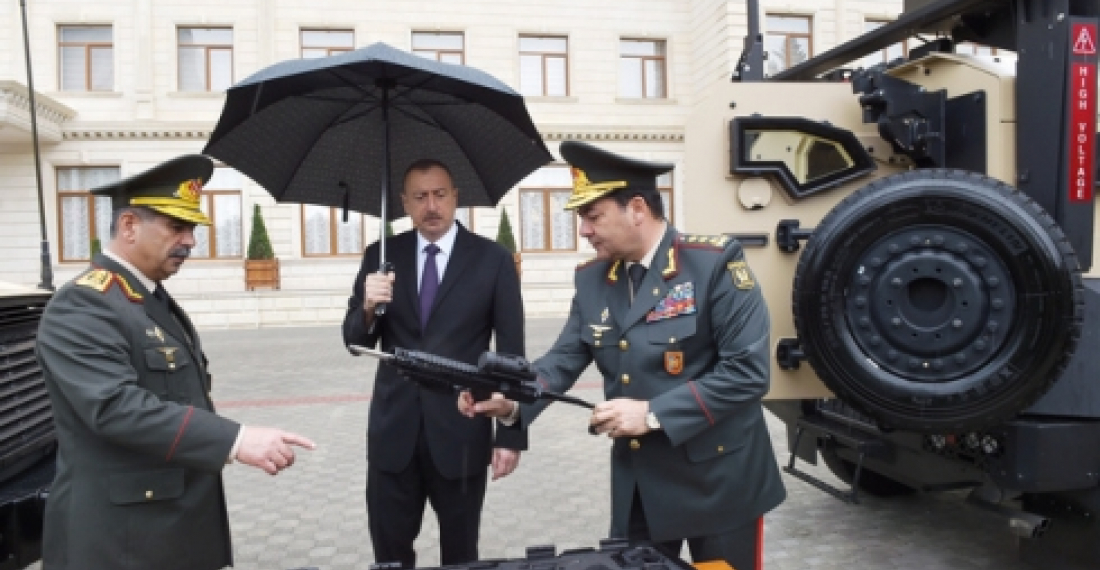
Президент Ильхам Алиев выступил на открытии новой штаб-квартиры Главного штаба Вооруженных сил Азербайджана.

источник: Commonspace.eu по материалам president.az

фото: Президент Ильхам Алиев осмотрел военную технику во время церемонии по случаю дня Вооруженных сил Азербайджана.
 

Related articles

Editor's choice
News
Russia adds pressure on Armenia ahead of key elections; recalls Ambassador in Yerevan for consultations

Russia adds pressure on Armenia ahead of key elections; recalls Ambassador in Yerevan for consultations

Ahead of key parliamentary elections,scheduled to be held in Armenia on Sunday, 7 June, Russia continues to attempt to put pressure on the Armenian Government led by prime minister Nikol Pashinyan. On 30 May, Russia recalled its Ambassador to Yerevan for consultations. A terse statement, published on the website of the Russian Foreign Ministry, said, "The Ambassador of the Russian Federation to the Republic of Armenia , S.P. Kopyrkin, has been summoned to Moscow for consultations in connection with the steps taken by the Armenian leadership to move closer to the European Union, which are detrimental to cooperation within the EAEU." This followed a statement issued the day before, by the leaders of the Eurasian Economic Union (EAEU) that challenges the Armenian trajectory towards approximating to the European Union. Vladimir Putin is undertood to have personally pushed the other four EAEU leaders to issue the statement, which said: "Taking into account the significant risks to the economic security of the member states of the Eurasian Economic Union (hereinafter referred to as the Union) arising in connection with the preparation of the Republic of Armenia for accession to the European Union, as well as the need to prevent the associated damage to the member states of the Union: decided that the members of the Eurasian Intergovernmental Council from the Republic of Belarus, the Republic of Kazakhstan, the Kyrgyz Republic and the Russian Federation will report at the next meeting of the Supreme Eurasian Economic Council in December 2026 on the possible consequences of the suspension of the Treaty on the Eurasian Economic Union with respect to the Republic of Armenia. We share the position on the need to hold a national referendum in the Republic of Armenia as soon as possible on joining the European Union or continuing to be part of the Eurasian Economic Union."
Editor's choice
News
The leaders of the states of the Eurasian Economic Union issued a tough statement warning fellow-member state Armenia of the consequences of its desire to join the European Union.

The leaders of the states of the Eurasian Economic Union issued a tough statement warning fellow-member state Armenia of the consequences of its desire to join the European Union.

The leaders of the states of the Eurasian Economic Union (EEAS) issued a tough statement warning fellow-member state Armenia of the consequences of its desire to join the European Union. The stark, sharply worded,  warning, comes days before crucial parliamentary elections in Armenia, scheduled for 7 June. The full statement said, “We, the Presidents of the Republic of Belarus, the Republic of Kazakhstan, the Kyrgyz Republic and the Russian Federation, Taking into account the actions of the Republic of Armenia aimed at joining the European Union, including the approval in 2025 by the National Assembly of the Republic of Armenia and the signing by the President of the Republic of Armenia of the Law of the Republic of Armenia "On the Start of the Process of Accession of the Republic of Armenia to the European Union", as well as the confirmation by the European Union of the European aspirations of the Government of the Republic of Armenia, expressed in the joint declaration following the first Armenia-European Union summit, adopted on 5 May 2026, Taking into account the significant risks to the economic security of the member states of the Eurasian Economic Union (hereinafter referred to as the Union) arising in connection with the preparation of the Republic of Armenia for accession to the European Union, as well as the need to prevent the associated damage to the member states of the Union: decided that the members of the Eurasian Intergovernmental Council from the Republic of Belarus, the Republic of Kazakhstan, the Kyrgyz Republic and the Russian Federation will report at the next meeting of the Supreme Eurasian Economic Council in December 2026 on the possible consequences of the suspension of the Treaty on the Eurasian Economic Union with respect to the Republic of Armenia. We share the position on the need to hold a national referendum in the Republic of Armenia as soon as possible on joining the European Union or continuing to be part of the Eurasian Economic Union. Astana, May 29, 2026” A meeting of the Supreme Eurasian Economic Council was held in Astana, Kazakhstan, on May 29, 2026. The meeting of the Supreme Eurasian Economic Council in a restricted format was attended by Russian President Vladimir Putin, Belarusian President Alexander Lukashenko , Kazakh President Kassym-Jomart Tokayev , Kyrgyz President Sadyr Japarov , Armenian Deputy Prime Minister Mher Grigoryan, and Chairman of the Board of the Eurasian Economic Commission Bakytzhan Sagintayev. From the Russian side, the meeting was also attended by Deputy Prime Minister and member of the Council of the Eurasian Economic Commission Alexey Overchuk and Presidential Aide Yury Ushakov . The heads of delegations from EAEU observer states, including President of Uzbekistan Shavkat Mirziyoyev , Vice President of Cuba Salvador Valdés Mesa, Minister of Industry, Mines, and Trade of Iran Mohammad Atabak, and CIS Secretary General Sergei Lebedev, joined the expanded meeting . Following the meeting of the Supreme Eurasian Economic Council, a number of documents were signed .

Popular

Editor's choice
Interview
Thursday Interview: Murad Muradov

Thursday Interview: Murad Muradov

Today, commonspace.eu starts a new regular weekly series. THURSDAY INTERVIEW, conducted by Lauri Nikulainen, will host  persons who are thinkers, opinion shapers, and implementors in their countries and spheres. We start the series with an interview with Murad Muradov, a leading person in Azerbaijan's think tank community. He is also the first co-chair of the Action Committee for a new Armenian-Azerbaijani Dialogue. Last September he made history by being the first Azerbaijani civil society activist to visit Armenia after the 44 day war, and the start of the peace process. Speaking about this visit Murad Muradov said: "My experience was largely positive. My negative expectations luckily didn’t play out. The discussions were respectful, the panel format bringing together experts from Armenia, Azerbaijan, and Turkey was particularly valuable during the NATO Rose-Roth Seminar in Yerevan, and media coverage, while varied in tone, remained largely constructive. Some media outlets though attempted to represent me as more of a government mouthpiece than an independent expert, which was totally misleading.  Overall, I see these initiatives as important steps in rebuilding trust and normalising professional engagement. The fact that soon a larger Azerbaijani civil society visits to Armenia followed, reinforces the sense that this process is moving in the right direction." (click the image to read the interview in full)

