


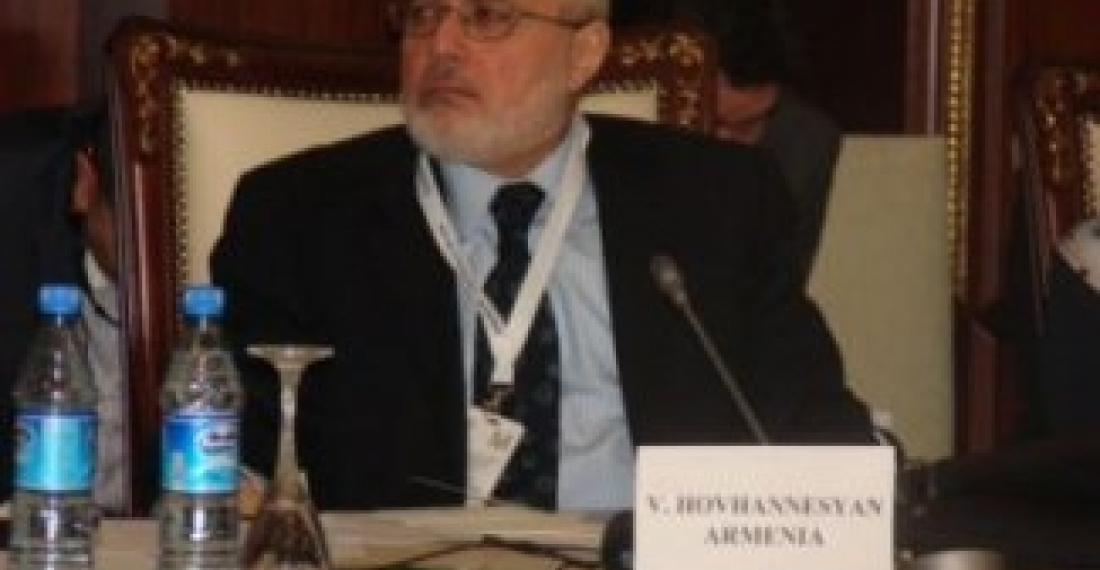
Руководитель фракции «Дашнакцутюн» считает взаимные уступки необходимым условием прогресса в урегулировании конфликта

БАКУ, 2 апр – 1NEWS.AZ

Я считаю, что статус-кво, когда нет ни войны, ни мира, естественно, не может продолжаться вечно, заявил азербайджанским журналистам глава делегации Армении в ПА «Евронест», руководитель фракции АРФ «Дашнакцутюн» в Национальном собрании Армении Ваан Ованнисян.

«Конечно, даже такой мир лучше войны, поскольку вы знаете, что мы очень часто слышим заявления после каждого тура переговоров о том, что у Азербайджана гораздо больший бюджет, и что значительная его часть расходуется на вооружение, и это верно», - сказал он в рамках проходящей в Баку Второй очередной сессии Парламентской Ассамблеи «Евронест», сообщает 1news.az.

По его мнению, «некоторые официальные лица Азербайджана из этого делают вывод, что решения вопроса проще достичь войной». «Но я думаю (по крайней мере, военные в Азербайджане должны знать), то, что тратится на наступательные средства вооружения, на порядки, в несколько раз всегда дороже оборонительных систем, на которые Армения расходует свой скромный бюджет. Конечно, Азербайджан всегда был богаче Армении и в обозримом будущем он будет богаче Армении. Но Армения никогда не будет настолько бедна, чтобы не иметь возможности себе позволить оборонительные системы. Поэтому, видимо, лучше найти компромисс, где обе стороны сделают взаимоприемлемые уступки.», - сказал В.Ованнисян.

Он отметил, что «со стороны Азербайджана пока что поступают предложения к возвращению к ситуации 1988 года, то есть Нагорный Карабах полностью в составе Азербайджана». «И предлагается какой-то уровень автономии. Но какой-то уровень автономии существовал и раньше. Значит, видимо, не в этом решение проблемы. Я думаю, что решение проблемы есть. И мирное решение проблемы тоже есть. Но для этого хотя бы однажды армянская сторона должна услышать азербайджанскую сторону, которая заявит, что она тоже согласна на уступки. Вот когда это будет сделано, тогда, я повторяю, когда уступки с двух сторон будут приведены к единой форме, решение вопроса займет всего несколько недель», - подчеркнул В.Ованнисян.
Related articles

Editor's choice
News
The British prime minister says Europe must "stand on its own two feet" when it comes to defence

The British prime minister says Europe must "stand on its own two feet" when it comes to defence

The UK will deploy a carrier strike group, led by the aircraft carrier HMS Prince of Wales to the Arctic and the High North as part of efforts to bolster security against Russian threats. British prime minister, Sir Keir Starmer announced the deployment in a speech on Saturday (14 February) at the Munich Security Conference. Europe must be ready to fight to protect its people, values, and way of life,  Sir Keir told the Conference. Starmer also called for deeper links and cooperation, including economic ties, between the UK and EU. The PM stressed the continent must "stand on its own two feet" when it comes to defence commitments. "We must build our hard power, because that is the currency of the age," he told the conference. (Click image to read the full story).

Popular

Editor's choice
Interview
Thursday Interview: Murad Muradov

Thursday Interview: Murad Muradov

Today, commonspace.eu starts a new regular weekly series. THURSDAY INTERVIEW, conducted by Lauri Nikulainen, will host  persons who are thinkers, opinion shapers, and implementors in their countries and spheres. We start the series with an interview with Murad Muradov, a leading person in Azerbaijan's think tank community. He is also the first co-chair of the Action Committee for a new Armenian-Azerbaijani Dialogue. Last September he made history by being the first Azerbaijani civil society activist to visit Armenia after the 44 day war, and the start of the peace process. Speaking about this visit Murad Muradov said: "My experience was largely positive. My negative expectations luckily didn’t play out. The discussions were respectful, the panel format bringing together experts from Armenia, Azerbaijan, and Turkey was particularly valuable during the NATO Rose-Roth Seminar in Yerevan, and media coverage, while varied in tone, remained largely constructive. Some media outlets though attempted to represent me as more of a government mouthpiece than an independent expert, which was totally misleading.  Overall, I see these initiatives as important steps in rebuilding trust and normalising professional engagement. The fact that soon a larger Azerbaijani civil society visits to Armenia followed, reinforces the sense that this process is moving in the right direction." (click the image to read the interview in full)

