


Политическое землетрясение в Турции в общем имеет положительные результаты.

Этот комментарий подготовлен политическим редактором commonspace.eu

На результаты состоявшихся в воскресенье (7 июня) выборов в Турции можно посмотреть с двух разных сторон. Правящая Партия справедливости и развития (ПСР), которую поддерживает президент Реджеп Тайип Эрдоган стала крупнейшей партией представленной в парламенте, но не добрала до конституционного большинства. Вместо того, чтобы изменить конституцию и дать больше полномочий Эрдогану, как они надеялись это сделать, ПСР в настоящее время вынужден бороться за сохранение власти.

Пессимисты скажут, что неопределенность в результате того, что ни одна из партии не взяла большинство навредит экономике Турции, и приведет к политическому кризису. Другие укажут на опасность ситуации, которая может возникнуть, если президент Эрдоган решит помыкать парламентом, на что у него, безусловно, будет соблазн.

Но на результаты выборов можно посмотреть и с другой, гораздо более позитивной стороны. В Турции победила демократия. Несмотря на то, что ПСР остается самой популярной, и на сегодняшний день крупнейшей политической силой в стране, избиратели, обеспокоенные авторитарными замашками, которые стали проглядываться в действиях президента и его сторонников, обрезали ей [партии] крылья. В этом смысле демократии возобладала.

Состоявшиеся выборы, хотя и были омрачены происшествиями, в целом были свободными и справедливыми - не то, что должно восприниматься как само собой разумеющимся, что после всего вполне резонно можно назвать новой демократией. С точки зрения явки избирателей, с более чем сорока шестью миллионами проголосовавших избирателей, это, наверное, было крупнейшим выражение воли народа в Европе в едином национальному голосовании за последние годы, если принять тот факт, что выборы в России далеки от свободных и справедливых.

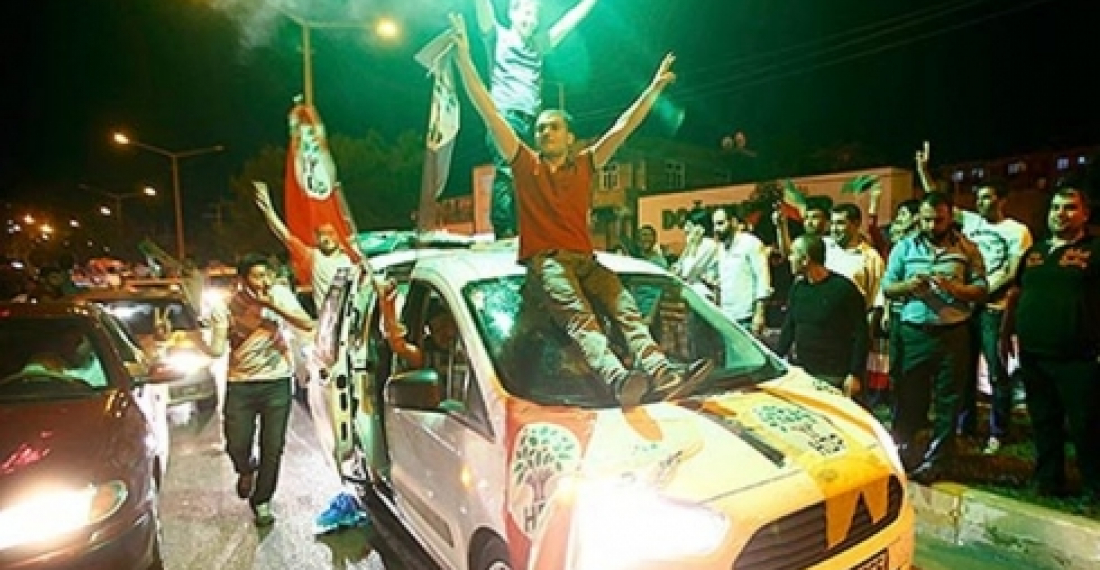
Третья причина, почему эти выборы должны быть рассмотрены с положительной точки зрения является тот факт, что новая партия, которая представляет интересы курдского меньшинства в Турции, НДП - Народно-демократическая партия преодолела минимальный порог и будет представлена в парламенте значительным количеством депутатов. В нынешней ситуации отсутствия у одной из партии абсолютного большинства дает НДП возможность занять важную роль в формировании будущего Турции, что следует приветствовать. Курдское меньшинство уже в течение длительного времени лишено гражданских прав, в связи с положением в конституции Турции, которое требует от партии преодоления 10% барьера при голосовании для прохождения в парламент. Усилия НДП по привлечению новых сторонников в лице левых и прогрессивных сил, помимо курдов, увенчались успехом, и помимо этого возможно имело место некоторое тактическое голосование со стороны других оппозиционных партий, которые хотели, чтобы НДП преодолело порог.

Реджеп Тайип Эрдоган доминировал на турецкой политической сцене более десяти лет. Он по-прежнему является популярным, особенно в Сердцеземье Анатолии и среди более социально-консервативных элементов турецкого общества. Он возглавлял в период радикальных и давно назревших перемен в Турции, которые прошли в основном мирно и в рамках правовых норм. В прошлом году турки избрали Эрдогана своим президентом - очень символичный пост, который несет за собой немного реальных полномочий. По результатам этих выборов понятно то, что турки не поддерживают его последнюю инициативу, которая подразумевала передачу президенту исполнительной власти. Их мнение теперь должно соблюдаться, и Эрдоган должен приложить усилия, чтобы иметь меньше разногласий во взглядах и мнениях. Турция должна продолжить модернизацию и реформы в целях становления современной и процветающей страной, которая много чем сможет поделиться с Европой и миром.

Источник: Этот комментарий был подготовлен политическим редактором commonspace.eu

Фото: Сторонники про-курдской НДП в Диярбакыр празднуют вступление своей партии в парламент по итогам парламентских выборов, состоявшихся в Турции 7 июня 2015 года (фото любезно предоставлено Today's Zaman)


 

Related articles

Editor's choice
News
European Political Community Summit opens in Yerevan

European Political Community Summit opens in Yerevan

The 8th Summit of the European Political Community (EPC) opened on Monday morning (4 May) in the Armenian Capital Yerevan. It is held under the slogan "Building the future: unity and stability in Europe". At the start of the meeting the leaders took a "family photo". (See image) The European Political Community (EPC) brings together the Leaders of around 50 European partners on an equal footing, in a spirit of unity, and with a shared purpose. It provides a political platform to: 1. foster political dialogue and cooperation to address issues of common interest 2. strengthen the security, stability and prosperity of the European continent The EPC offers a space for European Leaders to engage, exchange and enhance cooperation. It does not replace any existing organisation, structure or process. The European Political Community has met seven times since 2022, and convenes for the 8th time in Yerevan on the 4th of May 2026. European leaders arrived in Yerevan from all across Europe on 3 May to participate in the summit, making this the largest gathering of European leaders in the South Caucasus ever. Among those is Yerevan is French President, Emanuel Macron, who on Sunday evening, accompanied by Armenian prime minister Nikol Pashinyan, went on a walk on the streets of Yerevan. Canadian prime minister, Mark Carney, is also in Yerevan. He is the first non-European leader to participate in an EPC summit. There was a lot of speculation regarding Azerbaijan's participation. It is now understood that president Ilham Aliyev will participate in the summit by video link. commonspace.eu special correspondent at the summit, Alex Verge, will file a report on the summit conclusions at the end of the meeting.
Editor's choice
News
(Updated) European leaders arrive in Armenia for Monday's summit of the European Political Community

(Updated) European leaders arrive in Armenia for Monday's summit of the European Political Community

Updated at 1700 CEST. European leaders are arriving in Armenia on Sunday, for the 8th summit of the European Political Community (EPC), which is expected to take place in Yerevan on Monday 4 April. This is the biggest gathering of European leaders in the South Caucasus ever. This afternoon, British Prime Minister, Sir Keir Starmer, and Polish prime minister Donald Tusk where amongst those arriving. Sir Keir was welcomed at Zvarnots International Airport by Vahagn Khachaturyan, the president of Armenia Also among those arriving will be French President, Emanuel Macron, European Commission president, Ursula von der Leyen and European Council president, Antonio Costa. Ukrainian president Volodmyr Zelenski is also expected to attend and he is already in the Armenian capital. Turkish Vice president, Turkish Vice President Cevdet Yilmaz will represent his country in the summit. Also present will be Canadian prime minister, Mark Carney. The European Political Community (EPC) is an intergovernmental forum for political and strategic discussions about the future of Europe established in 2022 after the Russian invasion of Ukraine The group first met in October 2022 in Prague. The 47 EPC participating states are home to 689.5 million people, constitute 8.7 percent of the world's population and represent about 23.5 percent of the global GDP.

Popular

Editor's choice
Interview
Thursday Interview: Murad Muradov

Thursday Interview: Murad Muradov

Today, commonspace.eu starts a new regular weekly series. THURSDAY INTERVIEW, conducted by Lauri Nikulainen, will host  persons who are thinkers, opinion shapers, and implementors in their countries and spheres. We start the series with an interview with Murad Muradov, a leading person in Azerbaijan's think tank community. He is also the first co-chair of the Action Committee for a new Armenian-Azerbaijani Dialogue. Last September he made history by being the first Azerbaijani civil society activist to visit Armenia after the 44 day war, and the start of the peace process. Speaking about this visit Murad Muradov said: "My experience was largely positive. My negative expectations luckily didn’t play out. The discussions were respectful, the panel format bringing together experts from Armenia, Azerbaijan, and Turkey was particularly valuable during the NATO Rose-Roth Seminar in Yerevan, and media coverage, while varied in tone, remained largely constructive. Some media outlets though attempted to represent me as more of a government mouthpiece than an independent expert, which was totally misleading.  Overall, I see these initiatives as important steps in rebuilding trust and normalising professional engagement. The fact that soon a larger Azerbaijani civil society visits to Armenia followed, reinforces the sense that this process is moving in the right direction." (click the image to read the interview in full)

