


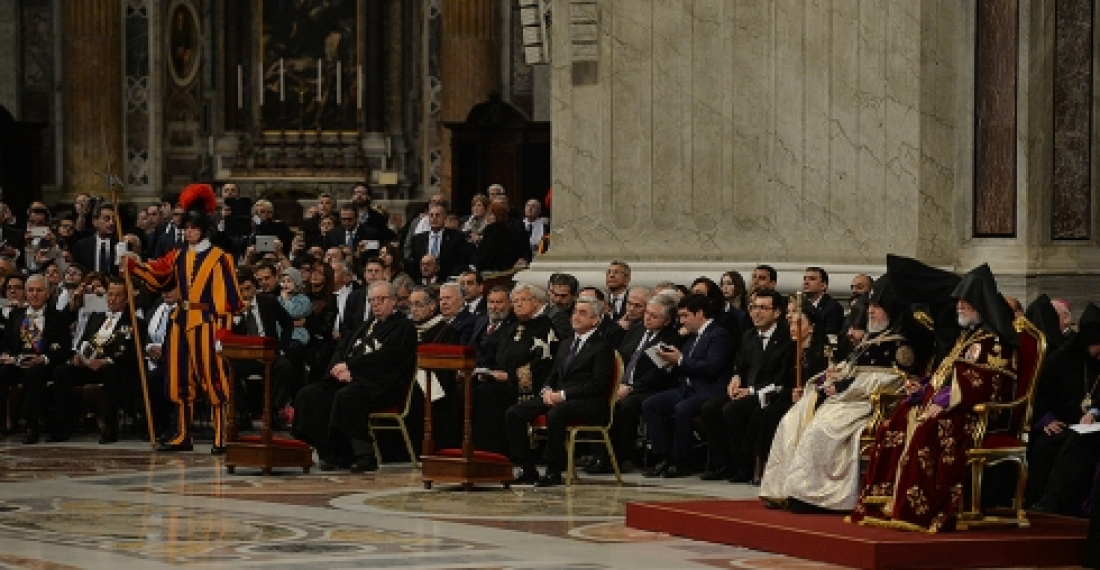
Папа отслужил святую мессу к столетию массовых убийств армян.

Президент Армении Серж Саргсян в сопровождении религиозных лидеров и государственных чиновников в воскресенье принял участие в святой Мессе, проведенной Папой Франциском в Ватикане.

Ниже приводится статья Радио Ватикана, под названием "Папа Франциск отслужил мессу к столетию Геноцида мучеников":

Папа Франциск прибыл в базилику Святого Петра в окружении Католикоса Гарегина II и Католикоса Арама I Армянской Апостольской Церкви, патриарха Католикоса Нерсеса Бедроса XIX. Патриарх Нерсес отслужил мессу со Святым Отцом

Приветствуя армянских верующих, которые прибыли в Рим по этому случаю, Папа Франциск говорил о жестокостях, вспоминая случаи из "третьей мировой войны", когда мы ежедневно наблюдали дикие преступления, жестокие массовые убийства и бессмысленные разрушения". Сегодня, по его словам, "мы испытываем своего рода геноцид, созданный общим и коллективным безразличием и молчанием..."

Франциск отметил три "массовые и беспрецедентные трагедий" ХХ века, первая из которых "большое преступление," систематическое массовые убийства армян-христиан, которые были убиты из-за их веры. Зверства нацистов и коммунистов, наряду с другими массовыми убийствами, показывают, что "человечество не в состоянии положить конец пролитиею невинной крови ... "Мы еще не поняли", сказал он, "что война это безумие", "бессмысленная бойня".

Необходимо, и даже обязательно, сказал он, вспомнить эти события, в частности, массовые убийства армян "с сердцем, наполненным болью, но в то же время с большой надеждой в воскресшего Христа."

Он сказал, что это было его долгом почтить память погибших.

В статье Радио Ватикана используется термин массовое убийство, но нет никаких ссылок на термин геноцид. Однако BBC в своем сообщении об этом мероприятии заявили, что Папа сказал, что человечество пережило "три массивные и беспрецедентные трагедий" еще в прошлом веке. "Во-первых, как принято считать" первый геноцид 20-го века", принял на себя Ваш армянский народ", сказал он, в виде слов, используемых в заявлении Папы Римского Иоанна Павла II в 2001 году.

Франциск также сослался на преступления, "совершенные во времена нацизма и сталинизма" и сказал, что за ними последовали и другие геноциды в Камбодже, Руанде, Бурунди и Боснии.

"Сокрытие или отказ от совершенного зла, это как рана, которая кровоточит и которую не перевязывают", добавил Папа.

Репортаж BBC также процитировал президента Армении Сержа Саргсяна, который приветствовал комментарии Папы, заявив, что это мощный сигнал международному сообществу.

источник: commonspace.eu по материалам радио Ватикана и BBC

Фото: Президент Армении Серж Саргсян с главами армянской церкови и государства на службе Папы Франциска в Ватикане, 12 апреля 2015.


Related articles

Editor's choice
News
Nikol Pashinyan re-appointed as Armenian prime minister after decisive June election victory

Nikol Pashinyan re-appointed as Armenian prime minister after decisive June election victory

Armenia president, Vahagn Khachaturyan has re-appointed Nikol Pashinyan as Armenian prime minister, after the decisive victory of his Civil Contract party in parliamentary elections in June. During a ceremony at the Presidential Palace in Yerevan, President Khachaturyan signed a decree on the appointment of Nikol Pashinyan as Prime Minister of the Republic. President Vahagn Khachaturyan said in short remarks: It is a great honor for me to sign a decree on appointing you to the post of Prime Minister of the Republic of Armenia, for which I received a proposal from the political majority in the National Assembly, under Article 149 of the Constitution of the Republic of Armenia. I sincerely congratulate you, I wish you great patience, endurance, and determination to lead us in these difficult times, to lead the country to the future, a prosperous future. Nikol Pashinyan thanked the president and added,  I must say honestly that in 2018, when I assumed the post of Prime Minister of the Republic of Armenia as a result of the People's, non-violent, velvet revolution, it would have been difficult to predict that we would go down such a path and I think it would have been difficult to predict that we would be able to overcome this path. But we are where we are, and I think that the key role and significance in all this is unequivocally and undoubtedly the people of the Republic of Armenia, who, after all, have demonstrated special expressions of state consciousness and state-centeredness throughout this period. And of course, this is a great obligation and commitment. Of course, the Government will be formed in the near future and all members of the Government, including me, will already enshrine our obligations to our people in the text of the oath.  In the meantime Ruben Rubinyan has been elected Speaker of the National Assembly of Armenia, following a secret vote of MPs. He is a 36-year-old MP from the ruling Civil Contract party, who was one of the deputy speakers in the previous parliament and, until recently, was the special representative in the negotiations on the normalization of relations with Turkey.

Popular

Editor's choice
Interview
Thursday Interview: Murad Muradov

Thursday Interview: Murad Muradov

Today, commonspace.eu starts a new regular weekly series. THURSDAY INTERVIEW, conducted by Lauri Nikulainen, will host  persons who are thinkers, opinion shapers, and implementors in their countries and spheres. We start the series with an interview with Murad Muradov, a leading person in Azerbaijan's think tank community. He is also the first co-chair of the Action Committee for a new Armenian-Azerbaijani Dialogue. Last September he made history by being the first Azerbaijani civil society activist to visit Armenia after the 44 day war, and the start of the peace process. Speaking about this visit Murad Muradov said: "My experience was largely positive. My negative expectations luckily didn’t play out. The discussions were respectful, the panel format bringing together experts from Armenia, Azerbaijan, and Turkey was particularly valuable during the NATO Rose-Roth Seminar in Yerevan, and media coverage, while varied in tone, remained largely constructive. Some media outlets though attempted to represent me as more of a government mouthpiece than an independent expert, which was totally misleading.  Overall, I see these initiatives as important steps in rebuilding trust and normalising professional engagement. The fact that soon a larger Azerbaijani civil society visits to Armenia followed, reinforces the sense that this process is moving in the right direction." (click the image to read the interview in full)

