


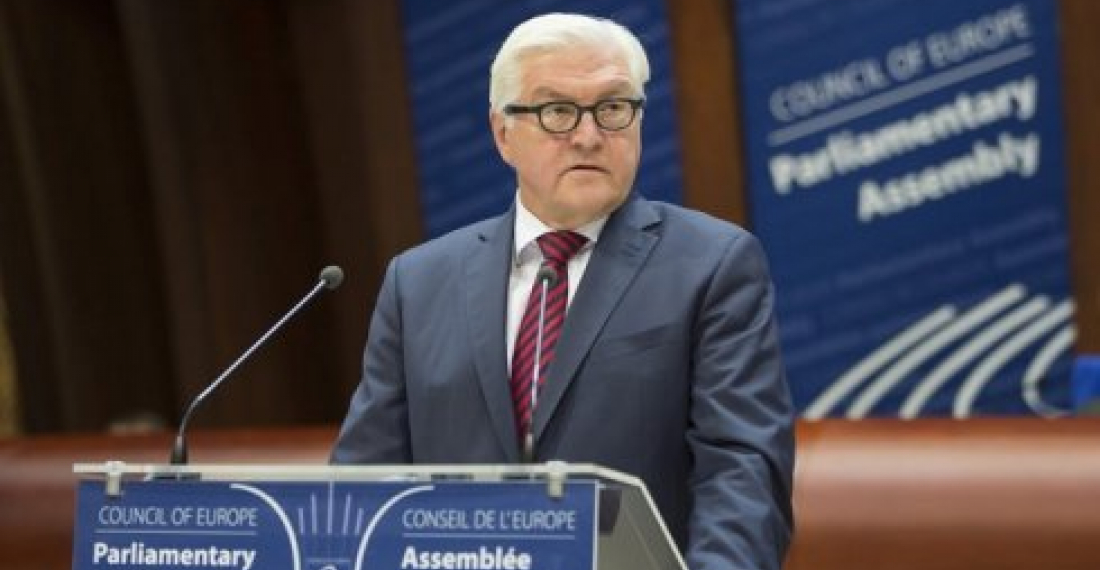
Выступление Штайнмайера на Парламентской ассамблее Совета Европы в Страсбурге

Министр иностранных дел Германии и нынешний председатель в Организации по безопасности и сотрудничеству в Европе (ОБСЕ), д-р Франк-Вальтер Штайнмайер, в четверг выступил в ходе заседания Парламентской Ассамблеи Совета Европы, которая проводит свою осеннюю сессию в Страсбурге. Касательно Абхазии, Южной Осетии, Приднестровья и Нагорного Карабаха немецкий министр сказал, что на европейском континенте не должно быть каких-либо слепых зон в плане контроля за соблюдением прав человека.

В своем выступлении министр иностранных дел Германии оживленно выступил в защиту прав человека и сказал, что Совет Европы обеспечивает правозащиту основных принципов во всех 47 государствах Совета Европы. Он не только хранитель стандартов, но на него также возложена определенная роль в период кризиса. Штайнмайер сказал, что он адвокат и реалист и он понимает, что правила нарушают. Но тот факт, что в Европейском суде по правам человека в настоящее время 76,000 дел это поражает.

В Европе есть места, где ценности и стандарты Совета Европы, права человека и верховенство закона, находятся под сильным давлением.

В некоторых государствах-членах пытаются обуздать свободу слова и свободу собраний: критиков из гражданского общества подвергают запугиванию и позору.

Касательно кризиса в Украине Штайнмайер сказал, что произошедшее там невозможно было представить. Германия вместе с Францией и Россией пытаются урегулировать кризис. Совет Европы сказал министр не может просто быть безучастным зрителем перед лицом серьезных нарушений, поэтому он приветствует вклад Совета Европы в демократическую трансформацию Украины.

Министр отметил, что Совет Европы пытается обеспечить доступ в Крым, чтобы следить за ситуацией с правами человека на месте. Это имеет важное значение и тоже самое касается и Южной Осетии, Абхазии, Приднестровья и Нагорного Карабаха. "На нашем континенте не должно быть каких-либо слепых зон в плане контроля за соблюдением прав человека," сказал министр.

источник: commonspace.eu

фото: министр иностранных дел Франк-Вальтер Штайнмайер на заседании Парламентской ассамблее Совета Европы


 

Related articles

Editor's choice
News
Azerbaijan-Armenia Internet Transit Deal Marks New Step in Regional Connectivity

Azerbaijan-Armenia Internet Transit Deal Marks New Step in Regional Connectivity

Azerbaijan and Armenia have signed an agreement allowing the mutual transit of international internet traffic, creating a direct telecommunications link between the two countries for the first time since the collapse of the Soviet Union. The deal, announced on 17 June by AzerTelecom and Telecom Armenia, is intended to improve route diversity and network resilience in the South Caucasus. The development follows a gradual process of normalisation of relations between Baku and Yerevan. Notably, Azerbaijan has repeatedly identified the restoration of transport and communication links as a key component of a future peace settlement. Since the initialling of a peace agreement during a summit in Washington in August 2025, the two sides have taken several important steps, including progress on border delimitation and the easing of certain transit restrictions. The telecommunications agreement is also significant because it was negotiated by private operators rather than government officials. Industry observers note that commercial infrastructure projects can create long-term economic ties and mutual dependencies that are more difficult to reverse than political declarations.

Popular

Editor's choice
Interview
Thursday Interview: Murad Muradov

Thursday Interview: Murad Muradov

Today, commonspace.eu starts a new regular weekly series. THURSDAY INTERVIEW, conducted by Lauri Nikulainen, will host  persons who are thinkers, opinion shapers, and implementors in their countries and spheres. We start the series with an interview with Murad Muradov, a leading person in Azerbaijan's think tank community. He is also the first co-chair of the Action Committee for a new Armenian-Azerbaijani Dialogue. Last September he made history by being the first Azerbaijani civil society activist to visit Armenia after the 44 day war, and the start of the peace process. Speaking about this visit Murad Muradov said: "My experience was largely positive. My negative expectations luckily didn’t play out. The discussions were respectful, the panel format bringing together experts from Armenia, Azerbaijan, and Turkey was particularly valuable during the NATO Rose-Roth Seminar in Yerevan, and media coverage, while varied in tone, remained largely constructive. Some media outlets though attempted to represent me as more of a government mouthpiece than an independent expert, which was totally misleading.  Overall, I see these initiatives as important steps in rebuilding trust and normalising professional engagement. The fact that soon a larger Azerbaijani civil society visits to Armenia followed, reinforces the sense that this process is moving in the right direction." (click the image to read the interview in full)

