


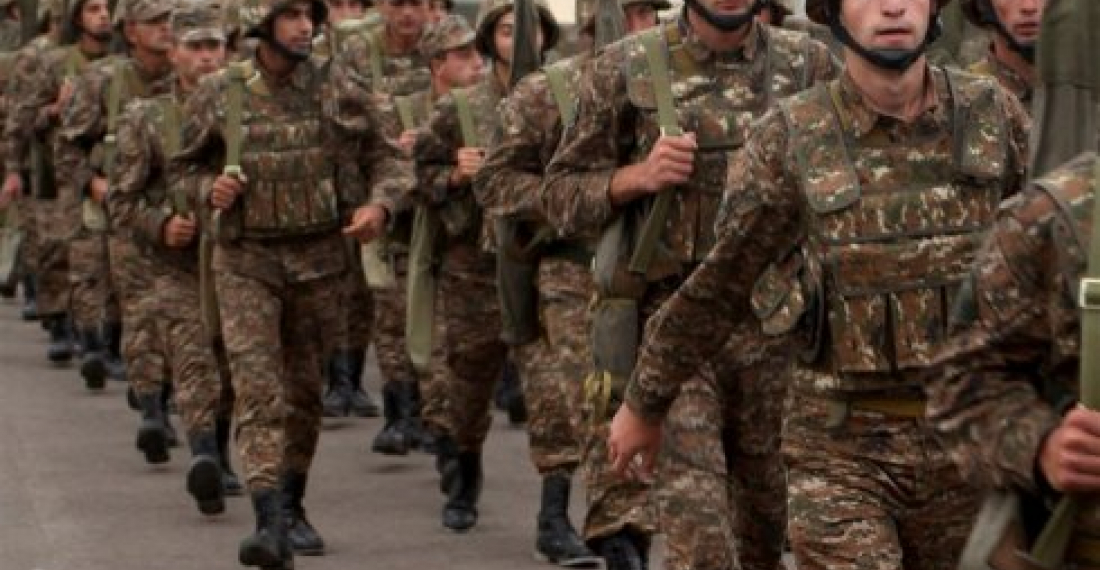
Только 2 из 29 смертей армянских солдат в первой половине 2019 года произошли из-за конфликта с Азербайджаном

В первые шесть месяцев 2019 года в Вооруженных силах Армении погибло 29 человек, и только два случая из них были результатом конфликта с Азербайджаном.

По данным армянской неправительственной организации «Мирный диалог», основанной на информации, полученной от Министерства обороны Республики Армения и Армии обороны Нагорно-Карабахской Республики, наряду с другими источниками, из 27 других зарегистрированных случаев смерти три были убийствами; двенадцать были вызваны несчастными случаями со смертельным исходом; четыре из них привели к смерти в результате самоубийства; семь случаев были результатом проблем со здоровьем; и один смертельный исход был результатом небрежности.

Данная информация содержится в 9-м выпуске двухгодичного доклада «Ситуация с правами человека в Вооруженных силах Армении», недавно опубликованного «Мирным диалогом».

В докладе также есть обновленная информация о различных случаях смерти в Вооруженных силах Армении, мониторинг которых осуществляет НПО. В нем также дается оценка подхода нынешнего руководства Министерства обороны Армении к ситуации с правами человека в вооруженных силах. Он выражает обеспокоенность по поводу того, что обязательства по этому вопросу могут противоречить продолжающейся поддержке политики «Национальной армии» прежнего правительства, которая подверглась критике со стороны ряда правозащитных организаций.

Вы можете прочитать рассылку в формате PDF здесь

источник: commonspace.eu по материалам «Мирного диалога», Варнадзор, Армения.

Related articles

Editor's choice
News
Uzbekistan calls for bigger voice for Central Asia in the UN

Uzbekistan calls for bigger voice for Central Asia in the UN

Uzbekistan called for a more effective and representative United Nations on September 23, as presidential administration chief Saida Mirziyoyeva used her address to the UN General Assembly to seek support for the country’s candidacy for a nonpermanent Security Council seat in 2035–2036. Speaking at the Assembly’s 81st session in New York, Mirziyoyeva argued that international cooperation remains necessary despite growing geopolitical divisions. She endorsed UN Secretary-General António Guterres’ UN80 reform initiative and called for an expanded Security Council, arguing that international rules should be applied consistently rather than according to the interests of powerful states. Uzbekistan’s planned chairmanship of the Non-Aligned Movement in 2027 was presented as another platform for promoting dialogue. Her emphasis on multilateralism also fits a broader Central Asian effort to increase the region’s role in international institutions. Kyrgyzstan, for example, will hold its first Security Council seat in 2027–2028. Mirziyoyeva also highlighted regional cooperation, pointing to improved relations among Central Asian states over longstanding border and water disputes. On Afghanistan, she urged countries not to view it solely as a security threat, stressing the importance of creating conditions for peaceful development. She linked Uzbekistan’s international agenda to domestic reforms, citing economic growth, falling poverty and expanded education. Climate and water security also featured prominently, with the Aral Sea serving as an example of the consequences of poor environmental management. (click image to read more)

Popular

Editor's choice
Interview
Thursday Interview: Murad Muradov

Thursday Interview: Murad Muradov

Today, commonspace.eu starts a new regular weekly series. THURSDAY INTERVIEW, conducted by Lauri Nikulainen, will host  persons who are thinkers, opinion shapers, and implementors in their countries and spheres. We start the series with an interview with Murad Muradov, a leading person in Azerbaijan's think tank community. He is also the first co-chair of the Action Committee for a new Armenian-Azerbaijani Dialogue. Last September he made history by being the first Azerbaijani civil society activist to visit Armenia after the 44 day war, and the start of the peace process. Speaking about this visit Murad Muradov said: "My experience was largely positive. My negative expectations luckily didn’t play out. The discussions were respectful, the panel format bringing together experts from Armenia, Azerbaijan, and Turkey was particularly valuable during the NATO Rose-Roth Seminar in Yerevan, and media coverage, while varied in tone, remained largely constructive. Some media outlets though attempted to represent me as more of a government mouthpiece than an independent expert, which was totally misleading.  Overall, I see these initiatives as important steps in rebuilding trust and normalising professional engagement. The fact that soon a larger Azerbaijani civil society visits to Armenia followed, reinforces the sense that this process is moving in the right direction." (click the image to read the interview in full)


