


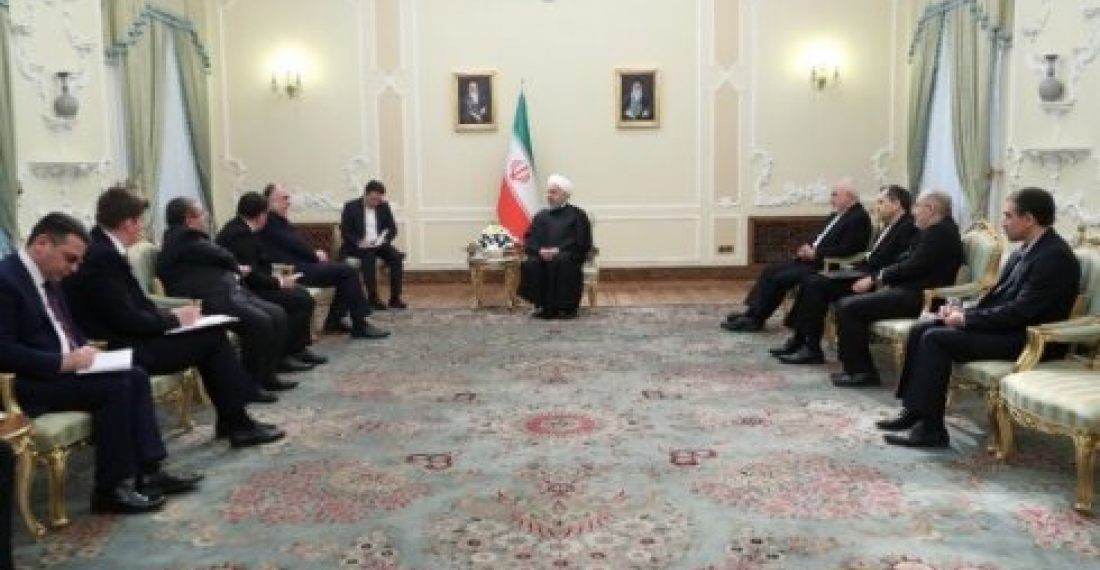
Президент Ирана Рухани говорит о необходимости расширения отношений с Азербайджаном

Президент Ирана Хасан Рухани заявил, что отношения между Ираном и Азербайджанской Республикой расширяются в различных областях, что подчеркивает необходимость их укрепления. Об этом Рухани заявил в субботу в ходе визита в Тегеран министра иностранных дел Азербайджана Эльмара Мамедъярова.

Президент также выразил готовность Ирана активизировать трехстороннее сотрудничество с Азербайджаном и Россией, осуществляя различные совместные проекты, говорится в сообщении агентства Mehr.

Он указал на возможности сотрудничества Тегерана и Баку в сфере энергетики и строительства плотин и электростанций.

Со своей стороны, Мамедъяров приветствовал «братские» отношения между Тегераном и Баку, заявив, что нет никаких препятствий для расширения политических, экономических, культурных и социальных связей с Тегераном, сообщает агентство.

Он также передал Рухани официальное приглашение президента Азербайджана Ильхама Алиева принять участие в следующей конференции Движения неприсоединения (ДН) в Баку.

Мамедъяров также встретился со своим иранским коллегой Мохаммадом Джавадом Зарифом и спикером парламента Ирана Али Ларджани для обмена мнениями по двусторонним и региональным вопросам.

Иранские СМИ сообщили, что глава МИД Азербайджана также встретился с секретарем Высшего совета национальной безопасности Ирана Али Шамхани.

В ходе встречи Мамедъяров подтвердил, что его страна "будет поддерживать тесные экономические связи с Тегераном независимо от санкций", сообщает Tehran Times. Он выразил готовность Азербайджана расширять отношения с Ираном во всех областях, отметив, что Баку приветствует любую инициативу в этом направлении.

Шамхани сказал, что Иран и Азербайджан полны решимости расширять двусторонние отношения, особенно в экономической сфере, добавив, что более тесное взаимодействие будет способствовать региональной безопасности и стабильности. «Он подчеркнул, что дружественные отношения между двумя мусульманскими соседями не представляют угрозы для какой-либо другой страны и никогда не будут подвержены влиянию других", - цитирует иранского чиновника Тегеран Таймс.

Азербайджан в этом году председательствует в Организации Движения неприсоединения, активным участником которого является Иран. Иран и Азербайджан также планируют развивать важный транспортный коридор Север-Юг, который, как ожидается, соединит Северную Европу с Юго-Восточной Азией через свои территории. По словам посла Ирана в Баку, которого цитирует информационное агентство Mehr, двусторонняя торговля между Ираном и Азербайджанской Республикой в 2018 году увеличилась на 73%.

Материалы по теме: Пашинян провел переговоры с руководством Ирана во время визита в Тегеран

источник: commonspace.eu, информационное агентство Mehr, Tehran Times и другие источники информации

фото: Президент Ирана Рухани в субботу (9 марта) принял в Тегеране министра иностранных дел Азербайджана Эльмара Мамедъярова


Related articles

Editor's choice
News
Borrell tells the European Parliament that the situation in Afghanistan was critical, but the EU will remain engaged

Borrell tells the European Parliament that the situation in Afghanistan was critical, but the EU will remain engaged

Borrell underlined that the European Union will make every effort to support the peace process and to remain a committed partner to the Afghan people. "Of course, we will have to take into account the evolving situation, but disengagement is not an option.  We are clear on that: there is no alternative to a negotiated political settlement, through inclusive peace talks.
Editor's choice
News
NATO Chief says war is on Europe's doorstep, and warns against complacency

NATO Chief says war is on Europe's doorstep, and warns against complacency

Russia could attack a NATO country within the next five years, the Secretary General of NATO, Mark Rutte, said in a stark new warning. "NATO's own defences can hold for now," Rutte warned in Berlin, but conflict was "next door" to Europe, and he feared "too many are quietly complacent, and too many don't feel the urgency, too many believe that time is on our side. "Russia is already escalating its covert campaign against our societies," Rutte said in a speech in Germany. "We must be prepared for the scale of war our grandparents or great-grandparents endured." Earlier this month, Russia's President Vladimir Putin said his country was not planning to go to war with Europe, but it was ready "right now" if Europe wanted to - or started a war. But similar reassurances were given by Moscow in 2022, just before 200,000 Russian troops crossed the border and invaded Ukraine. Putin has accused European countries of hindering US efforts to bring peace in Ukraine - a reference to the role Ukraine's European allies have recently played in trying to change a US peace plan to end the war, whose initial draft was seen as favouring Russia. But Putin was not sincere, Nato's secretary-general said in the German capital, Berlin. Supporting Ukraine, he added, was a guarantee for European security. "Just imagine if Putin got his way; Ukraine under the boot of Russian occupation, his forces pressing against a longer border with Nato, and the significantly increased risk of an armed attack against us." Russia's economy has been on a war footing for more than three years now - its factories churn out ever more supplies of drones, missiles and artillery shells. According to a recent report by the Kiel Institute for the World Economy, Russia has been producing each month around 150 tanks, 550 infantry fighting vehicles, 120 Lancet drones and more than 50 artillery pieces. The UK, and most of its Western allies, are simply not anywhere near this point. Analysts say it would take years for Western Europe's factories to come close to matching Russia's mass-production of weapons. "Allied defence spending and production must rise rapidly, our armed forces must have what they need to keep us safe," the Nato chief said.

Popular

Editor's choice
News
NATO Chief says war is on Europe's doorstep, and warns against complacency

NATO Chief says war is on Europe's doorstep, and warns against complacency

Russia could attack a NATO country within the next five years, the Secretary General of NATO, Mark Rutte, said in a stark new warning. "NATO's own defences can hold for now," Rutte warned in Berlin, but conflict was "next door" to Europe, and he feared "too many are quietly complacent, and too many don't feel the urgency, too many believe that time is on our side. "Russia is already escalating its covert campaign against our societies," Rutte said in a speech in Germany. "We must be prepared for the scale of war our grandparents or great-grandparents endured." Earlier this month, Russia's President Vladimir Putin said his country was not planning to go to war with Europe, but it was ready "right now" if Europe wanted to - or started a war. But similar reassurances were given by Moscow in 2022, just before 200,000 Russian troops crossed the border and invaded Ukraine. Putin has accused European countries of hindering US efforts to bring peace in Ukraine - a reference to the role Ukraine's European allies have recently played in trying to change a US peace plan to end the war, whose initial draft was seen as favouring Russia. But Putin was not sincere, Nato's secretary-general said in the German capital, Berlin. Supporting Ukraine, he added, was a guarantee for European security. "Just imagine if Putin got his way; Ukraine under the boot of Russian occupation, his forces pressing against a longer border with Nato, and the significantly increased risk of an armed attack against us." Russia's economy has been on a war footing for more than three years now - its factories churn out ever more supplies of drones, missiles and artillery shells. According to a recent report by the Kiel Institute for the World Economy, Russia has been producing each month around 150 tanks, 550 infantry fighting vehicles, 120 Lancet drones and more than 50 artillery pieces. The UK, and most of its Western allies, are simply not anywhere near this point. Analysts say it would take years for Western Europe's factories to come close to matching Russia's mass-production of weapons. "Allied defence spending and production must rise rapidly, our armed forces must have what they need to keep us safe," the Nato chief said.

