


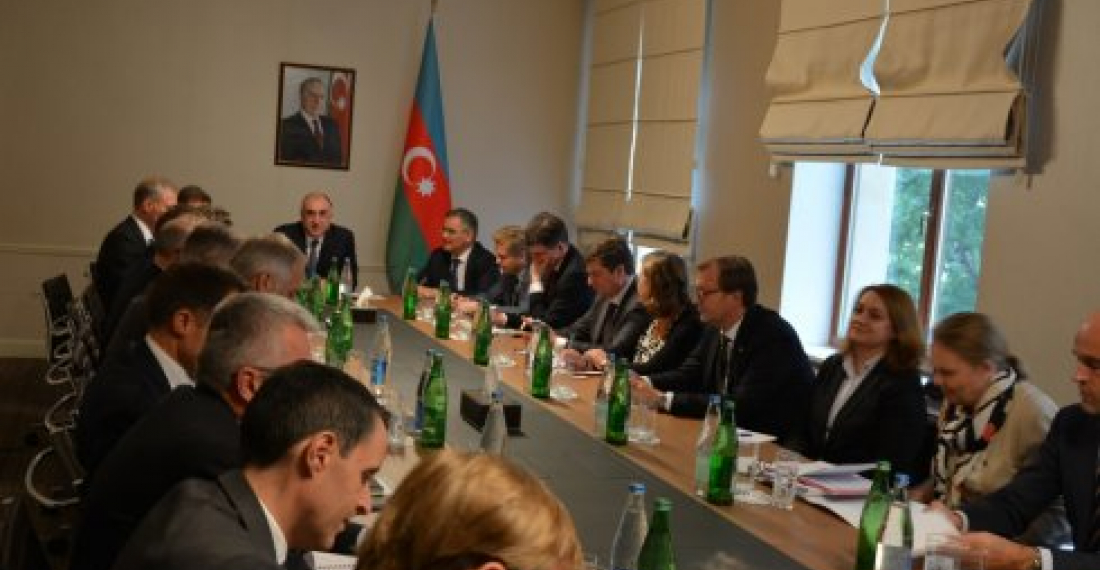
Представители 28 государств-членов ЕС посещают страны Южного Кавказа

Представители 28 государств-членов Европейского Союза, каждый представляющий свою страну в Комитете по политическим вопросам и вопросам безопасности Совета ЕС, прибыли с визитом в регион. Необычная миссия по установлению фактов направлена на подтверждение приверженности ЕС по отношению к региону.

В среду (4 октября) делегация прибыла в Азербайджан, где провела отдельные встречи с президентом Ильхамом Алиевым и министром иностранных дел Эльмаром Мамедъяровым. Как сообщает сайт МИД Азербайджана, во время встречи в МИДе Мамедъяров "говорил о развитии сотрудничества между Азербайджаном и Европейским Союзом и о ходе переговоров по проекту соглашения о стратегическом партнерстве и подчеркнул, что отношения стратегического партнерства были установленный между 10 странами Европейского Союза и Азербайджаном. Касаясь сотрудничества в сферах энергетики, транспорта и связи, министр сказал, что новое соглашение является важной основой для всестороннего развития отношений между Азербайджаном и ЕС, охватывающего политическую, экономическую, торговую, энергетическую, гуманитарную и другие сферы".

По словам того же источника, "Эльмар Мамедъяров предоставил подробную информацию о текущем состоянии переговорного процесса по нагорно-карабахскому конфликту между Арменией и Азербайджаном, еще раз подтвердил, что урегулирование конфликта в рамках территориальной целостности, суверенитета и международно признанных границ Азербайджана единственный вариант урегулирования конфликта. Он также рассказал о встрече с сопредседателями Минской группы ОБСЕ, а также министром иностранных дел Армении в кулуарах 72-й сессии Генеральной Ассамблеи ООН и отметил, что сопредседатели Минской группы посетят регион в ближайшие дни."

Эльмар Мамедъяров заявил, что уважение территориальной целостности и неприкосновенности границ государств является основополагающим принципом международных отношений и подчеркнул, что оно также закреплено в Документе глобальной стратегии Европейского Союза".

В ходе встречи министр иностранных дел Азербайджана ответил на ряд вопросов гостей относительно отношений Азербайджана с соседними странами, его позиции по актуальным вопросам международной повестки дня, проблемам региональной безопасности, а также борьбе с терроризмом и другие вопросы взаимного сотрудничества.

Делегация также намерена посетить Грузию и Армению.

источник: commonspace.eu по материалам пресс-службы Министерства иностранных дел Азербайджана.

фото: Министр иностранных дел Азербайджана Мамедъяров с членами Комитета по политическим вопросам и безопасности Совета Европейского Союза в Баку, 4 октября 2017 года (фото предоставлено пресс-службой МИД Азербайджана)
Related articles

Editor's choice
News
Uzbekistan strengthens its relations with China and US

Uzbekistan strengthens its relations with China and US

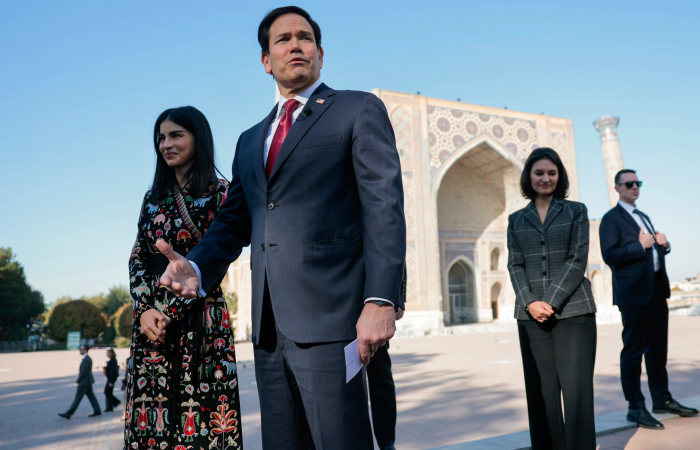
In recent days, Uzbekistan welcomed the Chinese and American governments in quick succession. During Chinese Premier Li Qiang’s visit on 17-18 October, the Uzbek presidential administration said that joint projects backed by firm agreements had reached nearly $60 billion. US Secretary of State Marco Rubio then arrived in Samarkand for C5+1 talks, accompanied at the time by American business leaders seeking contracts, particularly in critical minerals. During the visit, Uzbekistan announced 54 agreements covering trade, investment, and technology. The agreements are said to be worth a total of $12 billion, according to Uzbekistan’s Ministry of Investment, Industry and Trade. However, China still accounts for 23% of Uzbekistan’s foreign trade in January-August 2026, while US goods trade with Uzbekistan totalled at $1.05 billion in 2025, which is less than a fifteenth of the value of its trade with China. Rubio said Washington was not asking Central Asian countries to stop cooperating with other partners, but would instead compete for investment. Tashkent is likely to welcome investment from both sides, but the trade gap shows how challenging it will be if it were to decrease its dependence on Beijing. “Chinese Premier Li Qiang visited Uzbekistan on October 17–18, just ahead of United States Secretary of State Marco Rubio, who arrived in Samarkand on October 18 with a delegation of American business leaders seeking new contracts. While China already has a substantial presence in Uzbek manufacturing and energy, Washington is seeking to expand American involvement in critical minerals and technology. The visits highlight the growing competition between the world’s two largest economies for influence in Central Asia. On October 17, President Shavkat Mirziyoyev received Li Qiang. According to the Uzbek presidential administration, the portfolio of joint projects backed by firm agreements has reached nearly $60 billion. More than 6,000 joint ventures with Chinese participation have been established in Uzbekistan. (...) Construction of the China–Kyrgyzstan–Uzbekistan railway was another topic of discussion. Work officially began in December 2024. The route will cross mountainous areas of Kyrgyzstan and connect the railway networks of China and Uzbekistan. The 304-kilometer section through Kyrgyzstan alone is estimated to cost $4.7 billion and will require 50 bridges and 29 tunnels. (...) On October 19, Rubio attended talks in Samarkand under the C5+1 format, bringing together the U.S. and Kazakhstan, Kyrgyzstan, Tajikistan, Turkmenistan, and Uzbekistan. Rubio said nearly 300 American businesses were represented in Samarkand. Companies were discussing agreements potentially worth billions of dollars, with concrete announcements expected following the meetings. Among Washington’s priorities are critical minerals used in advanced technologies, including electronics and batteries.”

Popular

Editor's choice
Interview
Thursday Interview: Murad Muradov

Thursday Interview: Murad Muradov

Today, commonspace.eu starts a new regular weekly series. THURSDAY INTERVIEW, conducted by Lauri Nikulainen, will host  persons who are thinkers, opinion shapers, and implementors in their countries and spheres. We start the series with an interview with Murad Muradov, a leading person in Azerbaijan's think tank community. He is also the first co-chair of the Action Committee for a new Armenian-Azerbaijani Dialogue. Last September he made history by being the first Azerbaijani civil society activist to visit Armenia after the 44 day war, and the start of the peace process. Speaking about this visit Murad Muradov said: "My experience was largely positive. My negative expectations luckily didn’t play out. The discussions were respectful, the panel format bringing together experts from Armenia, Azerbaijan, and Turkey was particularly valuable during the NATO Rose-Roth Seminar in Yerevan, and media coverage, while varied in tone, remained largely constructive. Some media outlets though attempted to represent me as more of a government mouthpiece than an independent expert, which was totally misleading.  Overall, I see these initiatives as important steps in rebuilding trust and normalising professional engagement. The fact that soon a larger Azerbaijani civil society visits to Armenia followed, reinforces the sense that this process is moving in the right direction." (click the image to read the interview in full)

