


Новый четырехсторонний формат объединил Азербайджан, Грузию, Иран и Турцию

Азербайджан, Грузия, Иран и Турция выступили с заявлением после встречи министров иностранных дел в Баку 15 марта, подтвердив свою приверженность «дальнейшему укреплению солидарности и сотрудничества» между ними.

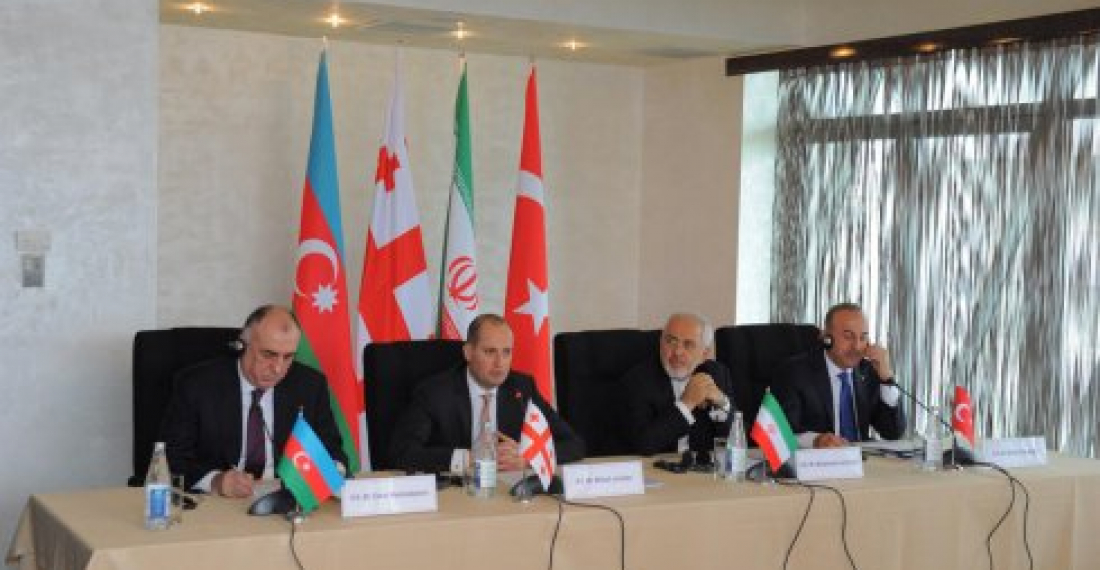
15 марта 2018 года в Баку в рамках четырехстороннего формата состоялась первая совместная встреча Эльмара Мамедъярова (Азербайджан), Михеила Джанелидзе (Грузия), Мухаммада Джавада Зарифа (Ирана) и Мевлюта Чавушоглу (Турция).

Затем министры выступили с совместным заявлением, в котором подтвердили свою приверженность «дальнейшему укреплению солидарности и сотрудничества между народами четырех стран на основе глубоко укоренившихся исторических и культурных связей, которые будут способствовать укреплению мира, стабильности и процветанию в регионе».

Министры подчеркнули их общую заинтересованность «в укреплении регионального мира и стабильности» [и] в этом контексте подчеркнули свою приверженность принципам международного права в отношении уважения суверенитета, территориальной целостности и неприкосновенности международно признанных границ государств, а также мирного урегулирования всех конфликтов в регионе».

В своем заявлении министры подчеркнули важные шаги, предпринятые для расширения транзитного потенциала четырех стран, географически выгодно расположенных на международных транзитных коридорах, с целью интеграции их национальной транспортной инфраструктуры в международную транзитную систему.

Они также «подтвердили свою твердую приверженность укреплению сотрудничества в борьбе с терроризмом, насильственным экстремизмом и сепаратизмом во всех их формах и проявлениях, с транснациональной организованной преступностью, с незаконным оборотом наркотических средств и их прекурсорами, оружием, преступлениями против культурного и исторического наследия, киберпреступностью, с торговлей людьми и незаконным ввозом мигрантов».

источник: commonspace.eu по материалам пресс-службы Министерства иностранных дел Азербайджана.

фото: Министры иностранных дел Азербайджана, Грузии, Ирана и Турции в Баку, 15 марта 2018 года (фото предоставлено информационным агентством TREND).


Related articles

Editor's choice
News
The British prime minister says Europe must "stand on its own two feet" when it comes to defence

The British prime minister says Europe must "stand on its own two feet" when it comes to defence

The UK will deploy a carrier strike group, led by the aircraft carrier HMS Prince of Wales to the Arctic and the High North as part of efforts to bolster security against Russian threats. British prime minister, Sir Keir Starmer announced the deployment in a speech on Saturday (14 February) at the Munich Security Conference. Europe must be ready to fight to protect its people, values, and way of life,  Sir Keir told the Conference. Starmer also called for deeper links and cooperation, including economic ties, between the UK and EU. The PM stressed the continent must "stand on its own two feet" when it comes to defence commitments. "We must build our hard power, because that is the currency of the age," he told the conference. (Click image to read the full story).

Popular

Editor's choice
Interview
Thursday Interview: Murad Muradov

Thursday Interview: Murad Muradov

Today, commonspace.eu starts a new regular weekly series. THURSDAY INTERVIEW, conducted by Lauri Nikulainen, will host  persons who are thinkers, opinion shapers, and implementors in their countries and spheres. We start the series with an interview with Murad Muradov, a leading person in Azerbaijan's think tank community. He is also the first co-chair of the Action Committee for a new Armenian-Azerbaijani Dialogue. Last September he made history by being the first Azerbaijani civil society activist to visit Armenia after the 44 day war, and the start of the peace process. Speaking about this visit Murad Muradov said: "My experience was largely positive. My negative expectations luckily didn’t play out. The discussions were respectful, the panel format bringing together experts from Armenia, Azerbaijan, and Turkey was particularly valuable during the NATO Rose-Roth Seminar in Yerevan, and media coverage, while varied in tone, remained largely constructive. Some media outlets though attempted to represent me as more of a government mouthpiece than an independent expert, which was totally misleading.  Overall, I see these initiatives as important steps in rebuilding trust and normalising professional engagement. The fact that soon a larger Azerbaijani civil society visits to Armenia followed, reinforces the sense that this process is moving in the right direction." (click the image to read the interview in full)

