


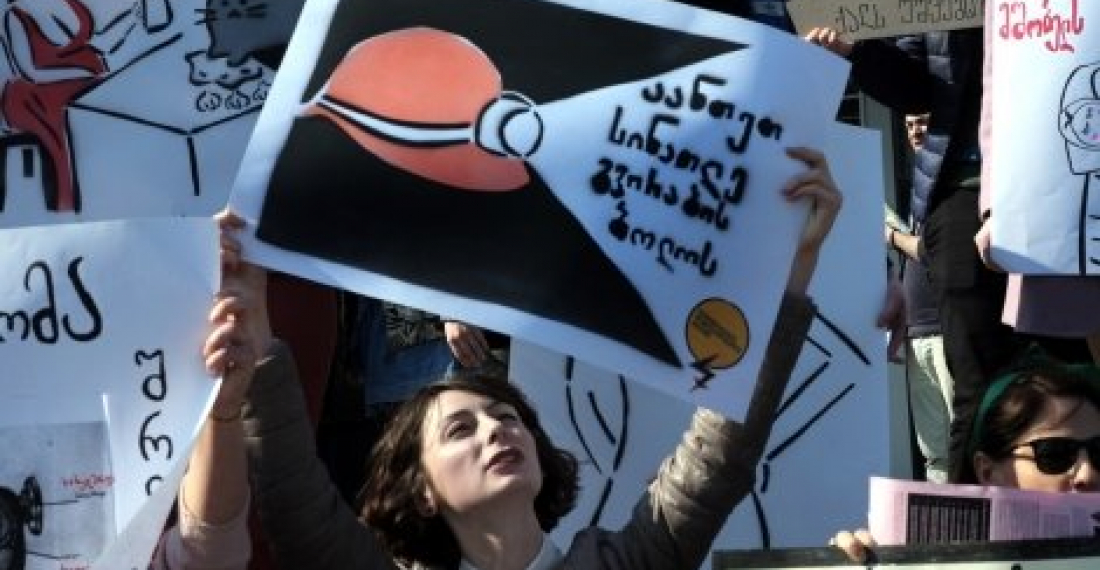
Грузинские женщины просят большой роли в политике

Женщины в грузинской политике играют все большую роль, но как некоторые считают, этого не достаточно. В своей статье, подготовленной специально для commonspace.eu, Дато Парулава исследует данный вопрос.

Политический накал страстей в Грузии с приближением к парламентским выборам в ближайшее время достигнет точки кипения. Как и во всем мире, грузинские политики обычно дают обещания, в которых сами несильно и заинтересованы. В Грузии, одним из таких обещании является установление гендерного баланса в политике.

Задолго до предстоящих выборов, сторонники прав для женщин активно агитировали за равное число мужчин и женщин среди депутатов в парламенте Грузии. Инициатива в конечном счете не прошла через парламент, но оставила свой след на перспективу увеличения числа женщин в законодательном органе в будущем.

Хотя 52% населения Грузии составляют женщины, в законодательном органе их всего 12%. Это ставит Грузию на 108-е место среди 140 стран в мире по числу женщин в парламенте. Помимо этого, число женщин в местных органах власти составляет всего лишь 11%, и среди них нет не одного мэра или губернатора.

На обсуждения в парламенте выносились 3 законопроекта, направленных по повышение числа представительниц женского пола в законодательном органе, но ни один из них не был принят. Одни хотели ввести обязательные гендерные квоты, другие же отказались.

Одна из инициатив, предложенных международным НПО, подразумевало введение обязательной нормы, при которой 50% всех кандидатов по партийным спискам должны быть женщины, чтобы партию можно было квалифицировать для дальнейшей регистрации в Центральной избирательной комиссии. Если бы такая инициатива прошла бы, то по крайней мере, среди 150 членов парламента было бы 38 женщин.

Еще одна инициатива депутатов от правящей партии Грузинская мечта, в том числе вице-спикера парламента Мананы Кобахидзе, предполагала распределить 30% имеющегося бюджета среди тех партии, в списках которых по крайней мере 33% составляют женщины таким образом, что по крайней мере каждый третий кандидат в списке будет женщина. В конце концов, ни один из проектов не получил парламентскую поддержку, с аргументами за и против варьирующихся между "расширение прав и возможностей женщин" и "искусственное вмешательство в систему".

Тем не менее, на встрече, организованной женским движением в апреле, стороны обменялись мнениями о системе гендерных квот. Хотя большинство присутствующих партий признали то, что они не поддержали обязательные квоты, они выразили согласие с тем, что участие женщин в политике возросло.

Однако, Национальный демократический институт (NDI) обнаружил, что только 4 из 25 партий и блоков, принимающих участие в выборах, удовлетворяют требования предложенной нормы - 3 женщины среди каждых 10 кандидатов.

Опрос, проведенный NDI демонстрирует, что по состоянию на 2014 год, 70% грузин считают, что по крайней мере 30% парламентариев должны быть женщины. Те же опросы также показывают, что 74% грузин полагают, что женщины на должностях работают наравне или же лучше, чем мужчины. Тем не менее, по сравнению с выборов 2012 года, число женщин в списках как по мажоритарной так и по пропорциональной системе увеличилось лишь незначительно.

Несмотря на провал усилий на законодательном уровне, политические партии пытаются подчеркнуть присутствие женщин в их списках. В июле этого года, когда Грузинская мечта выдвинула новых кандидатов на предстоящие выборы, 8 из них были женщины. Тем не менее, тенденция роста числа женщин остается на прежнем уровне - в избирательном списке Грузинской Мечты из 155 человек только 18 женщин. Среди первых 20 кандидатов в списке, все куда суровее, только 6 женщин.

В главной оппозиционной партии, Единое национальное движение, ситуация немного лучше - 50 женщин среди 200 человек в избирательном списке, но также, как и с Грузинской мечтой, только 6 женщин в топ-20 кандидатов.

Согласно опросам NDI, среди всех мажоритарных кандидатов, выдвинутых десятью крупнейшими партиями Грузии, только 17% составляют женщины. Что касается кандидатов из заявленных партиями списков, женщины всего лишь 37%.

Однако, в целом участие женщин в политике растет. В 2016 году Ряд видных женщин принимают участие в гонке на парламентских выборах в 2016 году. Пожалуй самая видная из них это кандидат от ЕНД экс-первая леди Сандра Рулофс. Также рядом с ней Тамар Чугошвили, экс-глава видного НПО, которая баллотируется по списку Грузинской мечты, и Тина Хидашели, экс-министр обороны и кандидат от Республиканской партии. Хотя они скорее остаются исключениями, нежели правилом, но если нынешние тенденции сохранятся, то полный гендерный паритет в политике является лишь вопросом времени.

источник: Дато Парулава журналист в liberali.ge. Данная статья была подготовлена им специально для Commonspace.eu

фото: 8 марта, Международный женский день, демонстрации в Тбилиси, организованная независимой феминистской группой под лозунгом "Больше женщин в парламенте".


Related articles

Editor's choice
News
Germany accuses Russia of cyberattacks and disinformation campaign

Germany accuses Russia of cyberattacks and disinformation campaign

The German government holds Russia responsible for a cyberattack on German air traffic control, and for targeted disinformation campaigns before the last federal election. According to the German Foreign Office in Berlin, the incidents could be clearly attributed to the Russian military intelligence service, the GRU. In response, the Russian ambassador to Berlin was summoned to the Foreign Ministry. "We have been observing a massive increase in threatening hybrid activities by Russia for some time now," a spokesperson for the Foreign Ministry stated. These range from disinformation campaigns and espionage to cyberattacks and sabotage attempts. The aim is to divide society, sow distrust, and undermine confidence in democratic institutions. The spokesperson added that with these actions, Russia is "very concretely threatening our security, not only through its war of aggression against Ukraine, but also here in Germany."  The Foreign Ministry spokesperson explained that the cyberattack on air traffic control in August 2024 was clearly attributed to the hacker collective "APT28," known as "Fancy Bear," and to the responsibility of the Russian military intelligence service, the GRU. Furthermore, it could now be "conclusively stated" that Russia had attempted "to influence and destabilize both the last Federal election and the ongoing internal affairs of the Federal Republic of Germany." There was "absolutely irrefutable evidence" for this". The so-called "Storm 1516" campaign, which has been running since 2024, is allegedly backed by "reliable information" that the Moscow-based think tank "Center for Geopolitical Expertise" is behind it. The Center is also said to be supported by Russian military intelligence. Its primary aim is to influence democratic elections in the West. (Click the image to read more).
Editor's choice
News
NATO Chief says war is on Europe's doorstep, and warns against complacency

NATO Chief says war is on Europe's doorstep, and warns against complacency

Russia could attack a NATO country within the next five years, the Secretary General of NATO, Mark Rutte, said in a stark new warning. "NATO's own defences can hold for now," Rutte warned in Berlin, but conflict was "next door" to Europe, and he feared "too many are quietly complacent, and too many don't feel the urgency, too many believe that time is on our side. "Russia is already escalating its covert campaign against our societies," Rutte said in a speech in Germany. "We must be prepared for the scale of war our grandparents or great-grandparents endured." Earlier this month, Russia's President Vladimir Putin said his country was not planning to go to war with Europe, but it was ready "right now" if Europe wanted to - or started a war. But similar reassurances were given by Moscow in 2022, just before 200,000 Russian troops crossed the border and invaded Ukraine. Putin has accused European countries of hindering US efforts to bring peace in Ukraine - a reference to the role Ukraine's European allies have recently played in trying to change a US peace plan to end the war, whose initial draft was seen as favouring Russia. But Putin was not sincere, Nato's secretary-general said in the German capital, Berlin. Supporting Ukraine, he added, was a guarantee for European security. "Just imagine if Putin got his way; Ukraine under the boot of Russian occupation, his forces pressing against a longer border with Nato, and the significantly increased risk of an armed attack against us." Russia's economy has been on a war footing for more than three years now - its factories churn out ever more supplies of drones, missiles and artillery shells. According to a recent report by the Kiel Institute for the World Economy, Russia has been producing each month around 150 tanks, 550 infantry fighting vehicles, 120 Lancet drones and more than 50 artillery pieces. The UK, and most of its Western allies, are simply not anywhere near this point. Analysts say it would take years for Western Europe's factories to come close to matching Russia's mass-production of weapons. "Allied defence spending and production must rise rapidly, our armed forces must have what they need to keep us safe," the Nato chief said.

Popular

Editor's choice
News
Germany accuses Russia of cyberattacks and disinformation campaign

Germany accuses Russia of cyberattacks and disinformation campaign

The German government holds Russia responsible for a cyberattack on German air traffic control, and for targeted disinformation campaigns before the last federal election. According to the German Foreign Office in Berlin, the incidents could be clearly attributed to the Russian military intelligence service, the GRU. In response, the Russian ambassador to Berlin was summoned to the Foreign Ministry. "We have been observing a massive increase in threatening hybrid activities by Russia for some time now," a spokesperson for the Foreign Ministry stated. These range from disinformation campaigns and espionage to cyberattacks and sabotage attempts. The aim is to divide society, sow distrust, and undermine confidence in democratic institutions. The spokesperson added that with these actions, Russia is "very concretely threatening our security, not only through its war of aggression against Ukraine, but also here in Germany."  The Foreign Ministry spokesperson explained that the cyberattack on air traffic control in August 2024 was clearly attributed to the hacker collective "APT28," known as "Fancy Bear," and to the responsibility of the Russian military intelligence service, the GRU. Furthermore, it could now be "conclusively stated" that Russia had attempted "to influence and destabilize both the last Federal election and the ongoing internal affairs of the Federal Republic of Germany." There was "absolutely irrefutable evidence" for this". The so-called "Storm 1516" campaign, which has been running since 2024, is allegedly backed by "reliable information" that the Moscow-based think tank "Center for Geopolitical Expertise" is behind it. The Center is also said to be supported by Russian military intelligence. Its primary aim is to influence democratic elections in the West. (Click the image to read more).

