


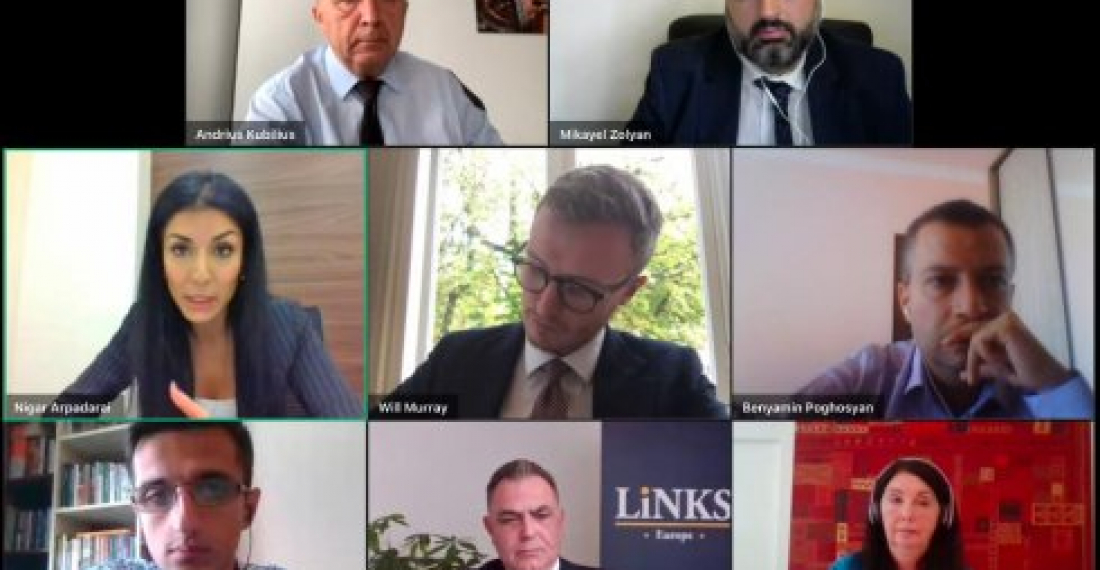
Эксперты и депутаты обсудили роль ЕС в разворачивающемся карабахском кризисе

Центр европейской политики (EPC) в сотрудничестве с LINKS Europe провел в среду, 14 октября, онлайн-круглый стол, который позволил экспертам и парламентариям из Армении, Азербайджана и ЕС обсудить продолжающийся конфликт на Южном Кавказе и ответ ЕС на него. Круглый стол на тему «Война по соседству с ЕС: что может и должен делать ЕС на Южном Кавказе?»

На мероприятии выступили Деннис Саммут, директор LINKS Europe; Бениамин Погосян, основатель и председатель Центра политических и экономических стратегических исследований, Ереван; Фуад Шахбазов, старший аналитик-аналитик, Центр стратегических коммуникаций, Баку; Нигяр Арпадарай, депутат Милли Меджлиса; Микаел Золян, депутат парламента Армении; Андрюс Кубилюс, депутат Европарламента, председатель комитета Евронест Европейского парламента, Бывший премьер-министр Литвы.

Мероприятие, которое модерировала Аманда Пол, старший политический аналитик EPC, при содействии Уильяма Мюррея, руководителя проекта и координатора LINKS Europe, проходило по правилам Chatham House.

Представитель LINKS Europe в Гааге сказал, что веб-конференция позволила политикам и аналитикам из разных уголков конфликта присоединиться к коллегам из ЕС, чтобы поделиться взглядами и информацией в очень деликатный момент продолжающейся ситуации вокруг нагорно-карабахского конфликта. «LINKS Europe приветствует тот факт, что мероприятие было проведено в спокойной и конструктивной манере, и мы полны решимости продолжать предоставлять пространство и платформы, необходимые для обеих сторон, для обмена мнениями, а также для того, чтобы их позиции были известны и лучше поняты».

источник: commonspace.eu

фото: Скриншот онлайн круглого стола, организованного LINKS Europe и Европейским центром политики 14 октября 2020 г.


 

Related articles

Editor's choice
News
The British prime minister says Europe must "stand on its own two feet" when it comes to defence

The British prime minister says Europe must "stand on its own two feet" when it comes to defence

The UK will deploy a carrier strike group, led by the aircraft carrier HMS Prince of Wales to the Arctic and the High North as part of efforts to bolster security against Russian threats. British prime minister, Sir Keir Starmer announced the deployment in a speech on Saturday (14 February) at the Munich Security Conference. Europe must be ready to fight to protect its people, values, and way of life,  Sir Keir told the Conference. Starmer also called for deeper links and cooperation, including economic ties, between the UK and EU. The PM stressed the continent must "stand on its own two feet" when it comes to defence commitments. "We must build our hard power, because that is the currency of the age," he told the conference. (Click image to read the full story).

Popular

Editor's choice
Interview
Thursday Interview: Murad Muradov

Thursday Interview: Murad Muradov

Today, commonspace.eu starts a new regular weekly series. THURSDAY INTERVIEW, conducted by Lauri Nikulainen, will host  persons who are thinkers, opinion shapers, and implementors in their countries and spheres. We start the series with an interview with Murad Muradov, a leading person in Azerbaijan's think tank community. He is also the first co-chair of the Action Committee for a new Armenian-Azerbaijani Dialogue. Last September he made history by being the first Azerbaijani civil society activist to visit Armenia after the 44 day war, and the start of the peace process. Speaking about this visit Murad Muradov said: "My experience was largely positive. My negative expectations luckily didn’t play out. The discussions were respectful, the panel format bringing together experts from Armenia, Azerbaijan, and Turkey was particularly valuable during the NATO Rose-Roth Seminar in Yerevan, and media coverage, while varied in tone, remained largely constructive. Some media outlets though attempted to represent me as more of a government mouthpiece than an independent expert, which was totally misleading.  Overall, I see these initiatives as important steps in rebuilding trust and normalising professional engagement. The fact that soon a larger Azerbaijani civil society visits to Armenia followed, reinforces the sense that this process is moving in the right direction." (click the image to read the interview in full)

