


Члены гражданского общества Азербайджана обсудили дальнейшие шаги на пути к миру

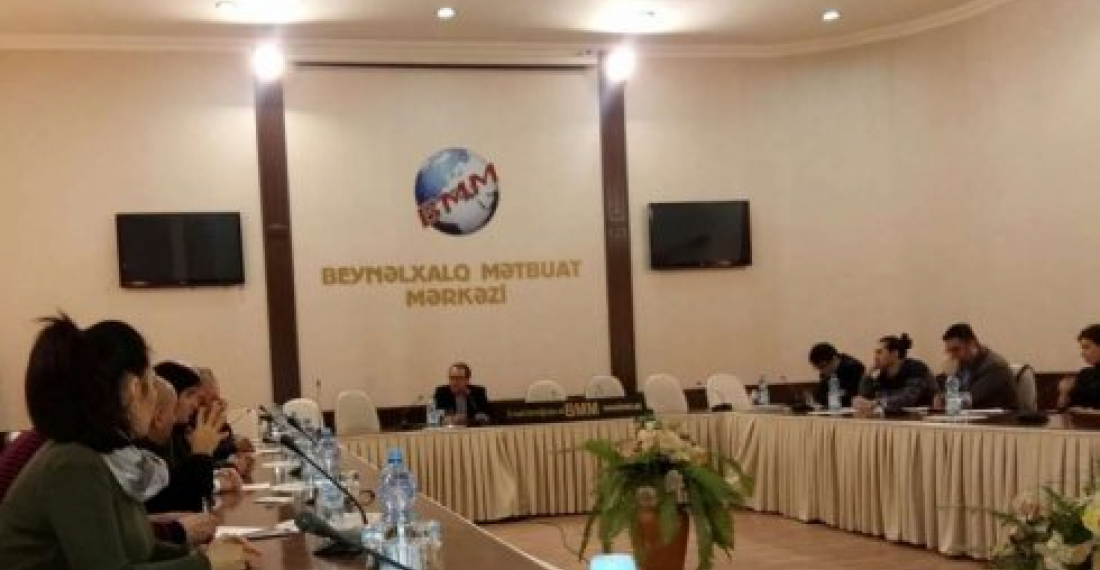
Представители гражданского общества Азербайджана в понедельник (4 февраля) обсудили дальнейшие шаги на пути к миру в ходе круглого стола, организованного в Международном пресс-клубе в Баку. Мероприятие на тему: «Подготовка народов к миру: проблемы прошлого и настоящего» было организовано Общественным объединением гуманитарных исследований.

Руководитель организации Аваз Гасанов отметил, что 16 января после встречи министров иностранных дел Азербайджана и Армении в Париже было распространено заявление о необходимости подготовки народов двух стран к миру. Этот шаг может дать серьезный импульс процессу урегулирования конфликта, развитию региональной безопасности и устойчивому региональному развитию, сказал он.

Председатель Общества защиты прав женщин Дилара Алиева Новелла Джафароглу также подтвердила важность ведения диалога на пути к миру для народов. Она подчеркнула необходимость того, чтобы представители гражданского общества координировали свою деятельность в процессе построения мира. Она предложила организовать в ближайшее время встречу представителей гражданского общества и министра иностранных дел Азербайджана для обсуждения нагорно-карабахского конфликта.

В ходе мероприятия представители гражданского общества поделились опытом, ранее приобретенным представителями гражданского общества из Азербайджана и Армении. Независимый журналист Асаф Гулиев сказал, что представители гражданского общества имеют богатый опыт в этой области и могут быть вовлечены в процесс миростроительства.

Член Совета прессы Азер Хасрет заявил, что после встречи министров иностранных дел важность подготовки обществ к миру возрастает. «Мир должен быть объяснен обоим обществам. Необходимо предпринять шаги для устранения агрессивных отношений в обоих обществах», - сказал Хасрат.

Рауф Зейни, президент Национального форума неправительственных организаций, сказал, что в условиях, когда Азербайджан понес большие потери, миллион граждан являются беженцами и вынужденными переселенцами, будет нелегко объяснить потребность мира в стране населению. «Продолжение оккупации снижает доверие наших граждан к миру», - сказал он.

Координатор Азербайджано-армянской гражданской платформы Дилара Эфендиева рассказала о вкладе мирной платформы в нормализацию отношений между двумя народами. Она отметила, что у платформы мира есть потенциал для ускорения "таяния льда" между двумя странами посредством шагов, направленных на снижение напряженности между народами.

Правозащитник Саадат Бананярлы заявил, что «достижение мира должно стать условием восстановления справедливости». Председатель Бюро по правам человека Саида Годжаманлы сказала, что она ожидает, что люди будут более осторожны в переговорном процессе. «Люди, которые были изгнаны со своей родины, надеются в конечном итоге вернуться в свои дома», - сказала она.

Заур Шириев, аналитик Международной кризисной группы и представитель Специального представителя ЕС по Южному Кавказу Йоханна Кетола, подчеркнул важность правильной оценки роли гражданского общества в мирном процессе и использования их возможностей.

источник: commonspace.eu, информационное агентство Turan, Баку.

фото: Встреча гражданского общества Азербайджана для обсуждения процесса урегулирования карабахского конфликта, состоявшаяся 4 февраля 2019 года (фото любезно предоставлено contact.az)
Related articles

Editor's choice
News
Russia adds pressure on Armenia ahead of key elections; recalls Ambassador in Yerevan for consultations

Russia adds pressure on Armenia ahead of key elections; recalls Ambassador in Yerevan for consultations

Ahead of key parliamentary elections,scheduled to be held in Armenia on Sunday, 7 June, Russia continues to attempt to put pressure on the Armenian Government led by prime minister Nikol Pashinyan. On 30 May, Russia recalled its Ambassador to Yerevan for consultations. A terse statement, published on the website of the Russian Foreign Ministry, said, "The Ambassador of the Russian Federation to the Republic of Armenia , S.P. Kopyrkin, has been summoned to Moscow for consultations in connection with the steps taken by the Armenian leadership to move closer to the European Union, which are detrimental to cooperation within the EAEU." This followed a statement issued the day before, by the leaders of the Eurasian Economic Union (EAEU) that challenges the Armenian trajectory towards approximating to the European Union. Vladimir Putin is undertood to have personally pushed the other four EAEU leaders to issue the statement, which said: "Taking into account the significant risks to the economic security of the member states of the Eurasian Economic Union (hereinafter referred to as the Union) arising in connection with the preparation of the Republic of Armenia for accession to the European Union, as well as the need to prevent the associated damage to the member states of the Union: decided that the members of the Eurasian Intergovernmental Council from the Republic of Belarus, the Republic of Kazakhstan, the Kyrgyz Republic and the Russian Federation will report at the next meeting of the Supreme Eurasian Economic Council in December 2026 on the possible consequences of the suspension of the Treaty on the Eurasian Economic Union with respect to the Republic of Armenia. We share the position on the need to hold a national referendum in the Republic of Armenia as soon as possible on joining the European Union or continuing to be part of the Eurasian Economic Union."
Editor's choice
News
The leaders of the states of the Eurasian Economic Union issued a tough statement warning fellow-member state Armenia of the consequences of its desire to join the European Union.

The leaders of the states of the Eurasian Economic Union issued a tough statement warning fellow-member state Armenia of the consequences of its desire to join the European Union.

The leaders of the states of the Eurasian Economic Union (EEAS) issued a tough statement warning fellow-member state Armenia of the consequences of its desire to join the European Union. The stark, sharply worded,  warning, comes days before crucial parliamentary elections in Armenia, scheduled for 7 June. The full statement said, “We, the Presidents of the Republic of Belarus, the Republic of Kazakhstan, the Kyrgyz Republic and the Russian Federation, Taking into account the actions of the Republic of Armenia aimed at joining the European Union, including the approval in 2025 by the National Assembly of the Republic of Armenia and the signing by the President of the Republic of Armenia of the Law of the Republic of Armenia "On the Start of the Process of Accession of the Republic of Armenia to the European Union", as well as the confirmation by the European Union of the European aspirations of the Government of the Republic of Armenia, expressed in the joint declaration following the first Armenia-European Union summit, adopted on 5 May 2026, Taking into account the significant risks to the economic security of the member states of the Eurasian Economic Union (hereinafter referred to as the Union) arising in connection with the preparation of the Republic of Armenia for accession to the European Union, as well as the need to prevent the associated damage to the member states of the Union: decided that the members of the Eurasian Intergovernmental Council from the Republic of Belarus, the Republic of Kazakhstan, the Kyrgyz Republic and the Russian Federation will report at the next meeting of the Supreme Eurasian Economic Council in December 2026 on the possible consequences of the suspension of the Treaty on the Eurasian Economic Union with respect to the Republic of Armenia. We share the position on the need to hold a national referendum in the Republic of Armenia as soon as possible on joining the European Union or continuing to be part of the Eurasian Economic Union. Astana, May 29, 2026” A meeting of the Supreme Eurasian Economic Council was held in Astana, Kazakhstan, on May 29, 2026. The meeting of the Supreme Eurasian Economic Council in a restricted format was attended by Russian President Vladimir Putin, Belarusian President Alexander Lukashenko , Kazakh President Kassym-Jomart Tokayev , Kyrgyz President Sadyr Japarov , Armenian Deputy Prime Minister Mher Grigoryan, and Chairman of the Board of the Eurasian Economic Commission Bakytzhan Sagintayev. From the Russian side, the meeting was also attended by Deputy Prime Minister and member of the Council of the Eurasian Economic Commission Alexey Overchuk and Presidential Aide Yury Ushakov . The heads of delegations from EAEU observer states, including President of Uzbekistan Shavkat Mirziyoyev , Vice President of Cuba Salvador Valdés Mesa, Minister of Industry, Mines, and Trade of Iran Mohammad Atabak, and CIS Secretary General Sergei Lebedev, joined the expanded meeting . Following the meeting of the Supreme Eurasian Economic Council, a number of documents were signed .

Popular

Editor's choice
Interview
Thursday Interview: Murad Muradov

Thursday Interview: Murad Muradov

Today, commonspace.eu starts a new regular weekly series. THURSDAY INTERVIEW, conducted by Lauri Nikulainen, will host  persons who are thinkers, opinion shapers, and implementors in their countries and spheres. We start the series with an interview with Murad Muradov, a leading person in Azerbaijan's think tank community. He is also the first co-chair of the Action Committee for a new Armenian-Azerbaijani Dialogue. Last September he made history by being the first Azerbaijani civil society activist to visit Armenia after the 44 day war, and the start of the peace process. Speaking about this visit Murad Muradov said: "My experience was largely positive. My negative expectations luckily didn’t play out. The discussions were respectful, the panel format bringing together experts from Armenia, Azerbaijan, and Turkey was particularly valuable during the NATO Rose-Roth Seminar in Yerevan, and media coverage, while varied in tone, remained largely constructive. Some media outlets though attempted to represent me as more of a government mouthpiece than an independent expert, which was totally misleading.  Overall, I see these initiatives as important steps in rebuilding trust and normalising professional engagement. The fact that soon a larger Azerbaijani civil society visits to Armenia followed, reinforces the sense that this process is moving in the right direction." (click the image to read the interview in full)

