


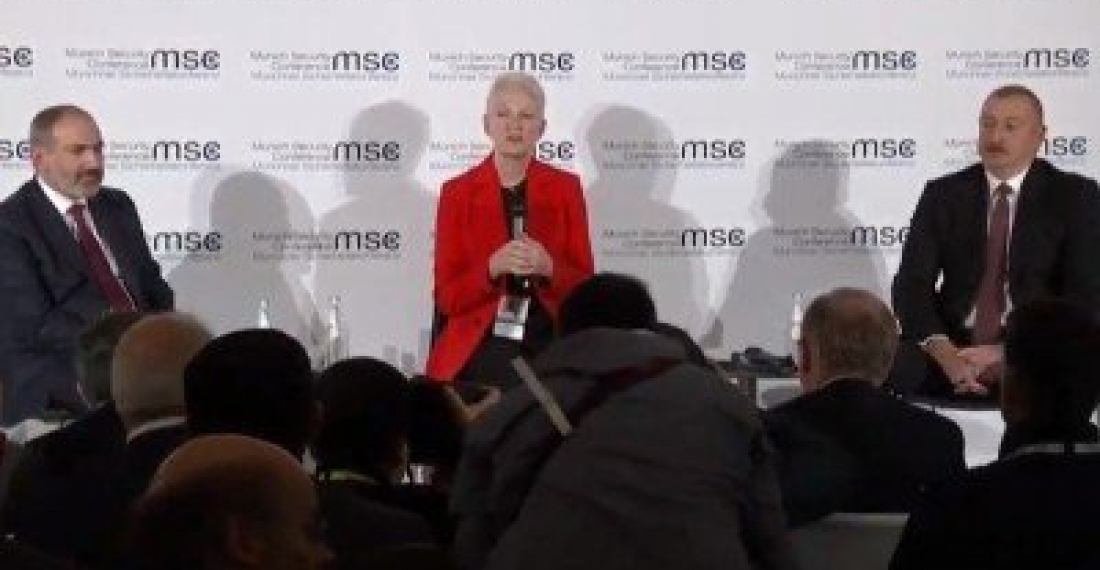
Алиев и Пашинян провели публичные дебаты по Карабаху

Лидеры Армении и Азербайджана провели публичные дебаты по карабахскому конфликту и его урегулированию. Беспрецедентное событие произошло в субботу 15 февраля в рамках мюнхенской конференции по безопасности.

Впервые лидеры двух стран провели публичную дискуссию друг с другом о том, что является одним из наиболее чувствительных вопросов для их обществ.

В начале встречи президент Азербайджана Ильхам Алиев сказал, что такое мероприятие было запланировано несколько лет назад в рамках встречи в Давосе, но что предыдущий армянский лидер отказался в последний момент.

Алиев и премьер-министр Армении Никол Пашинян вели разголвор на английском языке более сорока пяти минут. Многие обмены были сосредоточены на истории и праве каждой стороны претендовать на Нагорный Карабах.

источник: commonspace.eu

фото: Премьер-министр Армении Никол Пашинян и президент Азербайджана Ильхам Алиев обсуждают карабахский конфликт в рамках Мюнхенской конференции по безопасности, 15 февраля 2020 года.


Related articles

Popular

Editor's choice
Interview
Thursday Interview: Murad Muradov

Thursday Interview: Murad Muradov

Today, commonspace.eu starts a new regular weekly series. THURSDAY INTERVIEW, conducted by Lauri Nikulainen, will host  persons who are thinkers, opinion shapers, and implementors in their countries and spheres. We start the series with an interview with Murad Muradov, a leading person in Azerbaijan's think tank community. He is also the first co-chair of the Action Committee for a new Armenian-Azerbaijani Dialogue. Last September he made history by being the first Azerbaijani civil society activist to visit Armenia after the 44 day war, and the start of the peace process. Speaking about this visit Murad Muradov said: "My experience was largely positive. My negative expectations luckily didn’t play out. The discussions were respectful, the panel format bringing together experts from Armenia, Azerbaijan, and Turkey was particularly valuable during the NATO Rose-Roth Seminar in Yerevan, and media coverage, while varied in tone, remained largely constructive. Some media outlets though attempted to represent me as more of a government mouthpiece than an independent expert, which was totally misleading.  Overall, I see these initiatives as important steps in rebuilding trust and normalising professional engagement. The fact that soon a larger Azerbaijani civil society visits to Armenia followed, reinforces the sense that this process is moving in the right direction." (click the image to read the interview in full)

