


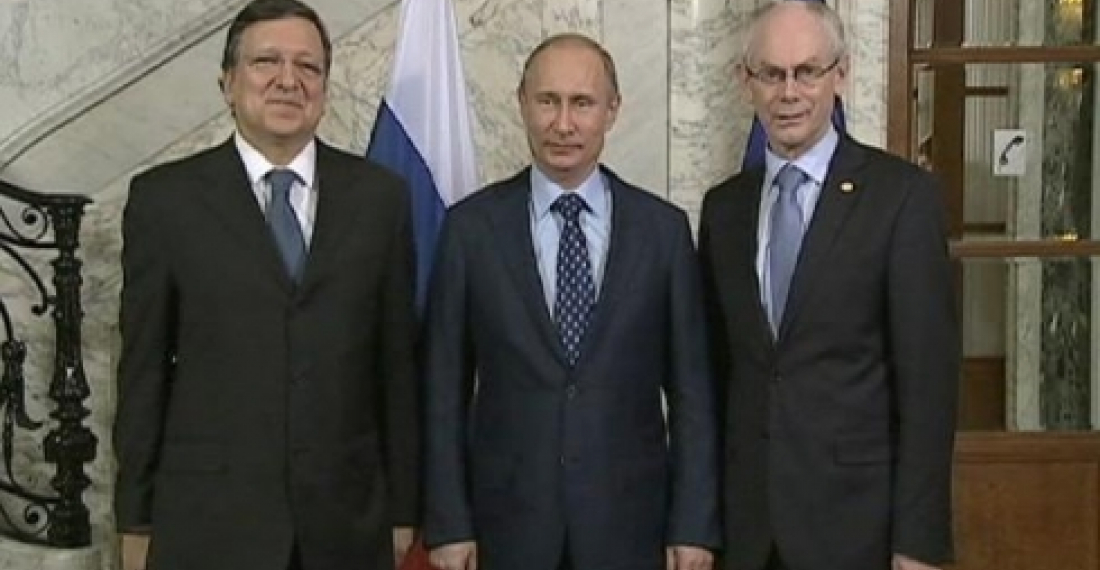
Путин и чиновники ЕС на саммите Россия-ЕС, прошедший в Брюсселе, обсудили ситуацию вокгрук Нагорного Карабаха и ситуацию в Грузии.

Кавказ был включен в повестку дня 30-ого саммита Россия-ЕС, который прошел в Брюсселе с 20 по 21 декабря. Президент России Владимир Путин направился в Брюссель для встречи с президентом Европейского Совета Херманом Ван Ромпейем и президентом Европейской комиссии Жозе Мануэлем Баррозу. ЕС заявил, что в повестку дня был включен широкий спектр вопросов двустороннего сотрудничества, охватывающие политические и экономические вопросы и стратегические перспективы отношений России и ЕС.

По итогам заседания председатель Европейского совета Херман Ван Ромпей сделал следующее заявление:

"Что касается нашего добрососедства, я подчеркнул необходимость достижения стабильности и безопасности, а также демократии и рыночной экономики. Это является целью поддержки ЕС в рамках программы Восточного партнерства, особенно в отношении Украины, Молдовы и Грузии. Мы приветствуем, что выборы в Грузии открывают новые возможности для улучшения двусторонних отношений и стремимся к стабильности на Южном Кавказе, на основе уважения территориальной целостности.

Это особенно важно для решения затянувшихся конфликтов.

Я также отметил важность прогресса в переговорах "5 +2" по урегулированию конфликта в Приднестровье и выразил обеспокоенность по поводу событий в Нагорном Карабахе. Работая вместе, ЕС и Россия могут внести значительный вклад в глобальное управление и урегулирование региональных конфликтов, в глобальное экономическое управление в G8 и G20, а также по широкому кругу других международных и региональных вопросов.

Я хотел бы поздравить президента Путина за принятие председательствования в G20. Я рад, что президент Путин и ЕС обсудили все эти вопросы открыто, в очень конструктивной атмосфере. Я хочу поблагодарить президента Российской Федерации за конструктивный и продуктивный обмен мнениями."

Политический редактор Commonspace.eu в своем комментарии сообщает: "Все понимают, что ЕС и Россия могут и должны быть в состоянии влиять на события в Кавказском регионе, если они работают вместе, но сотрудничество до сих было весьма ограниченным. России не была готова признать роль ЕС в регионе и оскорблялась инициативами ЕС. Вместе с тем ЕС становится все более важным политическим и экономическим партнером для всех трех стран Южного Кавказа. Встречи Советов по сотрудничеству ЕС-Грузия, ЕС-Армения и ЕС-Азербайджан состоялись непосредственно перед визитом президента Путина, тем самым указывая на то, насколько ЕС развил свои отношения с регионом. Похоже, что Россия сможет принять этот факт и будет готова к участию ЕС в качестве равноправного партнера при обсуждении Южного Кавказа. Это может привести к некоторым важным событиям в том числе по Карабаху и конфликтам в Грузии, но то, что мы видим, это только начало того, что может быть еще долгим процессом."

Источник: commonspace.eu

Фото: Президент России Владимир Путин с президентом Европейского Совета Херманом Ван Ромпейем и президентом Европейской комиссии Жозе Мануэлем Баррозу на 30-м саммите Россия-ЕС в Брюсселе, 20-21 декабря 2012 года.


Related articles

Editor's choice
News
Borrell tells the European Parliament that the situation in Afghanistan was critical, but the EU will remain engaged

Borrell tells the European Parliament that the situation in Afghanistan was critical, but the EU will remain engaged

Borrell underlined that the European Union will make every effort to support the peace process and to remain a committed partner to the Afghan people. "Of course, we will have to take into account the evolving situation, but disengagement is not an option.  We are clear on that: there is no alternative to a negotiated political settlement, through inclusive peace talks.
Editor's choice
News
Germany accuses Russia of cyberattacks and disinformation campaign

Germany accuses Russia of cyberattacks and disinformation campaign

The German government holds Russia responsible for a cyberattack on German air traffic control, and for targeted disinformation campaigns before the last federal election. According to the German Foreign Office in Berlin, the incidents could be clearly attributed to the Russian military intelligence service, the GRU. In response, the Russian ambassador to Berlin was summoned to the Foreign Ministry. "We have been observing a massive increase in threatening hybrid activities by Russia for some time now," a spokesperson for the Foreign Ministry stated. These range from disinformation campaigns and espionage to cyberattacks and sabotage attempts. The aim is to divide society, sow distrust, and undermine confidence in democratic institutions. The spokesperson added that with these actions, Russia is "very concretely threatening our security, not only through its war of aggression against Ukraine, but also here in Germany."  The Foreign Ministry spokesperson explained that the cyberattack on air traffic control in August 2024 was clearly attributed to the hacker collective "APT28," known as "Fancy Bear," and to the responsibility of the Russian military intelligence service, the GRU. Furthermore, it could now be "conclusively stated" that Russia had attempted "to influence and destabilize both the last Federal election and the ongoing internal affairs of the Federal Republic of Germany." There was "absolutely irrefutable evidence" for this". The so-called "Storm 1516" campaign, which has been running since 2024, is allegedly backed by "reliable information" that the Moscow-based think tank "Center for Geopolitical Expertise" is behind it. The Center is also said to be supported by Russian military intelligence. Its primary aim is to influence democratic elections in the West. (Click the image to read more).

Popular

Editor's choice
News
Germany accuses Russia of cyberattacks and disinformation campaign

Germany accuses Russia of cyberattacks and disinformation campaign

The German government holds Russia responsible for a cyberattack on German air traffic control, and for targeted disinformation campaigns before the last federal election. According to the German Foreign Office in Berlin, the incidents could be clearly attributed to the Russian military intelligence service, the GRU. In response, the Russian ambassador to Berlin was summoned to the Foreign Ministry. "We have been observing a massive increase in threatening hybrid activities by Russia for some time now," a spokesperson for the Foreign Ministry stated. These range from disinformation campaigns and espionage to cyberattacks and sabotage attempts. The aim is to divide society, sow distrust, and undermine confidence in democratic institutions. The spokesperson added that with these actions, Russia is "very concretely threatening our security, not only through its war of aggression against Ukraine, but also here in Germany."  The Foreign Ministry spokesperson explained that the cyberattack on air traffic control in August 2024 was clearly attributed to the hacker collective "APT28," known as "Fancy Bear," and to the responsibility of the Russian military intelligence service, the GRU. Furthermore, it could now be "conclusively stated" that Russia had attempted "to influence and destabilize both the last Federal election and the ongoing internal affairs of the Federal Republic of Germany." There was "absolutely irrefutable evidence" for this". The so-called "Storm 1516" campaign, which has been running since 2024, is allegedly backed by "reliable information" that the Moscow-based think tank "Center for Geopolitical Expertise" is behind it. The Center is also said to be supported by Russian military intelligence. Its primary aim is to influence democratic elections in the West. (Click the image to read more).

