This is an op-ed prepared for commonspace.eu by Dr. Vasif Huseynov, Head of Department at the Center for Analysis of International Relations (AIR Center) in Baku and Adjunct Professor at Khazar University.
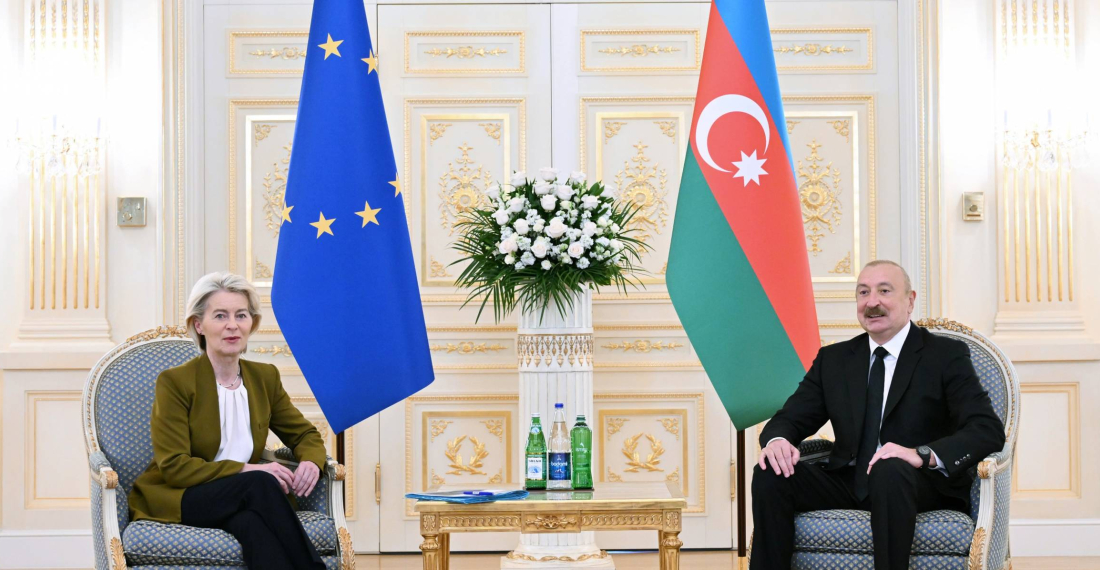
The tone out of Brussels has changed since the new European Commission took office in late 2024. Where the previous College, under the diplomatic stewardship of Josep Borrell, treated Azerbaijan largely as a subject of political conditionality, the current Commission has steadily repositioned Baku as a strategic partner — in energy, in connectivity, and now in the region's fragile peace process. That shift became unmistakable when Ursula von der Leyen touched down in Baku on July 1, her first visit since 2022, becoming the third senior EU official to travel to the Azerbaijani capital within a matter of months, following European Council President António Costa in March and foreign policy chief Kaja Kallas in May. She did not lead with the language of conditionality that so often defined the relationship in years past. She led with peace, energy and money — and that sequencing tells its own story.
At a joint press conference with the Azerbaijani president, von der Leyen described Azerbaijan's initialing of the peace agreement with Armenia as the most consequential regional development in decades, and pledged EU support in turning "peace on paper" into practice. She then turned to energy, calling Azerbaijan a reliable and trustworthy partner that Europe has not forgotten stepped in when Russia weaponized gas supplies. She credited the Southern Gas Corridor with reinforcing European energy security and welcomed Baku's ambitions in offshore wind and green hydrogen as complementary to the EU's own transition.
The substance matched the tone. Von der Leyen proposed a formal EU-Azerbaijan Connectivity Partnership spanning transport, energy and digital infrastructure, backed by a High-Level Connectivity Dialogue and a Regional Connectivity Investment Conference to be hosted in Baku by the end of 2026. Under the Global Gateway initiative she announced up to €200 million in grants for South Caucasus connectivity, with the potential to mobilize €2 billion in combined public and private financing — funds earmarked in part for a rail link to Nakhchivan and the expansion of the Port of Baku. A separate €20 million programme was unveiled to support demining, healthcare and rural development tied to the peace process.
None of this is happening in a vacuum. Europe is heading into a winter with gas storage levels at their lowest since at least 2011, a shortfall traced largely to the disruption of Gulf LNG flows during the recent US-Israel-Iran war. At the same time, the EU's own REPowerEU Gas Regulation locks in a permanent phase-out of Russian gas contracts by the end of 2027. That combination of vulnerability and self-imposed deadline is precisely what keeps Brussels' attention fixed on Azerbaijan and Central Asia, and explains why von der Leyen used her visit to press for the long-term contracts Azerbaijan says it needs to justify the investment required to expand Southern Gas Corridor capacity further.
President Ilham Aliyev, addressing the question directly at the Shusha Global Media Forum on July 13, described the frequency of these high-level visits — European Council President António Costa in March, EU foreign policy chief Kaja Kallas in May, and von der Leyen in July — as unprecedented, and said both sides consider themselves satisfied with the current level of cooperation. He also confirmed that talks on a new bilateral framework agreement, intended to replace the outdated 1999 Partnership and Cooperation Agreement, have resumed in earnest, with Partnership Priorities for 2026-2030 provisionally agreed in Baku on June 2-3.
This is, by any measure, a genuine recalibration. But it would be incomplete to describe EU-Azerbaijan relations today without acknowledging the other track running in parallel – one considerably less pragmatic and considerably more political.
The European Parliament has adopted more than a dozen resolutions critical of Azerbaijan since the 2020 Karabakh war, culminating in another one on April 30, 2026, that prompted Azerbaijan's Parliament to suspend all cooperation with the chamber and begin withdrawing from the Euronest Parliamentary Assembly. The Parliamentary Assembly of the Council of Europe (PACE) has followed a similar trajectory: since Azerbaijan's September 2023 anti-terror operation restored its sovereignty over the remaining parts of Karabakh, PACE has questioned the credentials of the Azerbaijani delegation and stripped it of voting rights, prompting Baku to stop attending altogether. As Aliyev noted at the Shusha forum, Azerbaijan was never sanctioned by PACE during three decades of actual occupation, only after it ended the occupation by force — a sequencing that speaks for itself about the real motivation behind the punitive measures. He also pointed to the toxic legacy of the previous European Commission's diplomacy chief, Josep Borrell, whose adversarial approach to Baku was later shown to have been compromised by corrupt influence networks.
These resolutions have also had a counterproductive effect beyond the EU-Azerbaijan bilateral track. By repeatedly casting doubt on Baku’s intentions and legitimacy, they have inadvertently strengthened the hand of the Russia-backed opposition in Armenia, which seizes on every such vote to undermine and de-legitimize Prime Minister Nikol Pashinyan’s peace efforts. It is with Pashinyan that the Azerbaijani leadership has achieved historic breakthroughs toward lasting peace and reconciliation. A European Parliament that claims to champion peace in the South Caucasus would do well to consider whose hand it is actually strengthening each time it reaches for another resolution.
Overall, the result of such standing of different EU institutions is an EU-Azerbaijan relationship that runs on two visibly different tracks. The Commission — the institution that actually negotiates energy contracts, structures investment packages and administers Global Gateway financing — has moved decisively toward treating Azerbaijan as an indispensable strategic partner. The Parliament and PACE, whose leverage is reputational and declaratory rather than transactional, remain locked in a cycle of resolutions and counter-suspensions that neither side seems able, or perhaps willing, to break.
Despite periods of political disagreement, the trajectory of EU-Azerbaijan relations is increasingly being shaped by shared strategic interests rather than ideological differences. Energy security, transport connectivity, green transition, and support for lasting peace in the South Caucasus have emerged as durable pillars of cooperation, creating strong incentives for deeper engagement. As negotiations on a new bilateral agreement advance and joint initiatives continue to expand, both sides have an opportunity to build a more resilient and forward-looking partnership grounded in mutual benefit, regional stability, and long-term strategic cooperation.
source: This is an op-ed prepared for commonspace.eu by Dr. Vasif Huseynov, Head of Department at the Center for Analysis of International Relations (AIR Center) in Baku and Adjunct Professor at Khazar University.