


Ukraine Hosts Fifth Southeast Europe Summit as EU Reaffirms Support on Statehood Day


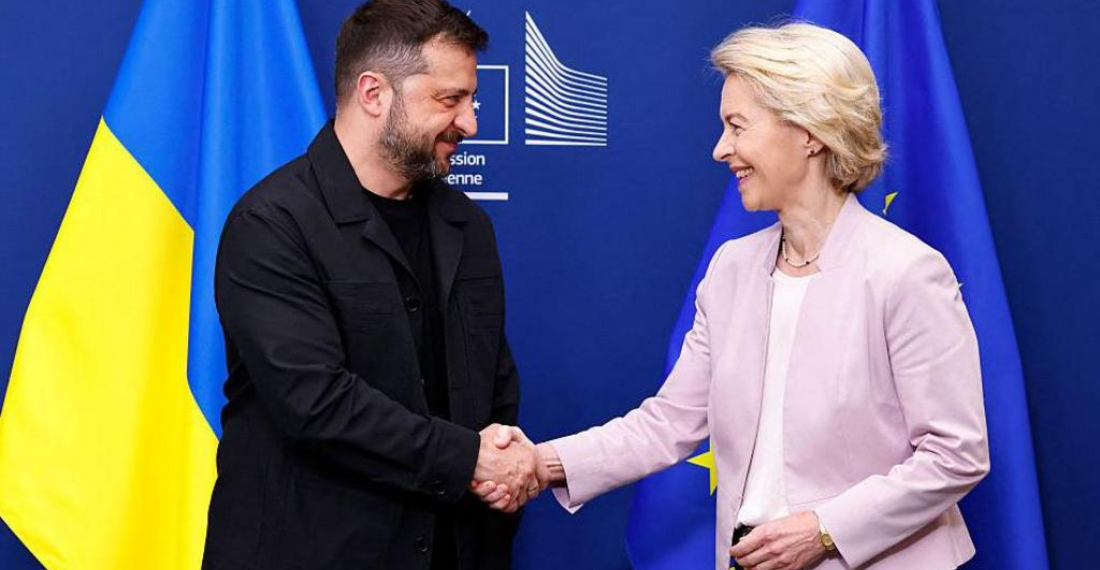
Ukraine welcomed European Commission President Ursula von der Leyen and leaders from East European countries to Kyiv on Wednesday for the fifth Ukraine–Southeast Europe Summit, held on Ukraine's Statehood Day. The meeting focused on regional security, Ukraine's European integration and continued support for the country as it defends itself against Russia's full-scale invasion.

Ukrainian Foreign Minister Andrii Sybiha said the summit aimed to reaffirm the partnership between Ukraine and Southeast European states while advancing cooperation on Ukraine's path toward EU membership. According to Sybiha, discussions centred on strengthening Europe through closer political coordination and expanding security and defence cooperation. He noted that the Kyiv gathering builds on previous summits held in Athens, Tirana, Dubrovnik and Odesa.

The participating heads of state and government – with Ursula von der Leyen attending as an observer rather than a signatory – adopted a joint declaration reaffirming their support for Ukraine's sovereignty, independence and territorial integrity within its internationally recognised borders, while Ursula von der Leyen attended the summit but was not among the signatories. The declaration condemned Russia's invasion and recent large-scale missile and drone attacks on Ukrainian cities, calling for an immediate end to the war and stressing that no decisions concerning Ukraine can be made without Kyiv.

The participants also described strengthening Ukraine's air defence as a priority, supporting additional financial resources and international mechanisms to provide air defence systems and ballistic missile interceptors. They called for increased sanctions on Russia, including stronger measures against its shadow fleet and sanctions evasion, while reaffirming support for accountability through the planned Special Tribunal for the Crime of Aggression against Ukraine.

Von der Leyen, making her 11th wartime visit to Ukraine, said the European Union would continue providing military and financial assistance. She announced new initiatives to deepen cooperation between the European and Ukrainian defence industries and to strengthen Ukraine's air defences ahead of winter, when Russia has repeatedly targeted the country's energy infrastructure. Discussions with President Volodymyr Zelenskyy were also expected to include expanded cooperation on drone production.

The visit comes as Kyiv reports growing momentum on both the battlefield and its European integration efforts. Ukraine has recently opened another cluster of accession negotiations with the EU. Accordingly, the declaration adopted refers to the future EU membership of Ukraine and the Western Balkans as a strategic investment in Europe's long-term security and stability. Furthermore, the bloc's €90 billion financial support package has now been finalised after previous delays. Ukrainian officials have also signalled that discussions with the European Commission will include expanded cooperation on drone production, with plans expected to facilitate manufacturing and storage within EU territory before equipment is transferred to Ukraine.  

The leaders also agreed that the next Ukraine–Southeast Europe Summit will be held in Slovenia in 2027.

Source: commonspace.eu with Euronews (Brussels), President of Ukraine (Kyiv), and Interfax-Ukraine (Kyiv).
 

Related articles

Editor's choice
News
Donald Trump’s extraordinary TV address

Donald Trump’s extraordinary TV address

United States President Donald Trump has delivered an extraordinary prime time television speech, alleging government “cover-ups” and “vulnerability” in the nation’s electoral system. He made broad accusations about a “deep state” conspiracy involving his Democratic predecessors, Barack Obama and Joe Biden, and he lashed out at familiar foes, including the news media and China. For years, Trump has spread baseless claims that his loss in the 2020 presidential election was “rigged” and “stolen”. Trump stopped short of repeating his false claim that he had, in fact, won that race. But in his remarks, he sought to raise suspicion about the election’s outcome, pointing to declassified government documents. Those files, however, painted a more nuanced picture than Trump portrayed, and they failed to substantiate his claims of a conspiracy. After the speech, Democrats criticised Trump for attempting to mislead the public and reduce confidence in the US electoral system, with months to go until the November midterm election. One of the biggest accusations of the night was levied against China, the US’s geopolitical rival. “Starting during the 2020 election cycle, the People’s Republic of China carried out what is believed to be the largest compromise of election data in history,” Trump said near the outset of his speech. He claimed that Beijing, through “illicit” means, had acquired 220 million US voter files, including names, addresses and party preferences. “Think of that: Tens of millions of voters’ data in 18 states have been bought, stolen or hacked by China,” Trump said. A spokesperson for China’s embassy denied such claims, saying the country “has never and will never interfere in the presidential elections of the US”. Trump, however, did not say that the information had been used to influence any election. But critics pointed out that such voter information is already publicly available. Some states even sell that public data, for prices ranging from $0 to $37,000, as the US Election Assistance Commission explained in a 2020 report. The documents declassified by the White House also appeared to indicate Beijing was, at least in part, drawing from publicly available data. It did, however, express curiosity at China’s increasing interest in such information. “While the PRC [People’s Republic of China] government has historically demonstrated interest in US elections, this is a newly-identified interest for this individual actor,” a heavily redacted assessment said. “The US voter registration information is available for public download, with 2021 voter registration information available for some states.”  (click image to read more)

Popular

Editor's choice
Interview
Thursday Interview: Murad Muradov

Thursday Interview: Murad Muradov

Today, commonspace.eu starts a new regular weekly series. THURSDAY INTERVIEW, conducted by Lauri Nikulainen, will host  persons who are thinkers, opinion shapers, and implementors in their countries and spheres. We start the series with an interview with Murad Muradov, a leading person in Azerbaijan's think tank community. He is also the first co-chair of the Action Committee for a new Armenian-Azerbaijani Dialogue. Last September he made history by being the first Azerbaijani civil society activist to visit Armenia after the 44 day war, and the start of the peace process. Speaking about this visit Murad Muradov said: "My experience was largely positive. My negative expectations luckily didn’t play out. The discussions were respectful, the panel format bringing together experts from Armenia, Azerbaijan, and Turkey was particularly valuable during the NATO Rose-Roth Seminar in Yerevan, and media coverage, while varied in tone, remained largely constructive. Some media outlets though attempted to represent me as more of a government mouthpiece than an independent expert, which was totally misleading.  Overall, I see these initiatives as important steps in rebuilding trust and normalising professional engagement. The fact that soon a larger Azerbaijani civil society visits to Armenia followed, reinforces the sense that this process is moving in the right direction." (click the image to read the interview in full)

