OSCE Parliamentary Assembly meets in The Hague

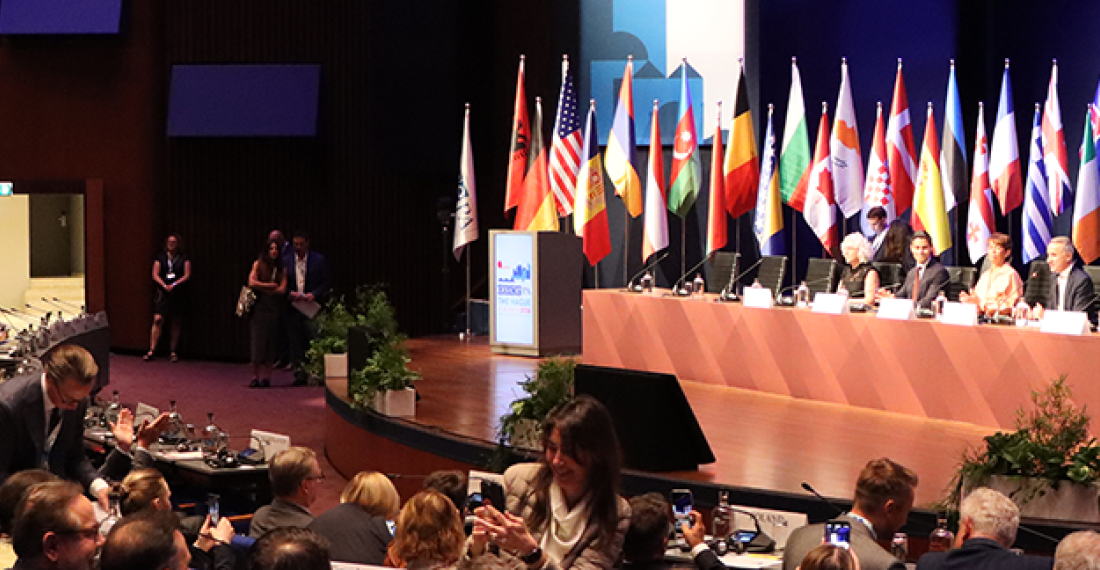
Hundreds of lawmakers from Europe, North America, and Central Asia have gathered in The Hague for the OSCE Parliamentary Assembly’s 33rd Annual Session, taking place from 4 to 8 July under the theme “International Law and Shared Principles: Foundations for Security and Co-operation in the OSCE Area.”

Kicking off several days of work that will culminate in the adoption of The Hague Declaration on 8 July, today’s opening plenary session featured speeches by Prime Minister of the Netherlands Rob Jetten, President of the Senate of the Netherlands Mei Li Vos, President of the House of Representatives Thom van Campen, Head of the Dutch Delegation to the OSCE PA Farah Karimi, OSCE PA President Pere Joan Pons (Spain), and the Chairman-in-Office of the OSCE, Swiss Foreign Minister Ignazio Cassis.

The opening session also included a video address by Ukrainian President Volodomyr Zelenskyy, in which he urged the Parliamentary Assembly to intensify pressure to stop the Russian Federation’s full-scale invasion before it results in even more devastation for his country, calling for the greater commitment to Ukraine’s defence and the full use of OSCE tools to achieve peace.

Addressing the OSCE parliamentarians, Prime Minister Jetten highlighted the significance of holding the Annual Session in The Hague, where the international community gathers to prevent conflict, resolve disputes, and accountable those responsible for the gravest of crimes. He noted the relevance of this venue for the OSCE, which, he pointed out, “was founded on the premise that security cannot be built with use of force, but must rest on democracy, respect for human rights, and a rules based international order.”

Welcoming her colleagues to the Netherlands, the Head of the OSCE PA’s Dutch Delegation, Farah Karimi highlighted the role of parliamentary diplomacy in these challenging times. “Even when governments disagree, parliamentarians can continue to engage,” Karimi said. “Through dialogue, election observation, committee work and co-operation across political divides, we preserve channels of communication and build trust.”

President Pons noted that a half-century after the Helsinki Final Act, the principles that once underpinned security are being openly challenged and therefore must be robustly defended.

“We see it in the continued war of aggression against Ukraine,” Pona said. “We see it in Gaza, where civilians continue to suffer. We see it wherever force replaces dialogue and international law is applied selectively or not at all. There can be no hierarchy of principles. What we defend in Ukraine, we must defend everywhere. Without consistency, we weaken the rules-based order.”

“Parliamentarians play a vital role in preserving dialogue across political divides,” said OSCE Chairman-in-Office, Swiss Foreign Minister, Cassis. “In the face of growing political tensions, where mistrust of institutions and political decision-makers is on the rise, the work of members of parliament is of crucial importance as a direct link to the people.".

source: commonspace.eu with OSCE PA (Copenhagen)
 

Related articles

Editor's choice
News
Rutte's big reveal: NATO chief announces major international defence projects at the start of Ankara summit

Rutte's big reveal: NATO chief announces major international defence projects at the start of Ankara summit

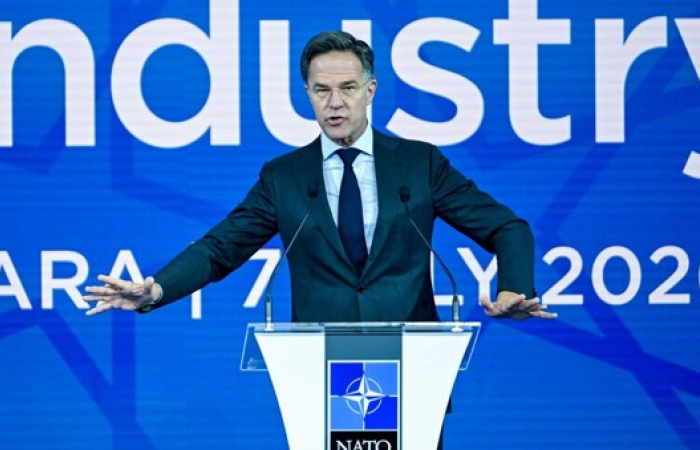
NATO on Tuesday unveiled a series of multinational defense initiatives ranging from airborne surveillance and counter-drone capabilities to space, industrial production and critical raw materials, as the alliance opened its 2026 summit with a defense industry forum in the Turkish capital. Opening the NATO Defense Industry Forum, the first official event of the two-day summit in Ankara, Secretary General Mark Rutte highlighted what he described as a new wave of billion-dollar defense agreements between North American and European companies, saying the projects demonstrate allies working "hand in hand" to develop next-generation military capabilities. Under the forum's "Big Reveal," Rutte announced three major multinational projects aimed at strengthening NATO's airlift, intelligence and surveillance capabilities. The first initiative is a multinational modernization program centered on the Airbus A400M transport aircraft and the Airbus A330 Multi Role Tanker Transport (MRTT) fleet. "Several allies are officially announcing the forthcoming delivery of additional Airbus A330 MRTT aircraft," Rutte said, describing the project as a step toward strengthening NATO's strategic airlift and aerial refueling capabilities. He also announced a joint procurement project for MQ-4C Triton unmanned aircraft to enhance the alliance's intelligence, surveillance and reconnaissance (ISR) capabilities. "These additional aircraft will provide persistent surveillance over large maritime areas," he said. Rutte's third announcement focused on replacing NATO's aging Airborne Warning and Control System (AWACS) fleet. According to the alliance's chief, NATO will jointly procure up to 10 Swedish-made Saab GlobalEye surveillance aircraft to replace the alliance's aging US-built Boeing E-3A Sentry AWACS aircraft, in a move aimed at modernizing airborne surveillance and early warning capabilities. (click image to read more)

Popular

Editor's choice
Interview
Thursday Interview: Murad Muradov

Thursday Interview: Murad Muradov

Today, commonspace.eu starts a new regular weekly series. THURSDAY INTERVIEW, conducted by Lauri Nikulainen, will host  persons who are thinkers, opinion shapers, and implementors in their countries and spheres. We start the series with an interview with Murad Muradov, a leading person in Azerbaijan's think tank community. He is also the first co-chair of the Action Committee for a new Armenian-Azerbaijani Dialogue. Last September he made history by being the first Azerbaijani civil society activist to visit Armenia after the 44 day war, and the start of the peace process. Speaking about this visit Murad Muradov said: "My experience was largely positive. My negative expectations luckily didn’t play out. The discussions were respectful, the panel format bringing together experts from Armenia, Azerbaijan, and Turkey was particularly valuable during the NATO Rose-Roth Seminar in Yerevan, and media coverage, while varied in tone, remained largely constructive. Some media outlets though attempted to represent me as more of a government mouthpiece than an independent expert, which was totally misleading.  Overall, I see these initiatives as important steps in rebuilding trust and normalising professional engagement. The fact that soon a larger Azerbaijani civil society visits to Armenia followed, reinforces the sense that this process is moving in the right direction." (click the image to read the interview in full)