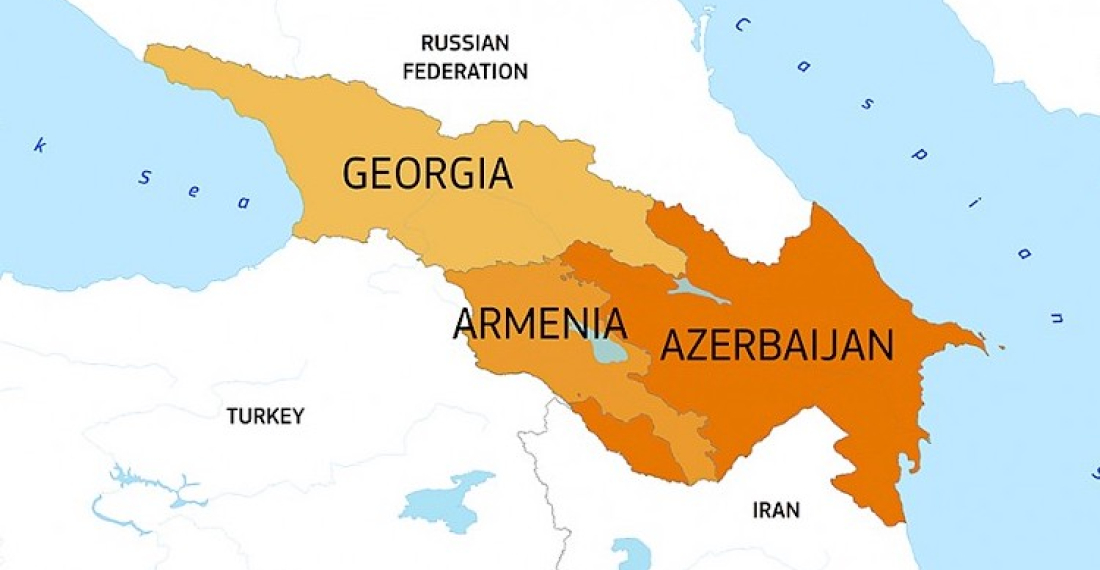
The year 2025 has ended up being a momentous year for the South Caucasus.
Armenia-Azerbaijan relations have been redefined, with consequences for the whole region and beyond. That huge development overshadowed key moments in the domestic trajectory of the two countries, which however have deep consequences for the two countries, and even beyond.
It has also been a tumultuous year for Georgia too. The country has been gripped in a political crisis throughout 2025, with no obvious end in sight. Whatever the domestic arguments, on the international stage Georgia is today a shadow of what it used to be until recently. It not only has lost the chance of joining the European Union any time soon, but it has also lost its position as the leading South Caucasus country. Today, in the new reality of the region, it lags as a tired third.
Important as 2025 was, it ended with a lot of unfinished business. So 2026 will also be crucial for the three countries.
Armenia-Azerbaijan Peace
Since regaining its statehood in 1991 after the dissolution of the Soviet Union, Armenia-Azerbaijan relations have been defined by war. The two fought open wars, wars of attrition, and propaganda wars, incessantly. Tens of thousands of people lost their lives, and hundreds of thousands were displaced.
Many had lost hope that the two could try the alternative – i.e. peaceful co-existence. Yet in 2025 they were proven wrong.
First, on 12 March the two governments announced that they had agreed on the text of a peace agreement. On 8 August in the White House, in the presence of the president of the United States, and the leaders of the two countries, they initialled it. At the White House, the two sides also turned the page. They were now not exactly friends, but certainly not enemies.
Since then there have been small positive steps which indicate the leadership on the two sides mean business in pursuing peace, and are willing to see the process through. There remain many who are not happy. They were comfortable with the enmity of the past. They exist inside the two societies, and they also exist within the governments of neighbouring countries, especially Russia and Iran.
But although there is a lot of hard work ahead, the Rubicon has been crossed, and there is no going back.
The leaders of the two countries, President Ilham Aliyev of Azerbaijan and Prime Minister Nikol Pashinyan of Armenia, appear to be energised by the prospect of peace.
Two years ago, at an event in Baku, organised by ADA University, which was also broadcast live by Azerbaijan Television, I asked President Aliyev directly if he wanted to be remembered as the “man of peace”. He replied that he had not thought much about it. But now clearly he has, and he is comfortable in that role.
Opening up the prospect of peace with Armenia is not the only important thing that has happened in Azerbaijan in 2025. In November, Azerbaijan became the 6th country of Central Asia. Of course, physically the country did not move, but Central Asia redefined itself to encompass Azerbaijan. This has huge consequences for both Azerbaijan and the other Central Asian republics.
Domestically however, 2025 will be remembered in Azerbaijan as the year of the fall from grace of Ramiz Mehtiyev, for a long time considered as the country’s shadow president. From his retirement, Mehtiyev is accused of trying to organise a coup to seize power. Russia is implicated, though how remains unclear. This development has huge consequences, which are likely to play out in 2026.
In Armenia too, the peace process has energised Prime Minister Nikol Pashinyan, who has relentlessly pushed his reform and change agenda, being constantly a step ahead of friends and foes alike. Perhaps Pashinyan’s boldest move has been his fight with the hierarchy of the Armenian Church, especially its head the Catholicus Karekin II Pashinyan is determined to have him replaced. By going for a head-on confrontation Pashinyan avoided the more dangerous subtle Church interference in the upcoming parliamentary elections.
Thus, in both Armenia and Azerbaijan, peace has been the harbinger of change, though what we saw in 2025 is just the beginning.
In Georgia, they could only watch as their two neighbours changed before their very eyes.
Since the flawed parliamentary elections in October 2024, Georgia has been gripped by a political crisis, which appears to have no end. For more than a year there have been protests on the streets of Tbilisi. The government has dug in, hoping it can survive the storm. It has abandoned the journey for EU membership. It has desperately tried and largely failed to find a different niche for Georgia.
Many, amongst Georgia’s, largely Tbilisi-based, chattering classes, and many in the international community, expected the Georgian Dream government to collapse. It has not, not yet anyway.
Many hanker back to 2003, when the so-called “Rose Revolution” brought to an end the government of Edward Shevardnadze. This is disingenuous, as the situation is very different in three ways:
At present, the Opposition is divided and dysfunctional. There is no clear leader, as Saakashvili was in 2003. Opposition to the government has sometimes looked like a tragi-comedy, rather than a strategy. The Georgians who are on the margins, and who are necessary for tipping the balance, are neither amused, nor convinced. Salome Zurabishvili, who potentially could be the opposition’s totem pole, has been marginalised.
The second big difference is that the Georgian Dream Government is much more consolidated than Shevardnadze’s in 2003. There is a clear divide between Tbilisi, with its strong European and anti-government outlook, and the regions, where people still have nostalgia for Soviet times. Furthermore, Georgia of today has a functioning economy, which makes many people stakeholders in stability.
And thirdly, and this should not be underestimated, too many people have something to lose, or worse, if there is a change of government. In 2003, Edward Shevardnadze left parliament and went home to Ktsanisi, and retirement. There was no Sheverdnadze system to speak of, and most people adjusted quickly to the new reality. If there is a sharp change of government in Georgia tomorrow tens of thousands of Georgian Dream supporters will feel exposed. They do not want to take the risk, so they are digging in.
However, this intransigence comes at a cost. In the last year, Georgia has lost a lot. It has lost its moment in Europe, and that will not be recovered for decades. But perhaps more understandable for many Georgians is that it has lost its primacy in the South Caucasus, where for centuries Georgia was considered, and considered itself, as the leader. First, Georgia has become a tired third.
To their credit, Armenia and Azerbaijan are trying to keep Georgia engaged. They have dismissed the hilarious hints from some in the West that you can have a South Caucasus without Georgia. But in Armenia and Azerbaijan, there is a strong desire to be the first in the South Caucasus. Or at least second. That leaves Georgia in only third place.
What will 2026 bring for the region?
Armenian-Azerbaijani peace and reconciliation must be consolidated and entrenched. This will require work, at multiple levels.
2026 will be a crucial year for Armenia and Azerbaijan domestically. Both feel on the eve of something big in their domestic agenda. Armenia will hold crucial parliamentary elections in the summer. No elections are scheduled in Azerbaijan, but they may happen too.
The question of how to get Georgia out of the present impasse is trickier. Both sides are determined to fight till the end. A repeat of the 2003 scenario is unlikely. One may however see a situation where both sides, and this includes Georgian Dream’s Supreme Leader, Bidzina Ivanishvili, may agree to a two-year cooling-off period. In this time Georgia will have a technical/technocratic government, agreed by the GD and the Opposition parties. Elections can then be held after two years.
It seems 2026 will be an interesting year in the South Caucasus.
Source: Monday Commentary is written every week by Dr Dennis Sammut, Director of LINKS Europe and Managing Editor of commonspace.eu
This is the last Monday Commentary by Dennis Sammut in 2025. Monday Commentary will be back in January 2026.